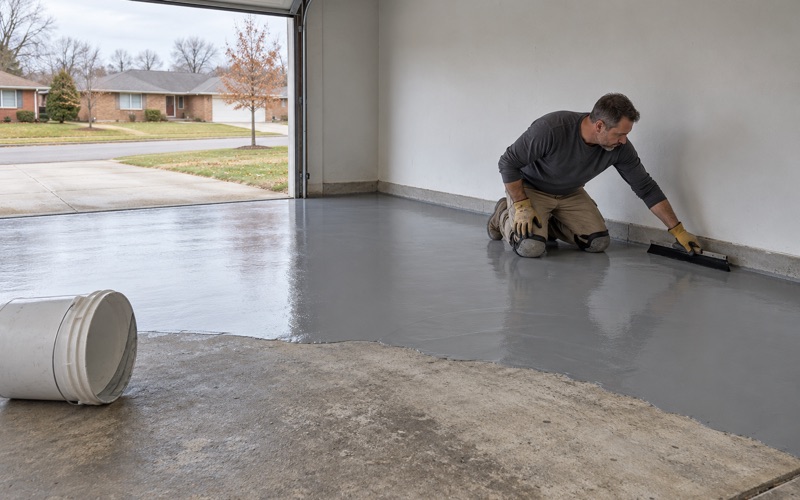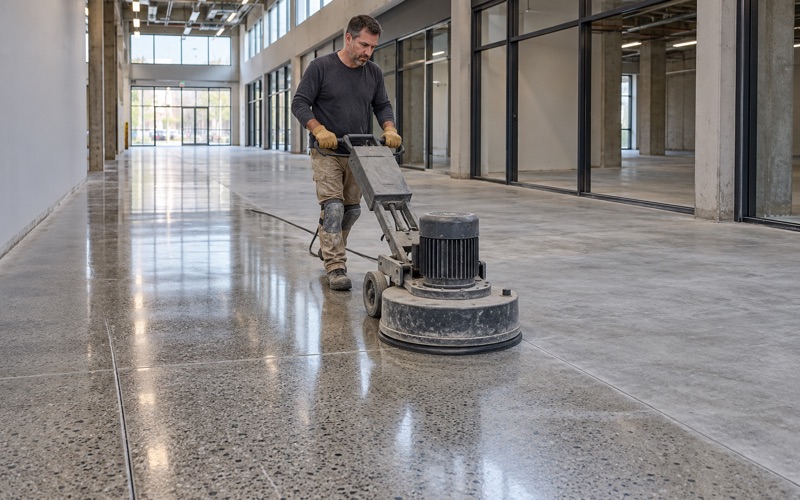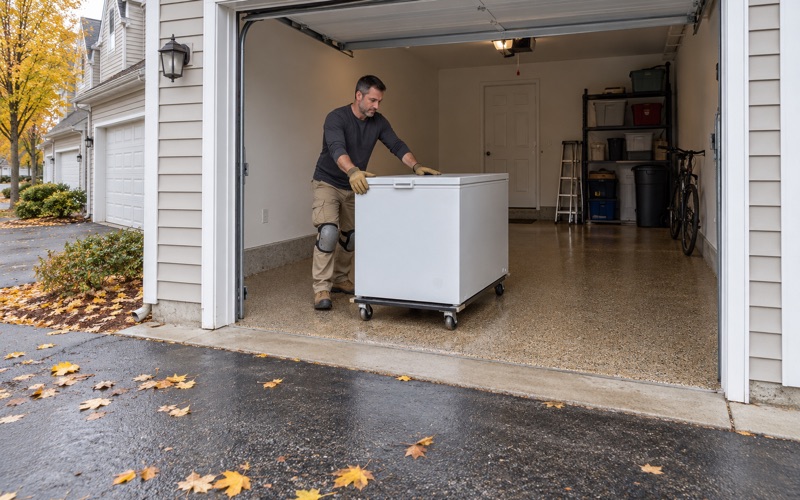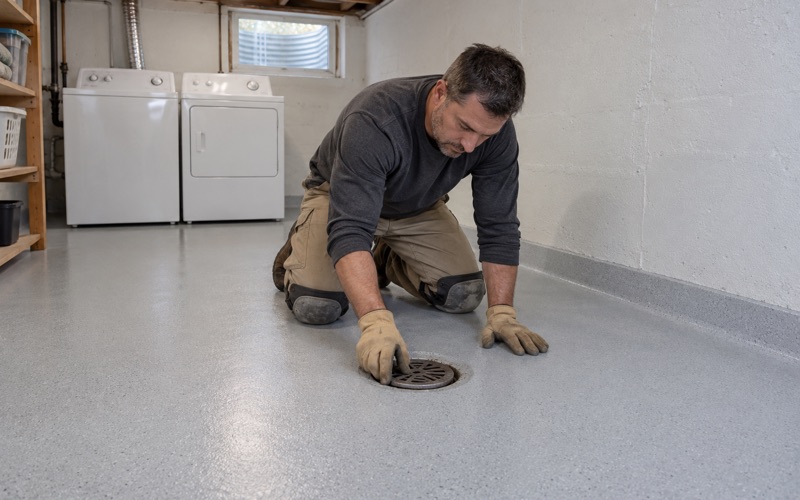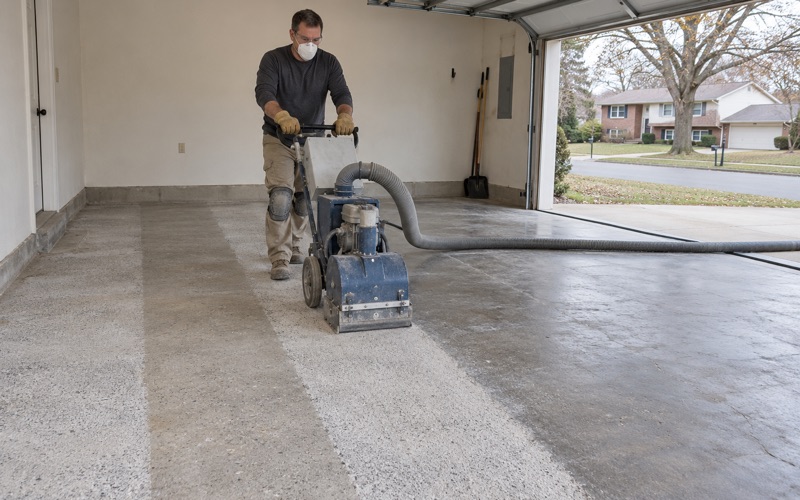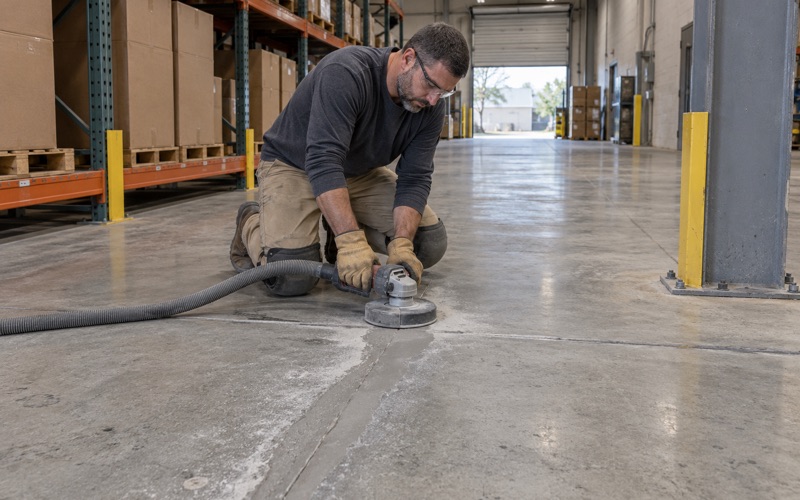
Hoffman Estates Epoxy Flooring brings more than 20 years of practice to epoxy flooring in Wood Dale, and the industrial floors here have taught us that the slab decides the result long before the resin does. That is why every floor we touch is opened mechanically with a diamond grinder or a shot blaster to a measured profile. We never acid etch, because an etched slab hides what a ground slab shows.
Moisture is the other half of the job, and we price it as part of the scope rather than offering it after a floor has blistered. A basement slab, a garage slab and a plant floor all get tested before we coat. Our proposals name the product, the system build and the finished thickness, so an owner can check what went down against what was quoted.
This page covers the floors where heat and moisture share a building: shops that sit beside a melt-and-pour operation, the areas where sand molds are handled and moved, and the home garage where someone has taken up metal casting as a hobby. In each one, knowing where a coating belongs matters as much as knowing which coating to use.
A Foundry Inside a Wood Dale Heater Plant
Most people driving Central Avenue would not guess that a working nonferrous foundry sits inside a heater manufacturer. It does, and it shapes how we think about plant floors in this city. A foundry floor answers different questions than an assembly floor, and the line between the two is where a flooring contractor either earns trust or makes an expensive mistake.
Cast-in heaters on Central Avenue
Tempco Electric Heater Corporation set up its first full-service nonferrous foundry and an in-house machine shop in 1982 to make aluminum and bronze cast-in heaters, which are used heavily in the plastics industry. In 1987 the company broke ground on its 130,000-square-foot world headquarters at 607 North Central Avenue. That address sits inside Wood Dale city limits, in Addison Township, DuPage County.
The city’s 2025 financial report lists Tempco Electric among its principal employers, at 217 people. We have no connection to the company. Tempco is not a customer, nothing in its plant is our work, and we have not seen its foundry floor. We describe its process here because it is a public, documented example of the hot work that changes how a nearby floor should be specified.
How the metal reaches the mold
Tempco’s foundry page describes two molding methods. No-bake sand molds handle low-volume aluminum, bronze and brass cast-ins, while tilt-pour gravity feed covers medium to high volume aluminum cast-ins, with Aluminum 356 named among the alloys. The page gives the 607 N. Central Ave address but does not say which Wood Dale building holds the foundry itself.
A company post from October 22, 2025 lists two traditional electric Shafer furnaces, a large Inductotherm induction furnace and two smaller Inductotherm furnaces. The same post describes a new mold manipulator able to handle sand molds of up to five tons and 80 inches in width. Equipment of that scale tells you the loads, the heat and the housekeeping a surrounding floor has to live with.
Looking for epoxy-flooring closer to Prospect Heights? See Epoxy-Flooring in Prospect Heights.
Molten Metal, Moisture and the Concrete Under It
Where molten metal can reach the floor, the first question is not gloss, color or texture. It is water. Concrete always holds some, and the amount changes with the season, the drainage around the building and whatever was spilled or washed down last week. A floor plan for a plant with a melt deck starts with that fact.
What the metal producer’s safety sheet says
An aluminum producer’s safety data sheet, Alcoa SDS 1352 dated May 31, 2015, warns that molten metal in contact with water or moisture can be explosive. It says any surfaces that may contact molten metal, concrete included, should be specially coated, that a spill should be contained with dry sand, and that stored metal should be protected from water run-on, precipitation included.
That language is general to molten aluminum. It is not a report about any Wood Dale plant, and we are not describing an incident anywhere. We cite it because it sets the order of decisions plainly: the pour area is governed by the metal producer’s guidance and the plant’s own safety staff, and a resin catalog has no business overriding either one.
Measuring the water in a slab
When a plant asks us about the floors around a hot process, we measure before we recommend. ASTM F2170 in-situ relative humidity probes read moisture inside the slab, ASTM F1869 calcium chloride tests give a vapor emission rate at the surface, and the ASTM D4263 plastic sheet test serves as a quick screen. We judge those readings against the ASTM F710 moisture thresholds and the coating maker’s own limits.
Those numbers go in writing, in the scope, before any product is chosen. A high reading may call for a moisture-mitigation primer, a different system, or a frank answer that coating is the wrong move until the source of the water is fixed. We never sell a floor coating as waterproofing, and we read the warranty exclusions out loud before a job is signed, with moisture named first.
Keeping a slab dry where metal is worked
Dry floors near a furnace come from habits as much as materials. Wash-down hoses, mop buckets and roof or door leaks belong nowhere near the pour side, and floor drains in that part of the building deserve a hard look. When we do coat a nearby area, we schedule the cure against slab temperature and the dew point spread at the surface, never the calendar.
Pour Zone, Sand Floor, Machine Shop: Three Different Floors
A plant that melts metal usually holds at least three kinds of floor under one roof, and treating them as one is the most common specification error we see. We zone the building by heat exposure first, then by traffic and chemistry. Each zone gets its own system, and sometimes the right system for a zone is no resin at all.
The pour zone gets its own specification
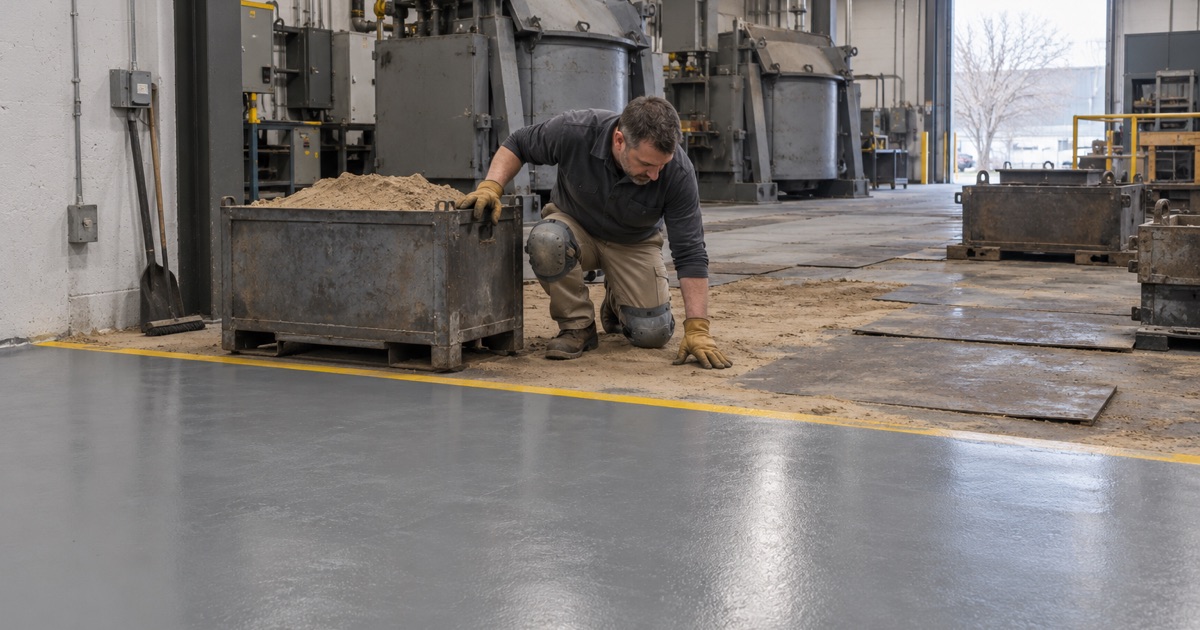
We do not market epoxy or any other resin as a surface for the floor where metal is melted, poured or could spill. The producer guidance above points to special coatings and dry sand there, and that specification belongs to the foundry’s engineers. Our part is defining exactly where our system stops, setting that edge back from the hot zone and finishing it flush.
A clean, deliberate boundary matters more than it sounds. A coating that creeps toward the pour line to make the floor look uniform is a coating in the wrong place. We mark the termination on the drawing, agree on it with the plant before grinding, and detail the edge so carts and forklifts cross it without catching a raised lip.
Sand handling and mold moving
No-bake sand molds mean loose sand on the floor, and sand under a wheel is an abrasive. Areas where molds are built, stored and moved wear a floor faster than almost any warehouse aisle. A thicker system with a quartz aggregate broadcast holds texture longer, and urethane cement is worth weighing where hot castings and thermal swings sit close by.
Heavy molds also mean concentrated loads from manipulators and forklifts, so we read the existing cracks, joints and old coatings before quoting. A coating is a film that follows the slab, and it will not hold together a slab that is moving. When repair has to come first, we say so plainly instead of coating over a problem and calling it finished.
The machine shop next door
The in-house machine shop beside a foundry is a more familiar floor. Coolant, cutting oil and metal chips call for a chemical-resistant 100% solids epoxy with enough broadcast texture to stay walkable when oily. The slab is diamond ground to the ICRI CSP profile the system calls for, and the proposal states the build and finished thickness so the plant can confirm it later.
A Casting Hobby in a Home Garage
Backyard and garage metal casting has a following, and a few of our garage customers melt aluminum or bronze on weekends. The same physics applies at a smaller scale. A decorative garage coating is a thin film on top of concrete that may hold more moisture than its owner expects, and it was never meant to catch a spill of molten metal.
Keep the melt off the finished floor
We tell hobby casters what the producer’s sheet tells a plant: the place metal is melted and poured is not where the coated floor goes, and dry sand should be within reach. We will gladly coat the rest of the garage and leave a defined, uncoated area for the furnace, set where the owner and the manufacturer’s instructions put it.
The rest of the garage
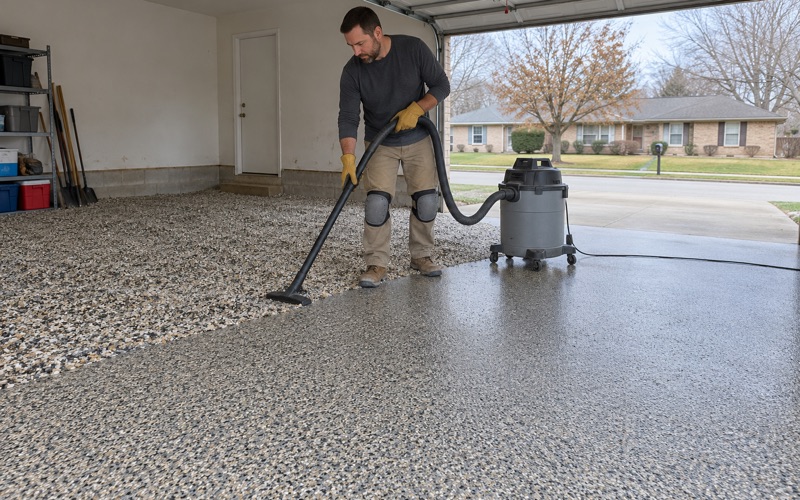
Outside that area, the garage is a normal northern Illinois floor. It has to stand up to calcium chloride brine and rock salt that tires track in all winter, which is why we favor a full broadcast system with a polyaspartic topcoat that resists hot tire pickup. In an unheated garage, we say plainly when the work has to wait for spring.
A newer slab is not automatically a dry one. The model code’s garage vapor retarder exception, IRC R506.2.3, means a garage poured to code may have no vapor retarder under it at all. We test that slab the same way we test a basement before anything is applied.
Paperwork before the work
The City of Wood Dale requires every contractor to be registered with its Community Development Department before a permit is issued, with a certificate of insurance carrying $2,000,000 in public liability coverage that names the city as certificate holder. Homeowners doing non-licensed work on their own property do not register. We confirm those requirements before scheduling, and every home job comes with a written contract and the state’s consumer-rights pamphlet, as the Illinois Home Repair and Remodeling Act requires.
- 20+ Years Coating Concrete
- Moisture Testing in Every Scope
- Written Contract on Every Home Job