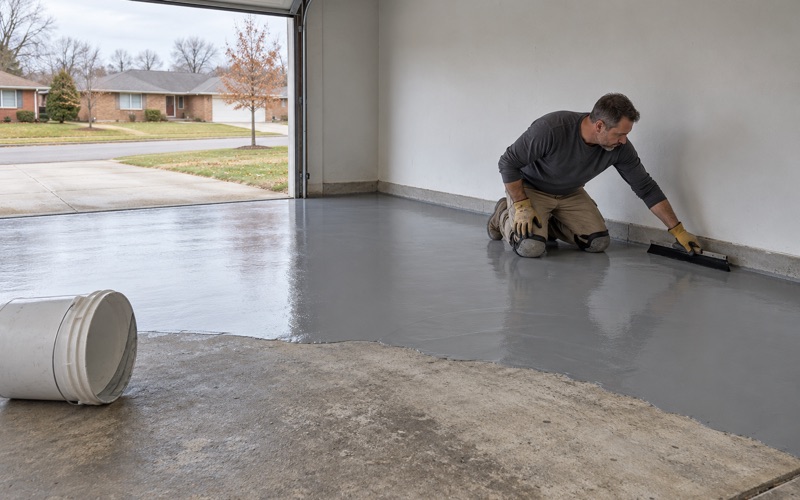
Hoffman Estates Epoxy Flooring has spent more than 20 years on concrete floors, and our epoxy-flooring in Winnetka work starts with a question most estimates skip: what will sit on this floor once it cures? A garage that parks two cars asks for abrasion resistance and protection against hot tire pickup. A garage or basement that holds family papers, framed photographs, silver or a box of letters asks for something more, because a fresh coating gives off vapors before it settles down.
So we treat chemistry and cure time as part of the specification rather than an afterthought. Every proposal names the product, the system build and the finished thickness, which means you can look up the safety data sheet for the exact coating before you sign instead of after the smell fades. The schedule we hand you shows when your belongings can return, not just when the floor can take foot traffic.
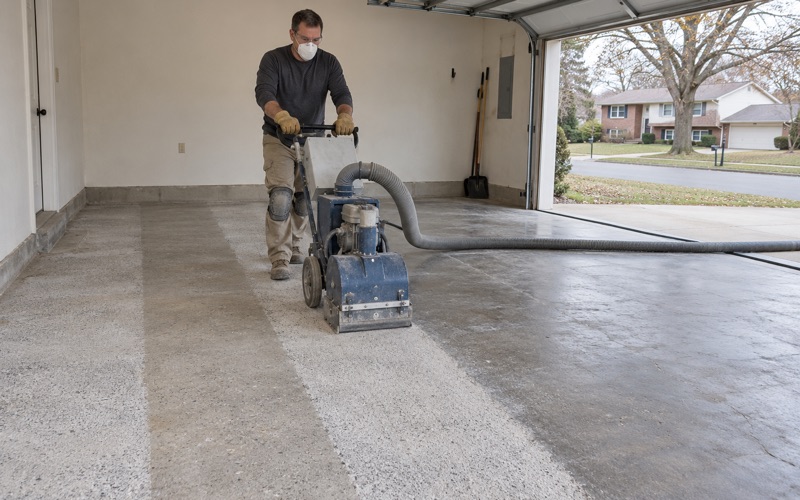
The slab itself is opened with a diamond grinder or a shot blaster, never acid etched, and moisture testing is its own line in the scope. The sections below explain why a stored collection changes the timeline, and where that way of thinking shows up in Winnetka itself.
A Garage Enlarged to Hold a Village’s Collections

The House at 411 Linden Street
The Winnetka Historical Society bought a two-story 19th-century house at the corner of Linden and Ash streets in June 2001 and moved its headquarters into it at 411 Linden Street in October 2005. Before the society occupied the house, the village granted a special use permit for “non-essential public use” and a zoning variation “to allow the WHS to enlarge the garage and attach it to the house to store valuable artifacts and collections.” The address sits inside Winnetka village, in New Trier Township.
We have no connection to that building and have never seen its floors, and nothing on record says what the garage addition or the storage rooms are surfaced with. What interests us is the decision itself. A village looked at a garage and agreed it could become collection storage, which is the same conversion many Winnetka homeowners make on a smaller scale.
Storage That Has to Stay Stable
A summary of the society’s own pages describes climate-controlled space at 411 Linden, with collections storage and curatorial work space on the second floor. Its collections are not yet online, and a digitization project is working toward publishing the catalog. A collection waiting to be catalogued is a collection that sits in boxes for years.
Anyone storing objects that long ends up judging a room by what it does to the air around them, not only by how it looks or wears. That is the lens we bring to a garage or basement that is about to become storage. The floor is the largest fresh surface in the room, so it is the first place to ask what will come off it.
Older Rooms, Long Service Lives
Winnetka keeps its older buildings working. Of the 4,539 housing units counted in the village, 2,216 were built in 1939 or earlier, so many garages and basements here are the original rooms of pre-war houses. When one of those rooms becomes storage, the floor is usually the first thing an owner wants to change.
Pre-war rooms bring their own questions. A slab that old predates modern under-slab vapor retarder practice, and a newer garage slab may lack one too, because the IRC R506.2.3 garage exception leaves it out. Either way we test before we coat, and the result goes into the schedule alongside the off-gassing window.
Looking for epoxy-flooring closer to Hinsdale? See Epoxy-Flooring in Hinsdale.
What a Fresh Coating Gives Off, and the Four-Week Window
The clearest guidance we know of comes from the National Park Service. Its Conserve O Gram 1/11, published in June 2001 and written by Paul Storch of the Minnesota Historical Society, covers floor coverings for exhibit galleries and visitor centers. It warns that volatile organic chemicals from construction and coating materials “can and will react with the chemical components of objects, causing accelerated deterioration.”
Which Compounds Come From Which Materials
The bulletin’s Table 2 traces ammonia, formaldehyde and nitrogen oxides to polyurethane adhesives and backcoatings, acetic acid to polyvinyl acetate, and hydrochloric acid to PVC. Copper alloys, silver and photographs are among the materials it lists as reactive to these vapors. That list reads like the contents of a family attic: an inherited silver service, brass hardware, a shoebox of prints.
Four Weeks Before the Boxes Go Back
The planning advice is direct: “Plan the installation so that there are at least four weeks for off-gassing and relative humidity (RH) equilibration in the space before installing artifacts.” Two things happen in those weeks. The coating finishes releasing what it is going to release, and the room’s humidity settles after a job that involved grinding, mixing and curing.
We build that window into the schedule whenever a client tells us the space will hold anything they cannot replace. A floor that can take a car in a few days is not the same as a room ready for archive boxes, and we write down which date is which. Curing is scheduled against slab temperature and dew point rather than the calendar, so the waiting period starts when the coating has actually cured.
Why Cure Time Is Not Shelf Time
A coating that feels hard underfoot can still be curing below the surface, and an epoxy that cured in cold or damp air can carry an amine blush on top. Sliding steel shelving back too early can also mark a fresh topcoat. Treating cure time as a scheduling constraint protects the floor as well as everything that ends up on it.
Reading the Data Sheet Before the Color Card
Most people choose a floor by flake blend or metallic color. For a storage room, we suggest the order runs the other way. The NPS bulletin recommends reviewing each product’s safety data sheet, and we put the sheet for every layer in front of a client before the color conversation starts.
What Our Proposal Lets You Check
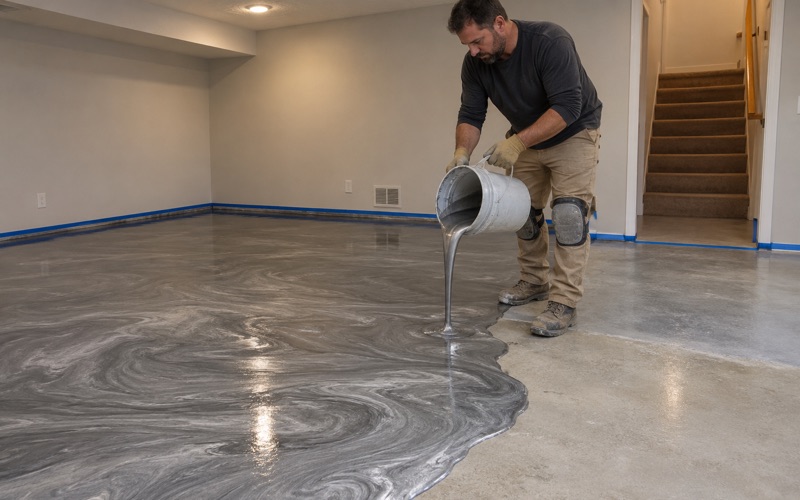
Because the proposal names the product, the system build and the finished thickness, you can pull the data sheet for the primer, the body coat and the topcoat yourself. A 100% solids epoxy body coat, a polyaspartic or polyurea topcoat, a vinyl flake broadcast and a quartz aggregate broadcast each carry their own sheet. We point out which components contain solvent and which do not, and we make no promise that any coating is free of emissions.
If a basement slab needs a moisture-mitigation primer, that layer gets the same scrutiny as the color coat. The point is that every product going into the room is named in writing, so nothing appears on the job that you did not get to read about first.
Limits That Already Apply
Floor coatings in Illinois fall under the VOC limits in 35 Ill. Adm. Code Part 223 Subpart C, alongside the national rule at 40 CFR 59 Subpart D. We choose within those limits, which bind the installer as well as the manufacturer.
A compliant product still releases something while it cures. A content limit sets a ceiling for the product category; it does not tell you how a particular photograph or piece of silver will respond, which is why the data sheet and the waiting period work together.
The Conservator’s Screen
The bulletin also notes the Oddy test as a general screen for VOCs, the method conservators use to check whether a material is likely to harm objects stored near it. If you are protecting something valuable enough to warrant that step, we can tell you exactly which products to sample before the job is booked.
The Same Caution for a Home Garage That Stores Heirlooms
Winnetka is largely a village of owner-occupied, detached houses: 3,837 of its 4,172 occupied units are owned, and 4,018 units are detached. That adds up to a lot of private garages and basements doing double duty as storage for things that matter. Wedding albums, tax archives, a framed print collection or inherited silver often end up on shelving against a garage wall.
Prepare the Slab, Then the Room
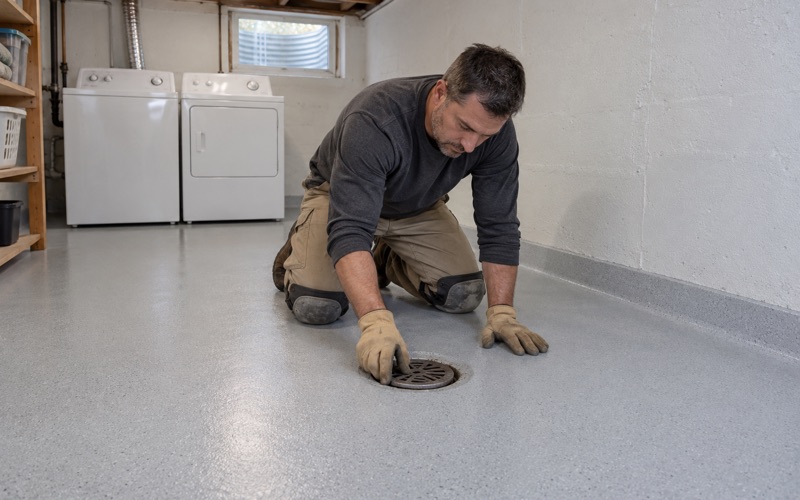
We open the slab mechanically to the ICRI CSP profile the system calls for, and we test moisture before anything is applied, using ASTM F1869 calcium chloride kits or ASTM F2170 in-situ relative humidity probes. In a room that will hold paper and photographs, a damp slab is a second problem on top of the coating, so we report what we find rather than coat over it. Water coming up through a basement slab is a drainage question first, and we never sell a coating as waterproofing.
We also read the cracks and any old coating before quoting, and we say plainly when a slab needs repair before it can be coated. A coating is a film that follows the concrete under it, so a crack that moves will show through, collection or no collection.
Plan Where Everything Lives for a Month
The hardest part of the off-gassing window is usually logistics. Before we start, we ask clients to decide where the boxes, frames and shelving will stay for the month after the floor goes down, ideally in a steady interior room rather than a hot attic or a damp shed. Keep the door to the house closed while the coating cures, ventilate the garage as the product sheet directs, and let the space settle before anything irreplaceable comes back.
Paperwork Before the First Pass
Every home job comes with a written contract and the Home Repair: Know Your Consumer Rights pamphlet before work begins, as the Illinois Home Repair and Remodeling Act requires. Illinois licenses no flooring or coatings contractor, so we confirm the village’s own requirements with the Winnetka Department of Community Development, and we ask whether a given coating needs a permit rather than assuming either answer. Warranty exclusions are read out before the job is sold, with moisture named first.
- 20+ Years Coating Concrete
- Moisture Testing in Every Scope
- Written Contract on Every Home Job