Hoffman Estates Epoxy Flooring brings more than 20 years of work to epoxy-flooring in Warrenville, and the jobs we think hardest about are the ones where water has already been on the slab. A basement gym, a rec room or a garage that took a leak is not a blank surface. It is concrete with a history, and that history decides what the next floor can be.
Our first visit is about reading that history. We look at the cracks, the old coating and any staining, and we put moisture testing in the written scope as its own line rather than offering it after a floor has blistered. When a slab needs repair before it can take a coating, we say so in plain words before anyone signs.
What follows is how we think about water and layered floors, built around a gym floor in town that had to come out after a sprinkler failure. It is also how we decide whether a home gym is better served by a layered build or by a coating bonded straight to the concrete, and what has to happen to the slab first either way.
A Gym Floor Replaced After a Sprinkler Head Failed
What the park district reported
The Warrenville Park District’s list of fiscal 2026 accomplishments includes two lines that belong together. One says the district removed and reinstalled a brand new flooring system in the Rec Center gym after water damage. The other says it replaced the sprinkler head system in that gym and added another level of security, after a sprinkler head was damaged the previous fall.
The Recreation Center sits at 3S260 Warren Avenue, inside the city in Winfield Township, DuPage County. Its lower-level gymnasium holds 300 at full capacity, and a court directory lists three indoor wood courts there with permanent lines and portable nets. The district did not say what kind of flooring system went back in, and we had no part in that project.
Why one sprinkler head matters on a sport floor
A fire sprinkler that discharges is doing its job, and it does that job by putting a great deal of water in one place. On bare concrete that water spreads out, finds the drains and evaporates over a few days. On a floor built in layers, the water has somewhere to hide, and the damage keeps working long after the puddle on top has been mopped up.
That is the part of the story worth carrying home. The trigger was not a storm or a river; it was water arriving from above, indoors, onto a floor designed for play rather than for a soaking. Any basement gym or finished rec room with layers over the slab carries the same exposure to a burst supply line, a failed water heater or a leak from the floor above.
Looking for epoxy-flooring closer to Norridge? See Epoxy-Flooring in Norridge.
Water From Above: What a Layered Sport Floor Does With It
Surface, pad and slab
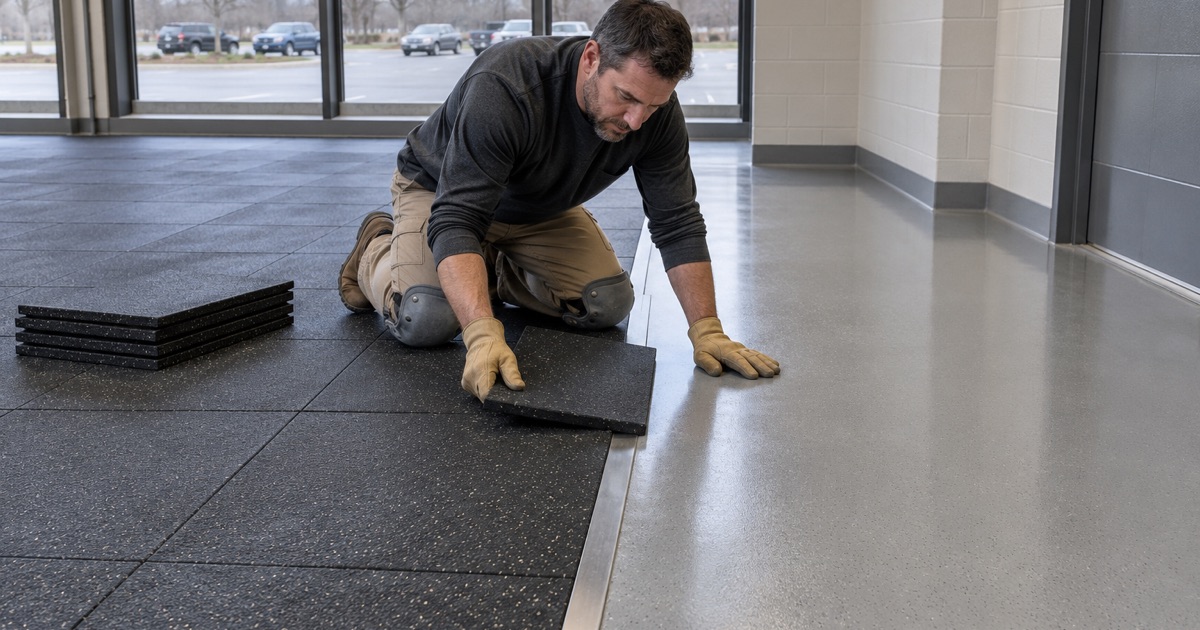
A typical sport floor is a system rather than a single material. There is a wearing surface on top, often a resilient pad or subfloor beneath it, and the concrete slab underneath everything. Each layer has a job, whether that is bounce, shock absorption or a flat playing plane, and every joint between layers is a place where water can collect and sit.
Water poured onto the surface finds the seams and the perimeter and runs down through them. Once it reaches the pad or the top of the slab, it is shielded from moving air by the very layers above it. The surface can look dry within a day while the zone between pad and concrete stays wet for weeks, out of sight and out of reach of a fan.
Cupping, buckling and why the whole system came out
The Maple Flooring Manufacturers Association puts it bluntly: water is your floor’s worst enemy. The association warns that too much moisture causes abnormal expansion, which can lead to cupping or buckling. Wood takes on water and swells, board edges rise, boards press hard against each other, and a floor that was flat and true starts to heave.
That is why a water event on a layered floor so often ends with the whole system coming out rather than a patch. Pulling up the top layer is the only way to see what the pad and the slab are holding, and a pad that soaked up water does not reliably dry back to what it was. Removing the system and starting over is often the honest repair, even when only part of the floor looked wet.
What we take from that for a home floor
We never sell a floor coating as waterproofing or as protection against a flood, and that holds in a gym, a basement or a garage. A coating is a thin film that follows the slab under it. What a coating bonded directly to concrete does change is the number of layers that can trap water, and that shapes how quickly a room recovers after a leak.
The choice is a trade, not a verdict on either floor. A layered build gives a softer, springier surface that some owners want for play or exercise, and it asks more of the room after a leak. A bonded coating gives up that cushion in exchange for a surface that dries where it lies, and we lay out both before anyone chooses.
Drying and Testing the Slab Before the Next Floor
Why the slab has to dry before anything goes back
Once the layers are gone, the slab underneath has usually absorbed its own share of the water. Concrete is porous, and a soaked slab can feel dry on the surface while its interior is still releasing moisture. Laying a new floor of any kind over that slab traps the moisture again, and under a coating it shows up as blisters, lifting edges or a cloudy film.
The tests we use
We test before we coat, and the method depends on the slab and the room. An ASTM F2170 in-situ relative humidity probe reads moisture inside the concrete, an ASTM F1869 calcium chloride test measures vapor emission at the surface, and an ASTM D4263 plastic sheet test gives a quick early read. We compare the results against the coating maker’s limits and the ASTM F710 thresholds.
One reading is rarely enough after a leak. We take readings where the water sat longest and again in a corner that stayed dry, because the gap between the two tells us how far the slab still has to go. A wet zone that keeps reading high after a week of drying is a reason to look for a second water source before any coating is quoted.
Readings over the limit change the plan rather than the price alone. Sometimes the answer is more drying time with air movement and heat; sometimes it is a moisture-mitigation primer under the system. When the source is water coming up through the slab rather than a one-time leak from above, we treat it as a drainage question first and tell the owner so before quoting any coating.
Preparing the surface once it is dry
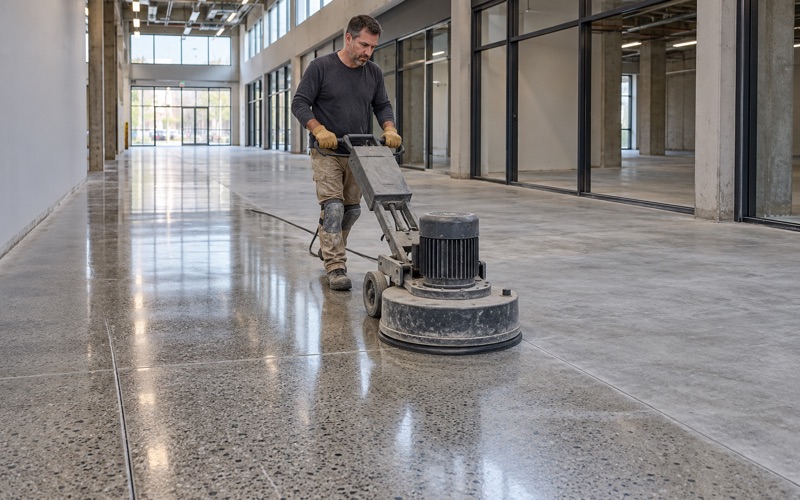
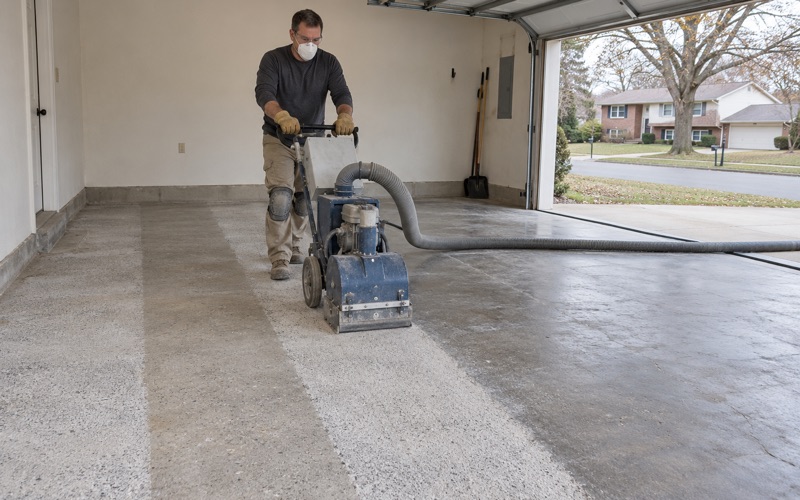
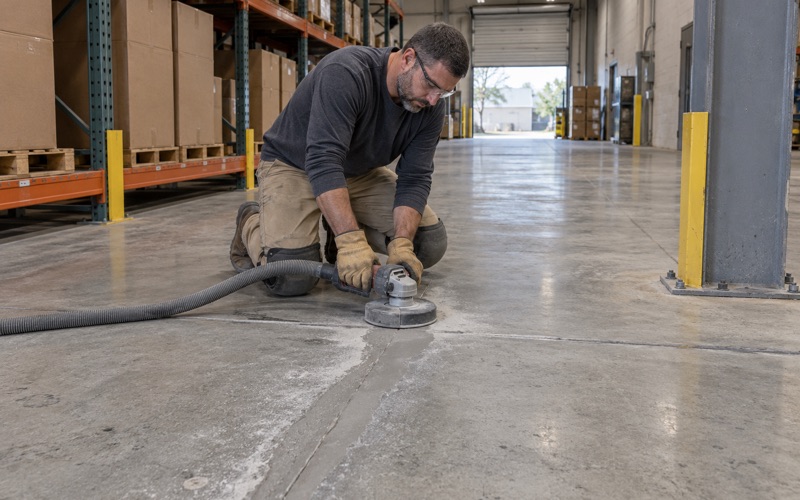
Every slab we coat is opened mechanically with a diamond grinder or a shot blaster, and we do not acid etch. Grinding removes whatever the water left behind, including efflorescence, old adhesive residue and any weak top layer, and leaves an ICRI CSP profile the primer can grip. Cure is then scheduled against slab temperature and dew point, not against a date on the calendar.
Basement Gyms and Rec Rooms: Layers Versus a Sealed Slab
Where this comes up in Warrenville
Warrenville is a far west suburb of Chicago on the DuPage River, part of the Illinois Technology and Research Corridor and just north of I-88. Of the 6,022 housing units in the census survey, 1,650 were built in the 1970s and 62.1 percent between 1970 and 1999. Many basement and garage slabs here are decades old and predate ASTM E1745, the 1997 standard for under-slab vapor retarders.
Newer homes are not automatically drier. The June 1, 2024 special census counted 6,764 housing units and named developments such as Everton, Lexington Trace, Arden, Westlyn and Riverview West that the 2020 count missed. A garage slab poured to code in one of them may still have no vapor retarder under it, because IRC R506.2.3 exempts garages, so we test those slabs too.
Home gyms in those basements usually start with rubber mats or interlocking tiles laid loose on the concrete. That is a layered floor in miniature, and it behaves like one after a leak. Water runs under the mats, sits against the slab and stays there until someone lifts every tile, which is usually when the musty smell and the stained concrete finally get found.
What a bonded coating changes
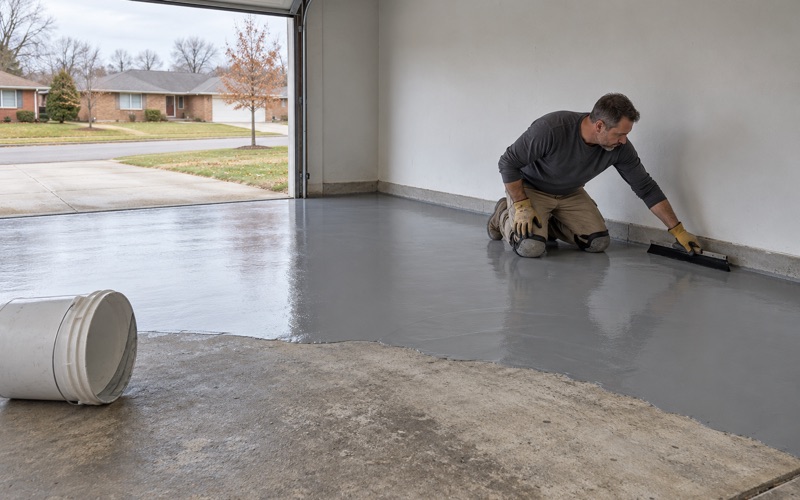
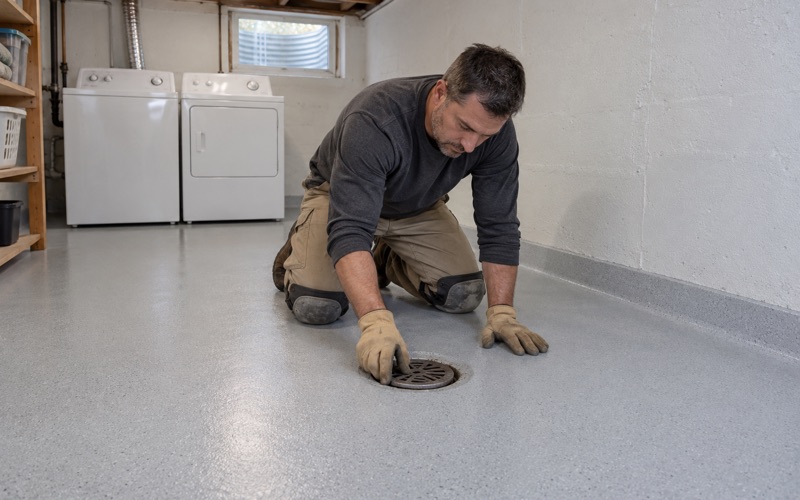
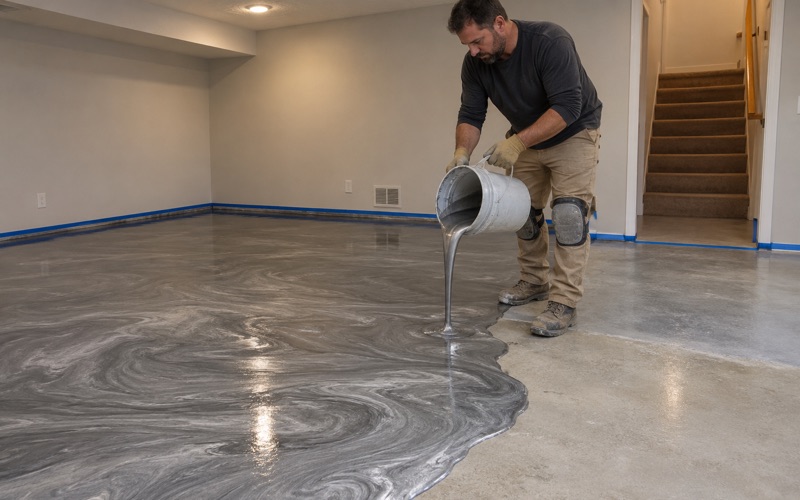
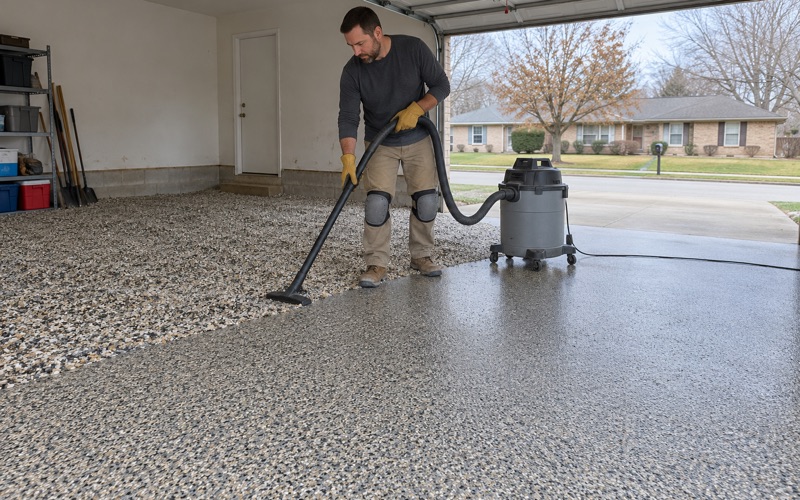
A 100% solids epoxy base with a polyaspartic topcoat, bonded to a ground slab, leaves no gap between floor and concrete for water to sit in. A spill stays on top where it can be seen and pushed to a floor drain with a squeegee. Mats can still go over the coating where someone wants cushion, and lifting them to dry the floor after a spill takes minutes.
None of that makes the slab immune to water. A coating will not stop water pushing up from below, will not bridge a crack that keeps moving and will not rescue a sump that cannot keep up. Our proposal names the product, the system build and the finished thickness, and we read the warranty exclusions out before the job is sold, with moisture named first.
Paperwork before the work
The City of Warrenville Community Development Department lists flooring among the work that does not need a building permit, so a home basement coating is usually not a city permit question. Commercial and multi-family floors still pass through the Warrenville Fire Protection District, whose plan review covers attached dwelling units and commercial buildings, so we confirm those requirements before scheduling.
Every home job gets a written contract and the Home Repair: Know Your Consumer Rights pamphlet before work starts, as the Illinois Home Repair and Remodeling Act requires. Because Illinois issues no state license for coatings work, we also confirm the city’s own contractor registration, bond and insurance rules ahead of time, so the paperwork is settled before the grinder comes off the truck.
- 20+ Years Coating Concrete
- Moisture Testing in Every Scope
- Written Contract on Every Home Job