Hoffman Estates Epoxy Flooring has spent more than 20 years on epoxy flooring in Prospect Heights and across the northwest suburbs, and the question we ask first on any slab is where the water is going. A floor coating is a thin film bonded to concrete. Whatever moves through that concrete, whether liquid water or vapor, eventually reaches the underside of the film and decides how long it holds.
That is why our scope starts with the slab rather than the color chart. Before we quote, we read the cracks, the old coating and any staining at the edges, and we write moisture testing into the proposal as a line item. If the concrete needs repair or the water source needs fixing first, we say that plainly instead of selling a floor that will blister in a year.
The proposal itself names the product, the system build and the finished thickness, so a homeowner can check what was quoted against what went down. Below, we walk through one sign we take seriously above almost any other on a slab or a wall, and why we refuse to coat over it until the cause is dealt with.
White Salt on a Library Wall, and What It Says About Water
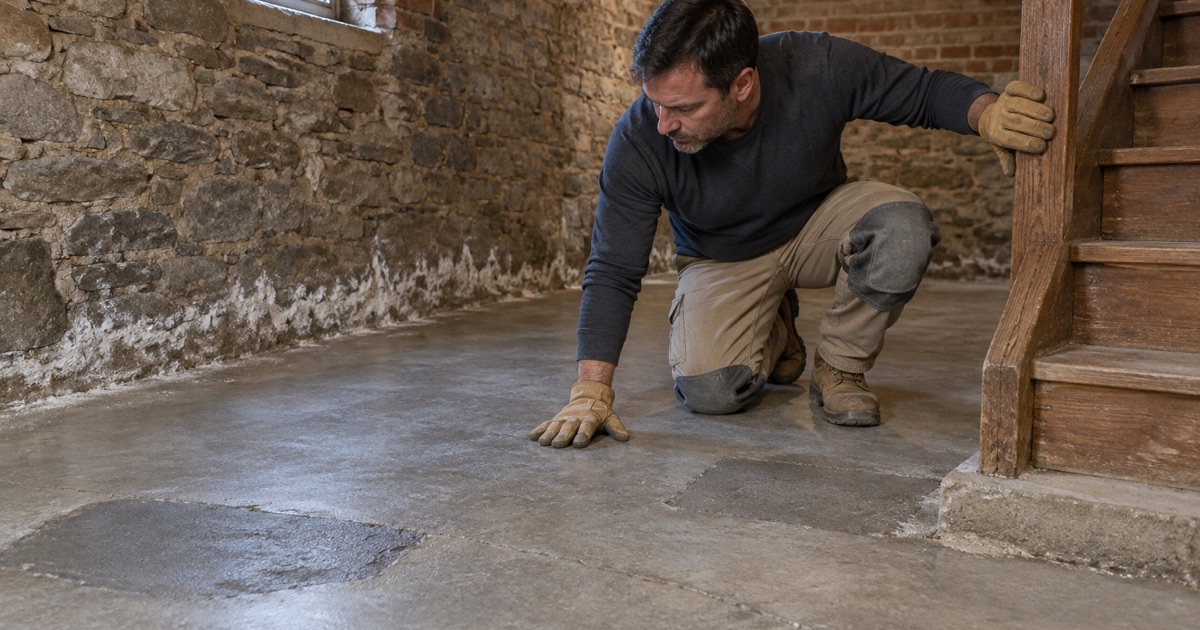
Efflorescence is the white, powdery deposit a wall or slab leaves behind when water has been moving through it. The water dissolves salts and alkaline residue inside the masonry or concrete, carries them to the surface and evaporates, leaving the crystals behind. It looks cosmetic, and it is tempting to sweep it away. It is really a record of moisture traveling through the material.
The Youth Department finding
The Prospect Heights Public Library on Elm Street offers a clear local example. On May 21, 2025, the library’s Building & Grounds Committee went to the Youth Department to see the interior efflorescence and the areas in need of repair along the west wall. They were working from a Hutchinson Design Group masonry report with photos of perimeter and interior areas, which estimated $32,000 to $37,000 for the east wall alone or $65,000 for all masonry repairs.
The committee recommended pursuing all of the masonry work rather than the narrower option. That is worth noticing, because the salt showed up inside the building, on interior masonry, which means water was finding a path through the wall from somewhere. Treating the visible white residue would have done nothing about the path itself.
Fix the masonry first: the order the library chose
On July 30, 2025, the library board unanimously approved a RestoreWorks Masonry Restoration proposal for the masonry work at $106,700. The same discussion covered trimming vines and sealing the building exterior. In other words, the response went to the wall and the envelope first, where the water was getting in, rather than to the finishes on the inside face where the salt appeared.
That sequence is the right one for any building, and it is the same order we follow on a floor. The building itself has seen several rounds of work: the library moved into a permanent 13,500-square-foot building in 1972, a renovation completed in 1991 doubled it to 26,000 square feet, and a $5.4 million interior renovation reopened it on June 5, 2021. New finishes inside still depend on a dry envelope outside.
Looking for epoxy-flooring closer to Cary? See Epoxy-Flooring Services in Cary.
Why a Coating Over Efflorescence Lets Go
Coating manufacturers are blunt about this. Dulux Protective Coatings, in its technical note on concrete floors and efflorescence, puts it simply: efflorescence should not be coated over. The note describes the deposit as salts and alkaline residue driven to the surface by hydrostatic pressure or moisture vapor transmission, and says it may indicate moisture coming in from a source outside the concrete itself.
A friable base under the film
The first problem is mechanical. Efflorescence is loose, crystalline and weak, so a coating applied over it is bonded to powder rather than to sound concrete. The note calls it a poor, friable base. Even 100% solids epoxy, which builds a thick, hard film, can only be as strong as the layer it grabs, and a layer of salt crystals lets go under the first real load or temperature swing.
Blisters and lift at the wall line
The second problem is the water that carried the salt in the first place. The same technical note warns that even after the deposit is cleaned off, remaining moisture can collect under the coating system, forming blisters and pushing the coating off. On a basement floor that often starts at the wall line, where the slab meets the foundation and moisture tends to concentrate, and spreads outward as small domes.
That kind of lift is sometimes described as osmotic blistering: moisture and dissolved salts build pressure beneath a film that does not let them escape. A polyaspartic or polyurea topcoat over the epoxy does not change the physics underneath. Once the bond line between coating and concrete is wet and salty, the system is failing from below, and patching the blisters only moves them a few feet over.
What a coating can and cannot do
A floor coating is not waterproofing, and it does not stop efflorescence. The Dulux note says it directly: efflorescence will cease when moisture transfer through the concrete stops. We never sell a coating as the fix for water coming through a slab. Water rising through a basement floor is a drainage question first, and our warranty exclusions, which we read out before a job is sold, name moisture first.
Wire Brush, Dry, Measure: Getting a Slab Ready After Salts
When we find efflorescence on a floor we are asked to coat, the job splits into stages. The coating is the last of them, and it waits until the earlier stages are finished and checked. Skipping ahead is how floors end up blistered, and a written contract that spells out the order protects both sides when the schedule slips because a slab is still too wet.
Find the source and stop it
The first stage belongs to whoever fixes the water. That may be a downspout dumping beside the foundation, a grading problem, a cracked wall, a failed drain tile or a leaking fixture. In Prospect Heights the city’s building specifications require downspouts to discharge onto splash blocks, with no piping to the storm sewer, so the discharge point next to the house matters. We point to what we see; the repair itself is often another trade’s work.
Remove the deposits, then let the slab dry
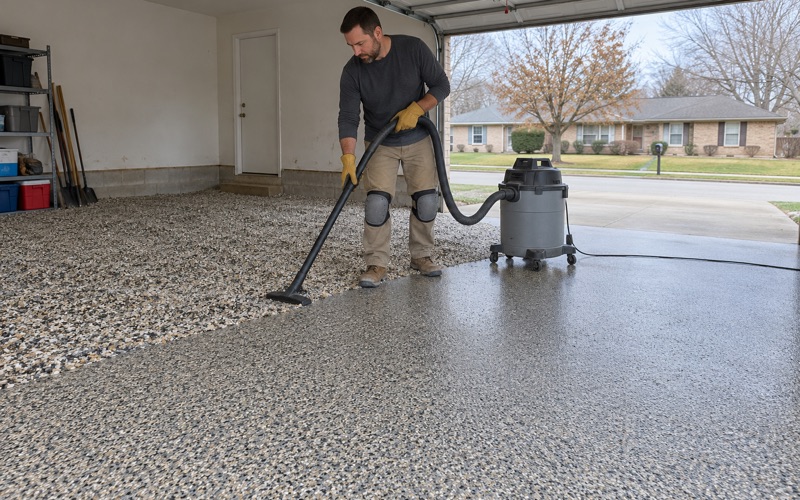
Once the source is addressed, the salt comes off. Light deposits respond to stiff brushing and vacuuming, and heavier ones come off during mechanical preparation. We do not acid etch, because acid adds liquid and residue to a slab we are trying to dry. Then the concrete needs time, and if the white powder returns during that wait, the water has not actually stopped.
Measure before anything goes down
Drying is confirmed with numbers rather than a glance. Depending on the slab, we use ASTM D4263 plastic sheet testing as a quick screen, ASTM F1869 calcium chloride testing for moisture vapor emission rate, or ASTM F2170 in-situ relative humidity probes drilled into the concrete. Readings get compared with the limits the chosen product requires, and with ASTM F710 thresholds where they apply.
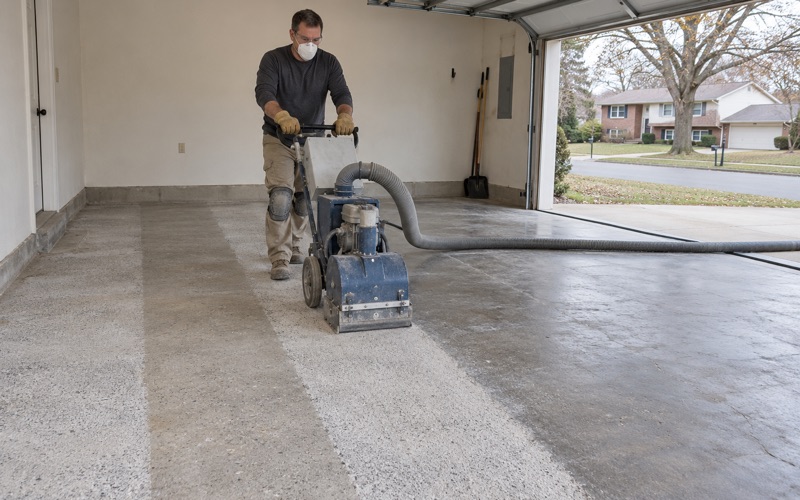
If the readings land in range, we open the surface with a diamond grinder or shot blaster to a profile on the ICRI CSP scale that suits the system. If the slab stays marginal after the source is fixed, a moisture-mitigation primer is sometimes the right base. That is a product choice made from the test results, not a substitute for fixing the water, and it is written into the proposal by name.
Spotting Efflorescence on a Basement or Garage Floor at Home
Most homeowners never see a masonry report, but the same white residue shows up in houses all the time. Knowing where to look before you call for a quote saves a wasted visit. It also helps you ask better questions of anyone who offers to coat over the floor without checking it first, or who promises a coating will keep a basement dry.
Where salt shows up on a slab
On a basement floor, look along the base of the foundation walls, around a sump pit or floor drain, at cracks and control joints, and under anything that has sat on the slab for years, like shelving or storage bins. The deposit is usually white and chalky and wipes off dry. A peeling old coating with white powder underneath is a strong hint that moisture caused the original failure.
Garage slabs are not automatically dry
Garages show it too, especially near the door, along the edges and where the slab meets the house foundation. A newer garage is not proof of a dry one. The model residential code exempts garage floors from the vapor retarder required under other slabs, in IRC R506.2.3, so a garage poured to code may have nothing beneath it to slow moisture. We test before we coat rather than assume.
Scheduling and sign-off in Prospect Heights
Prospect Heights is a city rather than a village, with its own building and permitting department. Its building specifications list concrete flooring, including garage and basement floors, among required inspections, and set construction hours of 7:00 a.m. to 6:00 p.m. Monday through Saturday. We ask the permit desk before the job whether a coating counts as decorating or needs a permit, rather than assuming either answer.
Curing gets scheduled against slab temperature and dew point, not the calendar, so a cold, unheated garage may have to wait for warmer weather. Every home job gets a written contract and the state’s Home Repair: Know Your Consumer Rights pamphlet before work starts, as the Illinois Home Repair and Remodeling Act requires. If you have spotted white residue on a floor you want coated, that is where our visit begins.
- 20+ Years Coating Concrete
- Moisture Testing in Every Scope
- Written Contract on Every Home Job