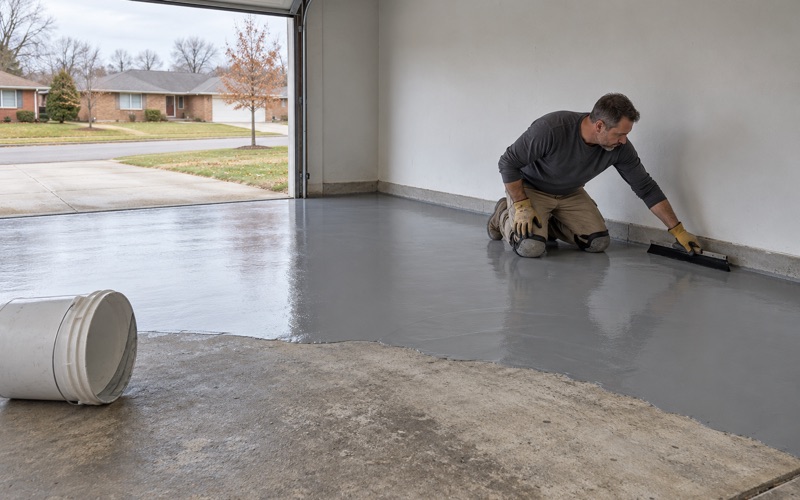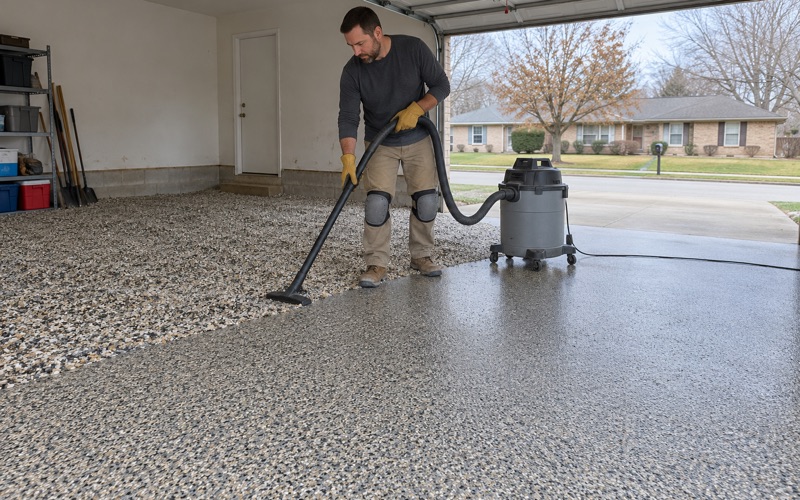
Hoffman Estates Epoxy Flooring has spent more than 20 years on epoxy flooring in Pingree Grove and the surrounding part of the Fox Valley, and the first question we ask on any job is what is going to attack the floor. A garage slab fights tire heat and road salt. A food room fights hot water and cleaners. A room that handles sewage fights something most people never think about, which is the air itself.
That last case is the one this page is about, because it shows more clearly than any other why one coating cannot be sold for every floor. The product that lasts decades on a residential garage can fail in a few seasons where acid forms on the surface from above. Matching the system to the exposure is the whole job, and it starts before anyone opens a pail.
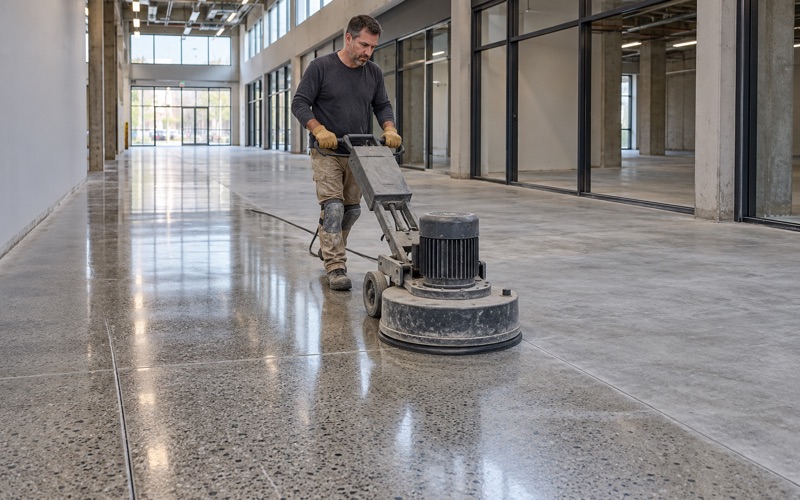
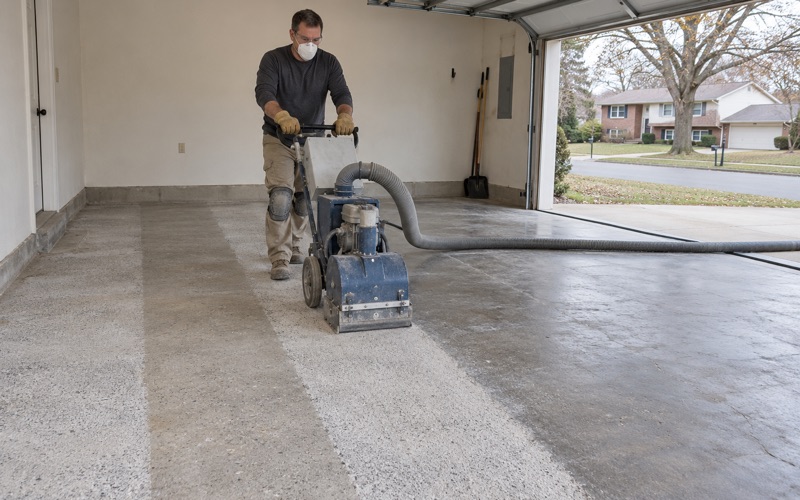
Every floor we quote is opened mechanically with a diamond grinder or shot blaster, never acid etched, and the proposal names the product, the build and the finished thickness. That way the owner can hold what was quoted against what actually went down, whether the room is a basement, a garage or a pump room.
A Village Doubling Its Own Sewage Plant
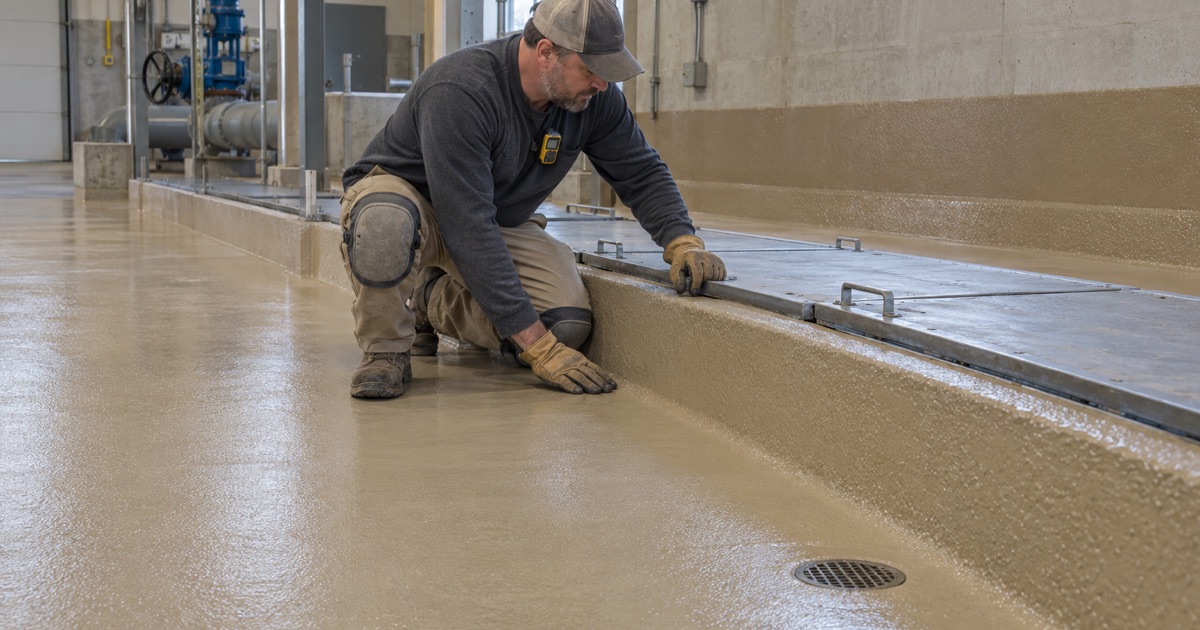
Pingree Grove is a village in Kane County, spread across Rutland and Plato Townships, and its growth is hard to overstate. The census counted 124 residents in 2000, 4,532 in 2010 and 10,365 in 2020. A wastewater plant sized for a small farm village does not stay adequate through that kind of change, and the village has been working on that problem for years.
What the expansion adds
According to the village engineer, Fehr Graham, the Pingree Grove wastewater treatment plant improvements double capacity from 1 to 2 million gallons per day. The work adds mechanical primary treatment units that use one tenth of the area of conventional primary clarifiers, along with anaerobic and anoxic tanks for biological nutrient removal. Construction began in spring 2021, with a construction cost of $28,581,280.
How it was funded
Kane County Connects reported in August 2023 that the village was awarded $51 million in Illinois EPA funding for the wastewater work. That package includes construction of a new preliminary and primary treatment building and a new influent pump station, and it targets effluent quality that meets phosphorus limits. On July 15, 2024, U.S. Rep. Raja Krishnamoorthi presented the village with $959,752 in federal community project funding to upgrade the existing facility.
The village’s 2024 State of the Village presentation listed the wastewater treatment expansion as well under way. We use the project here as a reference point, not as a job of ours: the plant is the village’s, and we have no part in it. What makes it useful is that a new preliminary treatment building and influent pump station are exactly the rooms where floor chemistry turns hostile.
Looking for epoxy-flooring closer to Schiller Park? See Epoxy-Flooring in Schiller Park.
What Happens to Concrete in a Headworks
The headworks is where raw sewage first enters a treatment plant, and it is turbulent by design. Screens, grit removal and pumping all churn the incoming flow, and churning wastewater gives up dissolved gases into the room. The most important of those gases, for anyone who cares about concrete, is hydrogen sulfide.
Sewer gas is only the first step
Hydrogen sulfide by itself is a corrosive, foul-smelling gas, but it does not dissolve concrete on contact. The damage comes from what happens next. Sulfur oxidizing bacteria live in the thin film of moisture on damp concrete walls, ceilings and floors, and they convert the gas into sulfuric acid right on the surface.
Acid made where it does the most harm
That process is usually called biogenic sulfuric acid attack, and the location is what makes it destructive. The acid is not a spill that lands once and gets hosed away. It is produced continuously, in place, on every surface that stays damp, which in a headworks means nearly all of them.
Concrete is alkaline, and sulfuric acid reacts with the cement paste that holds the aggregate together. As the paste softens, the surface loses strength, aggregate loosens and the section gets thinner. Moisture in the room keeps the bacteria alive, so the attack keeps going as long as the gas keeps coming.
Floors take a particular beating in that setting. They collect condensation running down the walls, they get washed down during routine cleaning, and they carry foot traffic and equipment that scuff away any softened surface. A floor that has lost its paste layer also becomes rougher and harder to clean, which holds more moisture and gives the bacteria an even better place to live.
What one plant’s case showed
WaterWorld reported in November 2003 on a different plant where hydrogen sulfide gas was released and formed sulfuric acid via sulfur oxidizing bacteria. Nearly 20 percent of that plant’s 8-inch headworks concrete was eaten away in about eight years. The repair used an epoxy mortar troweled to as much as 125 mils, far heavier than any decorative floor coating.
Why a Garage Coating Is the Wrong Product Here
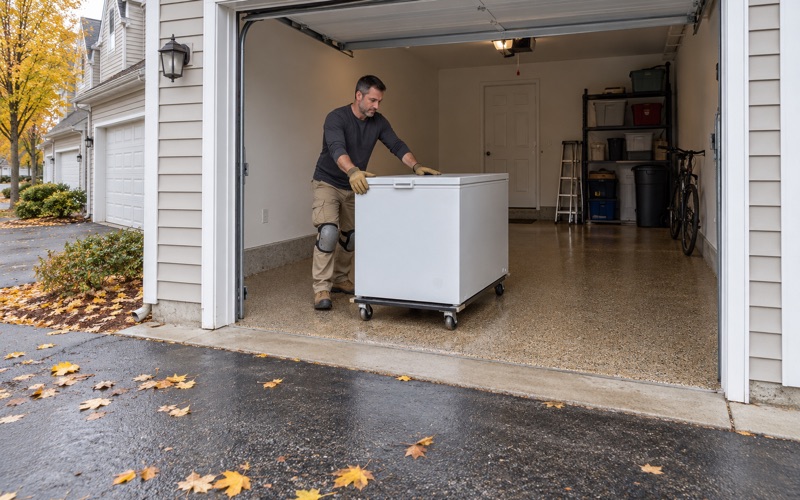
A residential garage system is built for a different fight. A good one combines a 100% solids epoxy base, a vinyl flake broadcast and a polyaspartic or polyurea topcoat, and together they handle hot tire pickup, calcium chloride brine and rock salt very well. Put the same system in a headworks and it is being asked to do a job it was never formulated for.
Thickness matters
A thin film has little material to give up. Where acid is generated on the surface day after day, any pinhole, scratch or thin spot becomes a path to the concrete behind it. Once the acid reaches the substrate, it can work under the film and lift it, and the coating that looked fine a year earlier starts to peel in sheets.
What H2S-rated systems look like
Floors and walls in sulfide exposure call for aggregate-filled epoxy mortar rated for hydrogen sulfide service, troweled thick rather than rolled thin. The aggregate adds body and impact resistance, and the build gives the system a margin of material between the acid and the concrete. Topcoats and joint details are chosen for the same chemistry, not for color or gloss.
Transitions are where a thin system usually gives up first. The edge where a floor meets a wall, the rim of a channel and the base of a pump pad all see splash, condensation and cleaning water at once. In sulfide service those details are built up and coved with the same mortar, so there is no weak line for the acid to find.
Surface prep becomes even more demanding in this setting. Corroded concrete has to be removed back to sound material, which is often a deeper ICRI CSP profile than a garage ever needs, and the repaired slab has to be dry enough to bond. Moisture testing with ASTM F2170 in-situ relative humidity probes or an ASTM F1869 calcium chloride test tells us whether the substrate is ready.
We say plainly when a coating is the wrong answer to a question. No floor coating should be marketed as protection against sewer gas, and we do not sell one that way. What an H2S-rated mortar does is resist the acid that forms on its surface, which is a narrower claim and an honest one.
What the Same Chemistry Means at Home
Most of our Pingree Grove calls are not about treatment plants. They come from owners of single-family homes and townhouses, and the village’s housing is overwhelmingly owner-occupied, with 3,584 of 3,637 occupied units held by owners. Still, a smaller version of the headworks problem sits inside a lot of homes, and it is worth understanding before choosing a coating for a utility room.
The ejector pit and the utility room
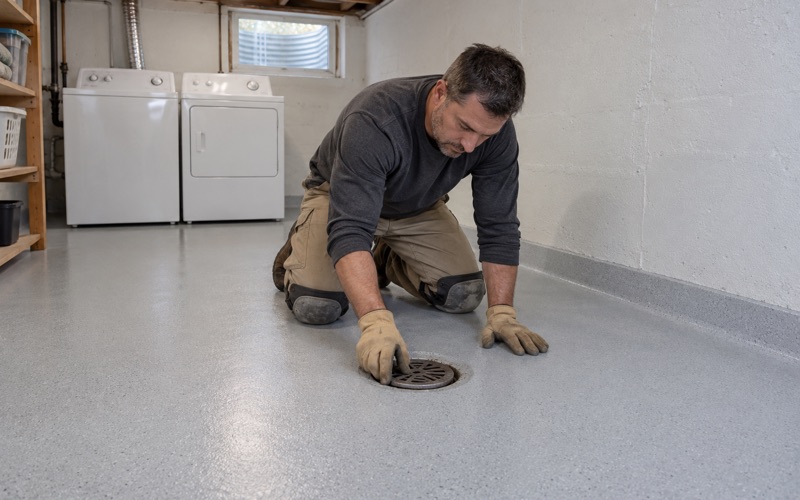
A sewage ejector pit lifts household wastewater from a basement up to the sewer line. The pit is sealed, but the concrete around it, the floor near a floor drain and the walls of a small utility room can stay damp, and damp concrete is where trouble starts. Where a sealed pit is opened for service, the surrounding slab sees the same kind of exposure on a very small scale.
For that floor, we usually recommend a heavier, fully bonded system with careful detailing at the pit rim and any drain, rather than a thin decorative coat. Sump pit and floor drain detailing matters more than the color chart. A coating is a film that follows the slab under it, so we read the cracks first and say when the concrete needs repair before anything goes down.
What a coating will not do
We never sell a floor coating as waterproofing, and we do not sell one as radon reduction. In Illinois, radon work takes a state license through IEMA, and water coming up through a slab is a drainage question first. An odor near an ejector pit is a plumbing question for a plumber, not a reason to buy a floor.
Testing before coating
Moisture testing is part of our scope on every basement and garage slab, not an upsell after a floor has blistered. We may start with an ASTM D4263 plastic sheet test and move to probes where the reading matters. Curing is scheduled against slab temperature and dew point, so an unheated space sometimes has to wait for warmer weather.
Paperwork in Pingree Grove
The Village of Pingree Grove is the building authority, with building permit fees set in Title 10, Chapter 4 of the Village Code. Illinois issues no state license for flooring or coatings work, so we confirm the village’s contractor registration, bond and insurance rules before scheduling. We also ask the permit desk whether a coating counts as decorating or needs a permit.
Every home job gets a written contract and the state’s Home Repair: Know Your Consumer Rights pamphlet before work begins, as the Illinois Home Repair and Remodeling Act requires. Warranty exclusions are read aloud before the job is sold, with moisture named first. The products we choose stay within the Illinois limit on VOC content, which binds us as installers and not just the manufacturer.
- 20+ Years Coating Concrete
- Moisture Testing in Every Scope
- Written Contract on Every Home Job