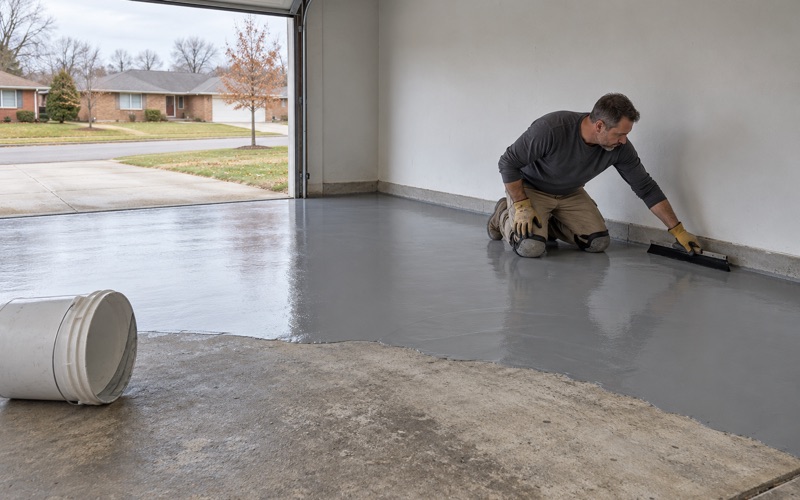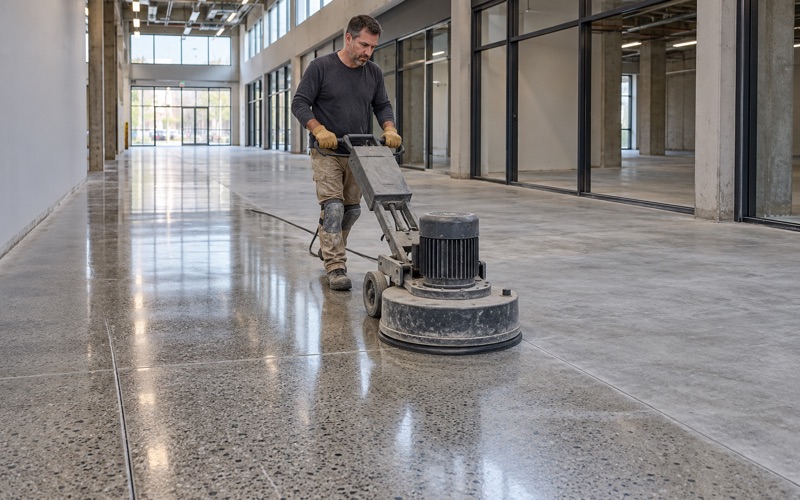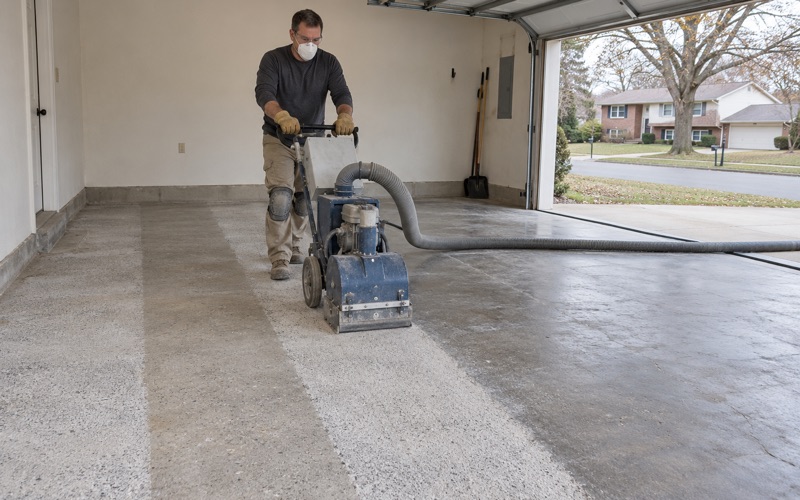
Hoffman Estates Epoxy Flooring has spent more than 20 years on epoxy-flooring in Northlake shops, garages and basements, and the work always starts with the slab rather than the coating. Before anything is applied, we open the concrete with a diamond grinder or a shot blaster to a measured ICRI CSP profile. We do not acid etch, because an etched slab gives a coating far less to hold.
A written proposal from us names the product, the system build and the finished thickness, so you can check what was quoted against what went down. Moisture testing is a line item in that scope, on a garage slab and a shop slab alike, using ASTM F1869 calcium chloride kits or ASTM F2170 in-situ relative humidity probes. Warranty exclusions are read out before the job is sold, with moisture named first.
Industrial floors in Northlake raise questions that are specific to the process running on them. One of the clearest examples is a small-parts finishing shop, where the thing wearing down a coating is not a chemical spill or a forklift but loose grit rolling across the concrete.
A Deburring and Mechanical-Plating Shop on Lake Street
Dynaburr Chicago sits at 65 E. Lake Street, inside Northlake city limits on the Proviso Township side. The company says it was founded in the early 1970s as a Chicago-area deburring provider, and it now offers mechanical plating, mechanical galvanizing and metal deburring. Lake Street itself is half of the city’s name: Northlake takes it from North Avenue and Lake Street, which intersect on its west border.
Industry has been part of Northlake since Tri-State Tollway construction in the 1950s attracted it. Small-parts finishing is one of the less visible trades in that mix, and it puts a very particular kind of wear on a floor.
We have no connection to the shop and have not seen its floor, so nothing below describes how Dynaburr’s building is laid out or finished. What the company does publish is enough to frame the flooring question. Its deburring page says staff use a variety of media, including ceramic, stone and corncobs, to tumble small steel, stainless steel, spring steel, brass and powdered metal parts up to 1 lb.
What a Finishing Shop’s Floor Is Up Against
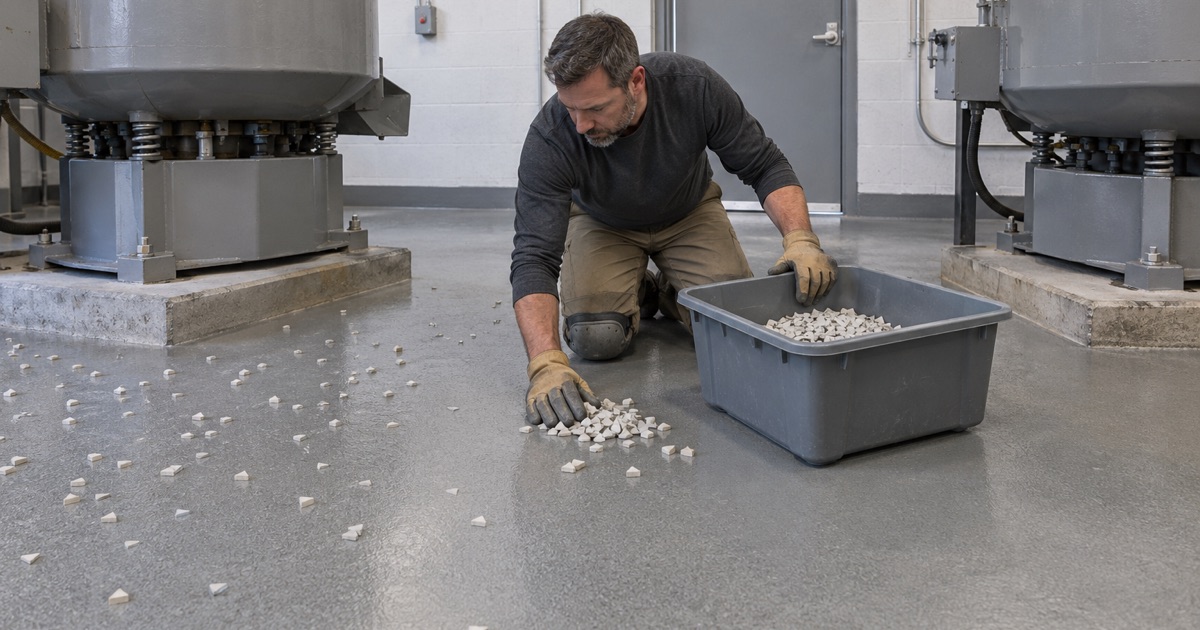
Tumbling media is made to wear things down. That is its whole job inside the barrel or bowl, where it knocks burrs and sharp edges off parts. The same property makes it a problem once it leaves the machine, because a ceramic or stone chip on the floor keeps doing what it was designed to do, only now to the coating.
Media tends to spill in a tumbling room: when a load is dumped and separated, when a machine is charged, when chips ride out in a parts tub or a boot tread. Nobody has documented how much reaches the floor in this particular shop, and we are not claiming to know. The point is that the floor in a room like this should be specified on the assumption that it will see abrasive chips every shift.
Corncob Is a Different Problem
Corncob media is softer and organic, used more for drying and light finishing than for cutting. It does not grind a floor the way a ceramic chip does, but it scatters easily, absorbs oil and coolant, and turns a smooth floor slick when it is crushed underfoot. A floor in a mixed-media room has to handle both the hard chip and the soft, greasy crumb.
Looking for epoxy-flooring closer to Franklin Park? See Epoxy-Flooring in Franklin Park.
Chips Underfoot and Under Cart Wheels
A loose ceramic chip on bare concrete is a small grinding stone. Under a boot it skids and scratches; under a loaded cart wheel it gets pressed into the surface and dragged. Over months, that wears paths into an unprotected slab, and the dust it raises settles back onto parts, machines and the next layer of spilled media.
Hardness and Build, Not a Thin Paint Film
A thin floor paint or a one-coat kit will not last long under that kind of traffic. For a tumbling room we would look at a 100% solids epoxy base built to a real thickness, often with quartz aggregate broadcast into it, and locked in with a hard topcoat. Polyaspartic and polyurea topcoats resist scratching well; where heat or heavy washing is also in play, urethane cement is the tougher option.
Some shops ask whether a lithium silicate densifier on polished concrete would do instead of a coating. A densified slab is harder than raw concrete and sheds less dust, but it still has pores and saw-cut edges, and it offers no wear layer to sacrifice. Where chips are ground in every shift, we would rather the coating take that wear than the slab itself.
Bond matters as much as hardness. A coating that is only lightly attached will chip at the edges where a cart wheel rolls a stone into it, and once an edge lifts, media works under it. That is why the slab is opened to a coarse enough surface profile for the build we specify, and why the profile is checked before the base coat goes down.
Footing Without a Chip Trap
Media on a smooth, glossy floor is a slip hazard, a little like walking on ball bearings. Texture helps footing, but the wrong texture makes the problem worse: a deep, open profile gives chips and crushed corncob places to lodge, and then the floor cannot be swept clean. The goal is a fine, even texture that grips a boot sole without catching media.
In practice that usually means a fine quartz broadcast fully encapsulated under the topcoat, or a fine slip-resistant additive mixed into it, rather than a coarse, unsealed aggregate. We can lay a test patch so the shop can try it with a broom and a cart before the full floor goes down.
A Floor You Can Sweep Media Off Of
Housekeeping in a tumbling room comes down to how fast loose media can be swept or vacuumed up and returned or discarded. A seamless coated floor helps in three ways. It has no open pores for fine grit to pack into, it shows spilled chips clearly against a solid color, and it lets a broom or a floor scrubber move across it without catching.
Even a hard topcoat dulls in a cart lane under steady grit. The advantage of a properly bonded system is that a worn lane can be abraded and recoated with a fresh topcoat, without grinding the whole floor back to concrete. We would rather plan that maintenance cycle up front than sell a floor as if media will never touch it.
Color That Shows the Spill
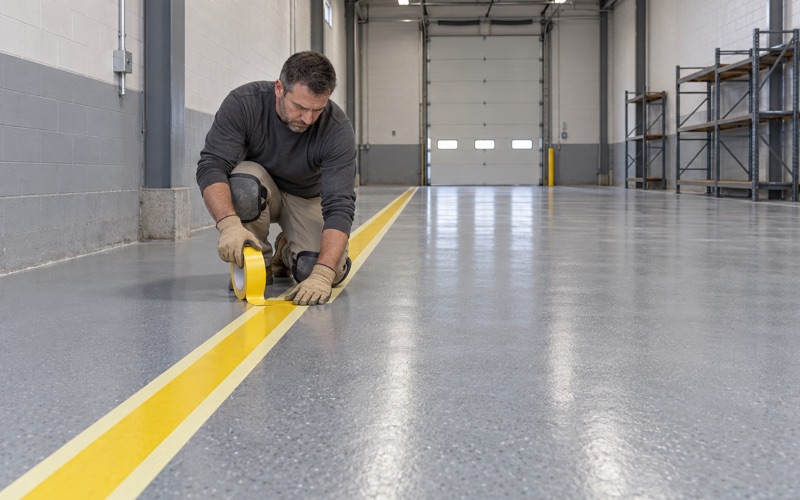
A busy vinyl flake broadcast hides dirt in a garage, which is exactly the wrong property here. In a room where the job is finding and picking up small gray or tan chips, a plain, light, contrasting color does more work than a decorative blend. Some shops also mark walk aisles and cart lanes in a second color so spills in traffic paths are obvious.
Edges, Saw Cuts and Machine Bases
Media collects where the floor meets something else: wall bases, machine pads, drains, and open saw cuts. A coved base where the floor turns up the wall leaves no corner for chips to hide in, and filled saw cuts stop media from packing into the slab’s own grooves. Around machine bases, the coating should run tight to the anchor points so spills can be swept out rather than dug out.
Cracks and Old Coatings First
Many existing shop slabs have been patched, painted or coated before. We read the cracks and any existing coating before quoting, because a new system laid over a failing one inherits its failure. Where a slab needs crack repair or old coating removed, that is named in the scope as its own step. A coating also follows the slab under it, so a moving crack can reappear through the new floor, and we say so before the job.
Descaling and Degreasing: The Wet Side of the Shop
Dynaburr’s site says it can descale or degrease parts before plating. We have not read what it uses for either step, and we are not describing its chemistry. What we can say is general: in any finishing shop, the area where parts are cleaned before plating is wetter and more chemically active than the tumbling floor, and it usually needs a different floor build.
Wash-Down, Drains and Containment
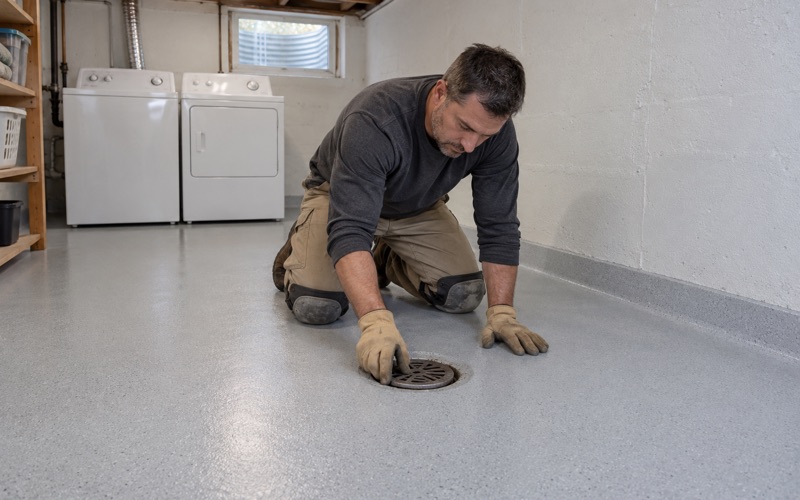
Where parts are washed, rinsed and moved wet, the floor sees standing water, cleaners and drips from racks and baskets. That calls for a seamless, non-absorbent system with coved edges, a floor drain the water can actually reach, and careful detailing where the coating meets the drain body. A chemical-resistant topcoat is chosen against the specific cleaners the shop uses, from the manufacturer’s resistance chart, not from a guess.
Wet areas also tend to be where hot water and steam cleaning happen, which is where urethane cement earns its place over standard epoxy. Its thermal shock tolerance lets it take a hot rinse on a cold slab without cracking or disbonding.
Moisture, Cure and Scheduling
A slab that is washed down every shift can carry more moisture than a dry shop floor, so the test results drive the primer choice. Where readings run high, a moisture-mitigation primer goes under the system. Curing is scheduled against slab temperature and the dew point spread at the surface, which matters on a slab near an overhead door in winter or in a damp wash bay.
Shops cannot always stop production for a full floor. We can phase the work, coating one area while the others keep running, and we schedule around the hours the building has to stay open. That sequencing is written into the proposal so everyone knows which zone is down and when.
Who Signs Off in Northlake
Illinois issues no state license for flooring or coatings work, so the local rules decide. The City of Northlake requires every contractor and subcontractor to register with a $100 annual license, a $10,000 bond and a certificate of insurance naming the city, and we confirm that before a job is scheduled. We also ask the Building Department whether a given coating job needs a permit.
Fire protection here comes from the Northlake Fire Protection District rather than a city department, so a fire-code question about a commercial floor goes to the district, not to City Hall. Stormwater and industrial discharge sit with the Metropolitan Water Reclamation District, which lists Dyna-Burr Chicago among its Significant Industrial Users.
- 20+ Years Coating Concrete
- Moisture Testing in Every Scope
- Written Contract on Every Home Job