Hoffman Estates Epoxy Flooring has spent more than 20 years on epoxy-flooring in North Aurora and beyond, and the floors that teach us the most are the ones judged by how they get cleaned. Some floors only have to look good on the day the crew leaves. Others collect something that must not be swept around, and the surface under that dust decides whether it comes up whole or settles into the concrete.
Our first visit is spent reading the slab. We look at the cracks and whatever old coating is still clinging to it, and we tell you plainly when the concrete needs repair before it can carry a new system. Moisture testing goes into the written scope as its own line item, never as an upsell offered after a floor has already blistered.
This page works through one demanding kind of floor in the village, an indoor firing range, and what federal cleaning rules say about the surface underneath it. The same reasoning applies to any shop, garage or utility room where fine debris lands and has to be removed without being pushed into open pores, cracks and joints.
A Police Range on Lincolnway, and Where the Lead Settles
The building and its range
The North Aurora Police Department works out of a headquarters at 200 S. Lincolnway, on the northwest corner of Route 31 and Airport Road. The address geocodes inside the village, in Aurora Township, Kane County.
Berglund Construction describes a 29,000-square-foot building finished in 12 months, with an evidence examination room, a detention cell, locker rooms, a community and training room and a separate 4,248-square-foot firing range. Wold Architects gives the building as 29,800 square feet, completed in 2010. The architect adds that a flexible-position firing range provides floor space for tactical training exercises.
We should be clear about what we know and what we do not. The department is a landmark on this page, not a client of ours, and we have not read anything about the range floor’s material, its ventilation or how it is cleaned. We use it because it is a real local room whose floor has to answer one of the strictest cleaning questions there is.
Why a range floor is a lead floor
NIOSH Alert 2009-136 warns that workers at indoor firing ranges may be exposed to hazardous concentrations of lead. The same alert calls for protecting the people who clean lead-contaminated surfaces and areas, which puts the floor squarely in the conversation.
Airborne particles do not stay airborne forever. Whatever a range produces eventually comes to rest, and the largest horizontal surface in the room is the floor. On bare concrete that dust can sit in the pores, slip into saw cuts and settle along the wall line, all places where a cleaning crew cannot easily reach it.
Looking for epoxy-flooring closer to River Forest? See Epoxy-Flooring Services in River Forest.
What OSHA’s Lead Rule Says About Cleaning a Floor
Surfaces kept as free as practicable
The federal lead standard for general industry, 29 CFR 1910.1025, carries a housekeeping section that reads like a floor specification. Paragraph (h) says all surfaces shall be maintained as free as practicable of accumulations of lead. That is a maintenance duty, and a floor that holds dust in its texture makes the duty harder to meet every single day.
Nothing in the rule names a coating, and we would never suggest it does. What the rule does is set the cleaning methods, and those methods only work well on certain kinds of surfaces. Read with a contractor’s eye, the paragraph describes a floor that releases what lands on it instead of storing it.
No compressed air, and the broom comes last
The standard says floors may not be cleaned by the use of compressed air. Blowing a floor clean would lift settled lead back into the air the crew is breathing, which defeats the whole purpose of cleaning. Anyone who has watched a garage floor get blown out with a hose from a compressor knows how far that dust travels.
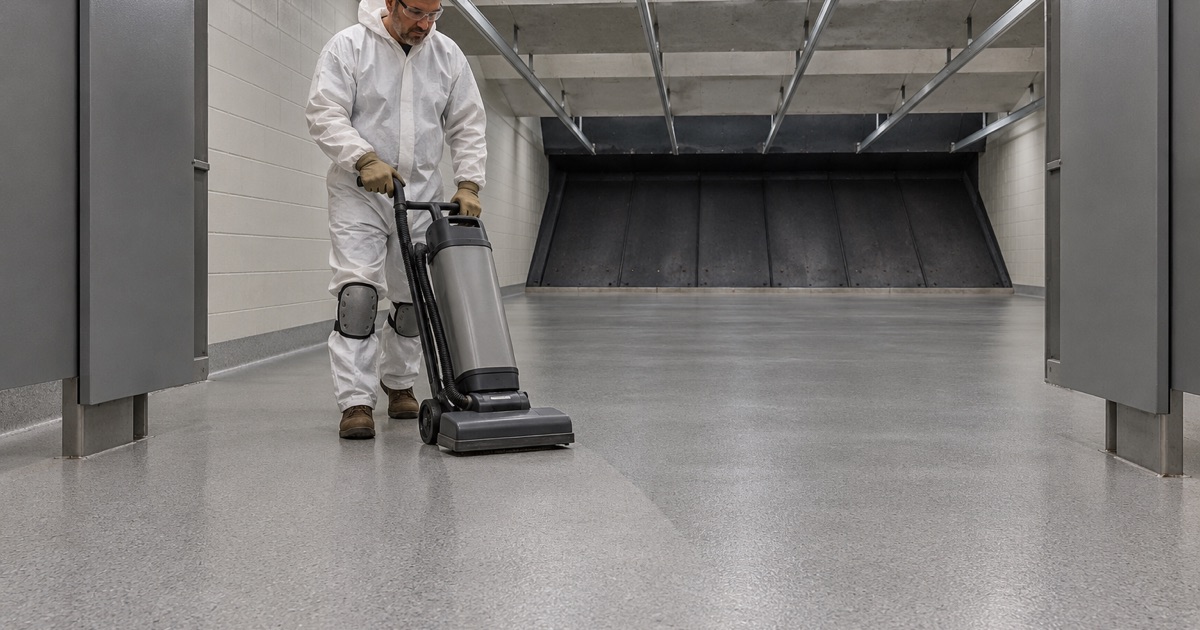
Sweeping gets a narrow lane too. The rule allows it only where vacuuming or other equally effective methods have been tried and found not to be effective. Vacuuming is the method the standard expects, and a vacuum is only as good as the surface under its nozzle.
What that asks of the concrete
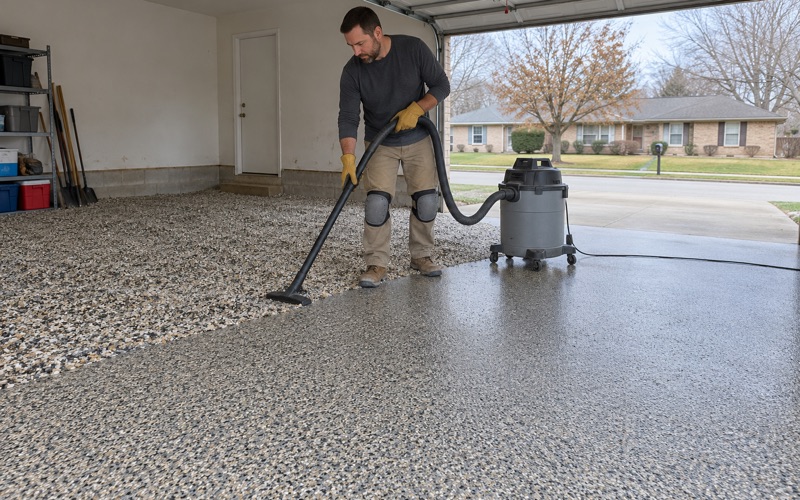
Open concrete is a poor partner for a vacuum. The pores, the broom texture from the original pour, hairline cracks and unfilled control joints all give fine dust a place to lodge below the reach of the airflow. A floor that is closed and continuous leaves the dust sitting on top, where it can be picked up.
That is the honest limit of what a coating does. It does not prevent exposure, remove lead or stand in for a proper cleaning program and the protections NIOSH describes. It changes the surface so the cleaning methods the rule requires have something smooth and sealed to work against.
The split of responsibility matters as well. The facility owner runs the cleaning program, sets the schedule and decides what protection the crew wears. Our part is narrower and physical: a floor without the cracks, pores and open joints that would make the vacuuming the rule calls for less effective than it should be.
Seamless, Sealed and Closed at Every Joint
Opening the slab before anything goes down
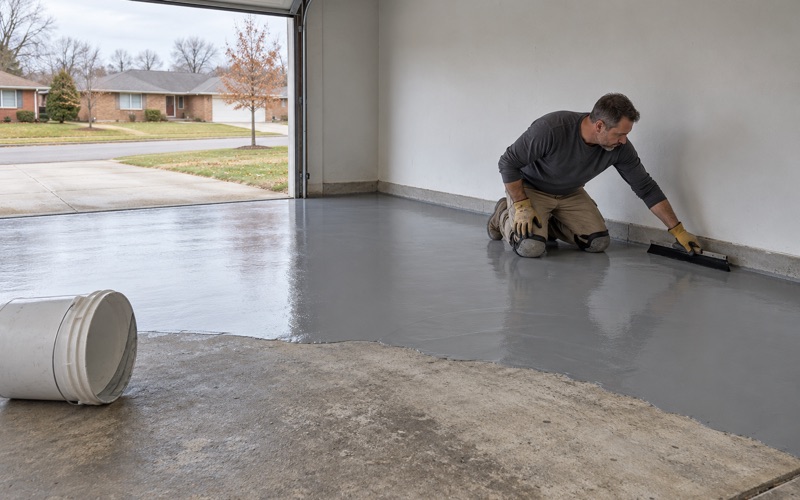
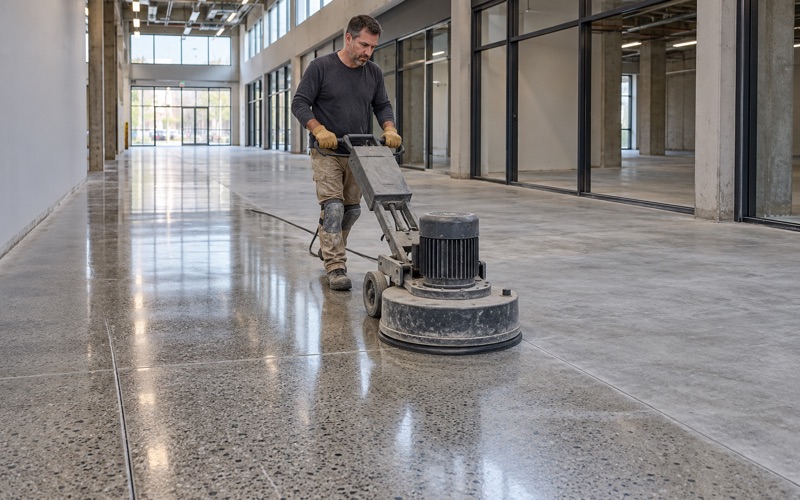
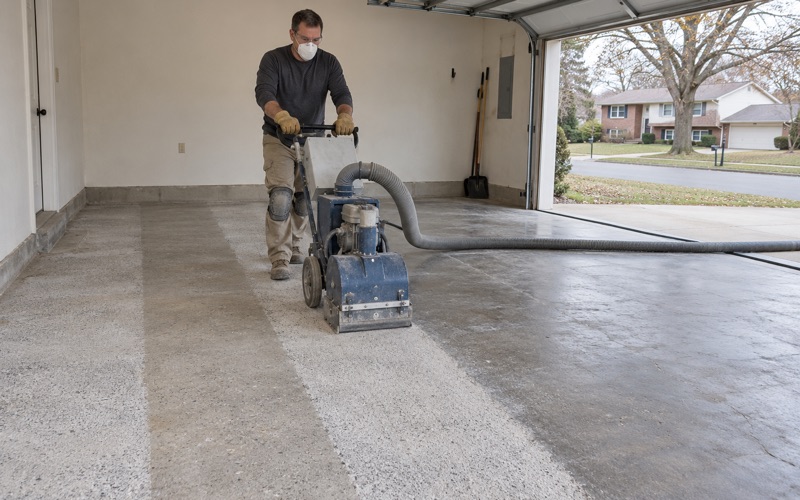
A closed surface starts with a bond that holds. Every slab we coat is opened mechanically with diamond grinding or shot blasting, and we do not acid etch. The goal is an ICRI CSP profile matched to the system, so the primer grips clean concrete instead of laitance, sealer residue or a weak top layer that would let the film peel.
We test before we coat. An ASTM F2170 in-situ relative humidity probe reads the moisture inside the slab, and an ASTM F1869 calcium chloride test measures vapor emission at the surface. Readings over the product’s limit call for more drying or a moisture-mitigation primer, because a blister or a lifted edge is exactly the kind of opening this floor cannot have.
An ASTM D4263 plastic sheet test sometimes comes first, as a quick look before the instruments go in. We tape a square of plastic to the slab, leave it in place and check the underside for condensation or darkened concrete. It is a screening step only, and the probe and calcium chloride numbers decide whether the floor goes ahead.
Joints, cracks and the wall line
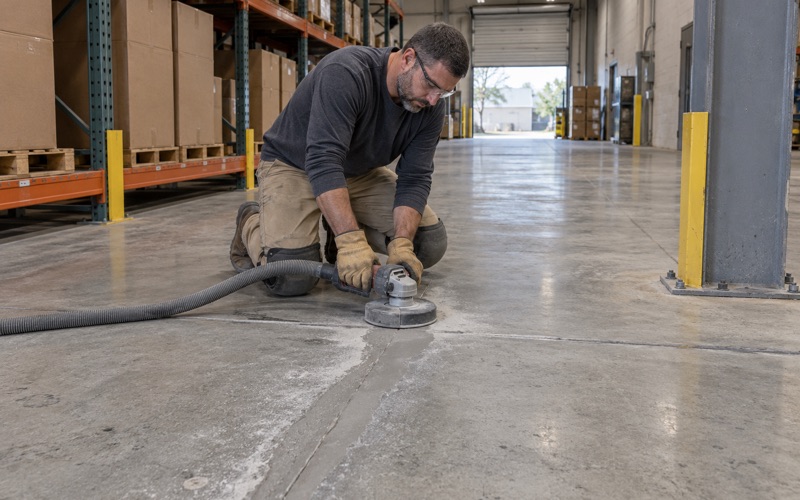
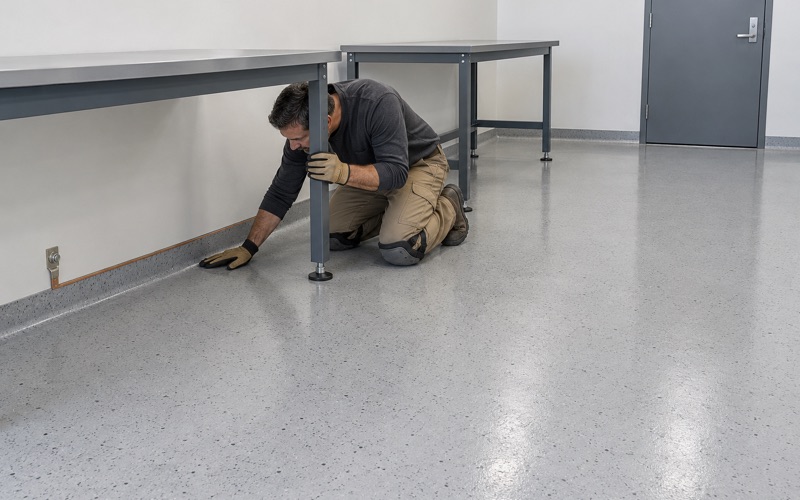
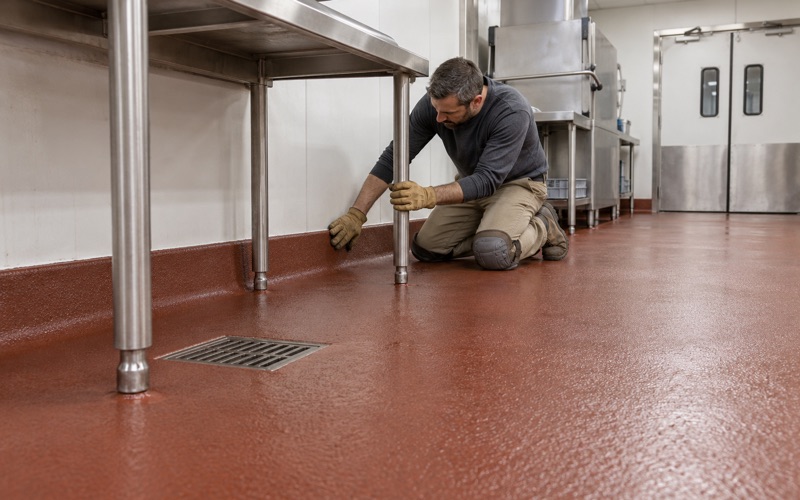
A seamless floor is only as seamless as its worst detail. We fill control joints and repair cracks before the base coat, and we carry the system cleanly to the wall line so there is no raw strip of concrete left at the perimeter. Those edges are where dust collects first and where a vacuum head is least effective.
We are also direct about movement. A coating is a film that follows the slab under it, so a crack that is still moving can reflect up through the system over time. When we see that kind of crack, we say so before the job, plan the repair around it and leave out any promise that the coating will hold the slab still.
A build you can check against the quote
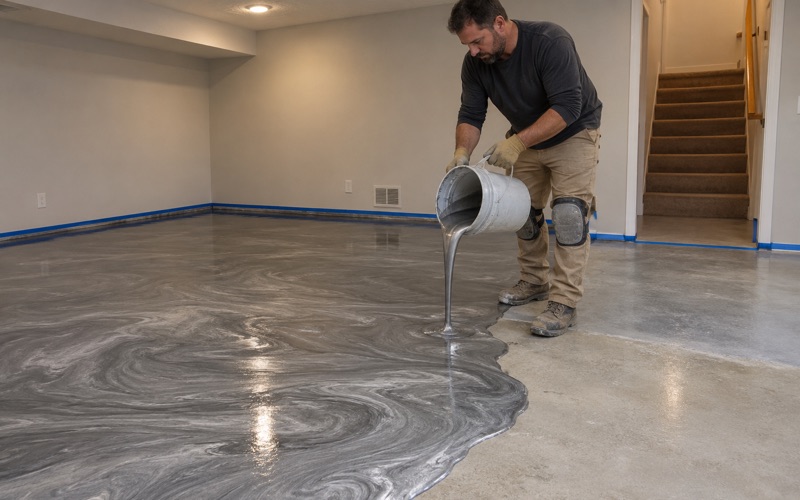
For a floor that has to be cleaned hard and often, we usually start with a 100% solids epoxy base and finish with a polyaspartic or polyurea topcoat chosen for chemical resistance. Products are selected within the Illinois limit on VOC content, which binds the installer as much as the maker. Our proposal names the product, the system build and the finished thickness, so the floor can be checked against what was quoted.
Floor Space for Prone, Kneeling and Tactical Training
Texture that still cleans
The architect’s phrase about floor space for tactical training points to a second demand. A training floor gets knelt on, lain on and moved across quickly, so it needs grip. The trouble is that grip and cleanability pull in opposite directions, because every peak of texture is also a place where dust can rest.
Our answer on a floor like that is a fine quartz aggregate broadcast locked in under the topcoat rather than a coarse, open texture. That gives traction underfoot and at the knee while leaving a surface a vacuum can still clear. We walk the owner through samples, since the right balance depends on how the room is used and how it is cleaned.
Some owners ask whether a ground and densified slab would do the same job for less. A lithium silicate densifier tightens the surface of polished concrete, but the control joints and any cracks are still open, and the concrete itself is still a porous material. Where dust has to come off completely, a continuous film closes those openings in a way densifying cannot.
Scheduling around a building that stays open
A public building rarely closes for a week so a floor can cure. We schedule commercial floors around the hours a facility has to keep running, overnight when necessary, and we set cure times against slab temperature and the dew point spread rather than a date on the calendar. Amine blush and a soft topcoat are what rushing a cure in a cold room buys.
What changes about the paperwork here
The village’s building and zoning page lists flooring among projects that do not need a permit, and it states that contractor registration is not required, apart from state roofing or plumbing licenses. Slab replacement, driveways, patios and structural work are on the permit list, so a coating that turns into concrete repair can change the answer. We confirm with the Building and Zoning Division before scheduling either way.
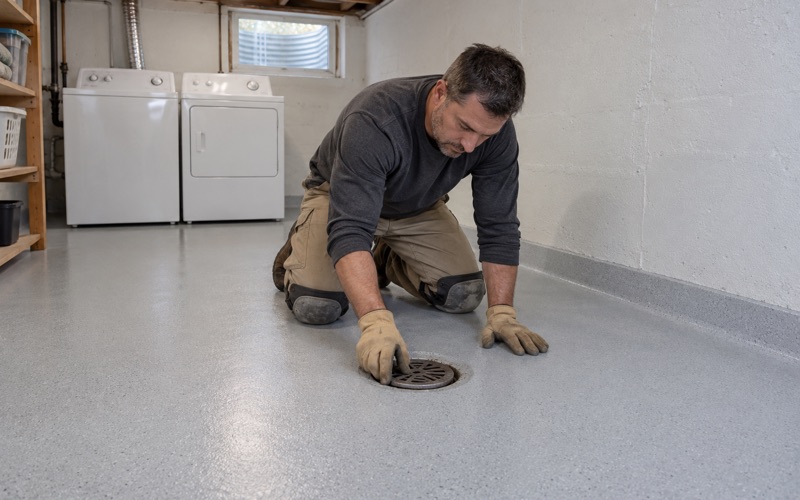
On a home job the same discipline applies to a garage or basement floor. Half of the homes in North Aurora were built in 2000 or later, and a garage slab poured to code may have no vapor retarder under it because the model code exempts garages. Every home job gets a written contract and the Home Repair: Know Your Consumer Rights pamphlet before work starts, as the Illinois Home Repair and Remodeling Act requires.
- 20+ Years Coating Concrete
- Moisture Testing in Every Scope
- Written Contract on Every Home Job