Hoffman Estates Epoxy Flooring has spent more than 20 years on epoxy flooring in Lake Zurich and the rest of the northwest suburbs, and the floors we think about hardest are the ones that get used by a crowd of people who do not own them. Volunteer rooms, parish halls and storage spaces take more wheels, more spills and more mopping than most garages ever will.
Those floors fail in a predictable way. A thin paint or an etched-and-rolled coating looks fine on day one, then wears through in the aisles, lifts where water sits, and turns glassy when someone mops it. A system that lasts starts with a slab opened by a diamond grinder or a shot blaster, never acid, and a moisture reading taken before any product is chosen.
We put that reasoning in writing. Every proposal names the product, the system build and the finished thickness, so a facilities committee or a homeowner can hold what was quoted against what went down. The rest of this page works through the floor type that best shows why those details matter here: a busy food pantry.
A Parish Food Pantry That Opens Every Thursday
Lake Zurich is a village in Lake County, in Ela Township, and one of its busiest rooms is not a shop or a warehouse. The St. Vincent de Paul food pantry, housed in the St. Francis de Sales Ministry Center at 135 S. Buesching Road, continues to provide food every Thursday, according to the parish bulletin. Its 2022 fiscal-year report counted 2,755 families served, drawn from Ela Township, greater Lake County and the northwest suburbs. That reach is a reminder that a village of under 20,000 people, named for the glacial lake that sits entirely inside its borders, can still host a room that works like a small distribution hub once a week.
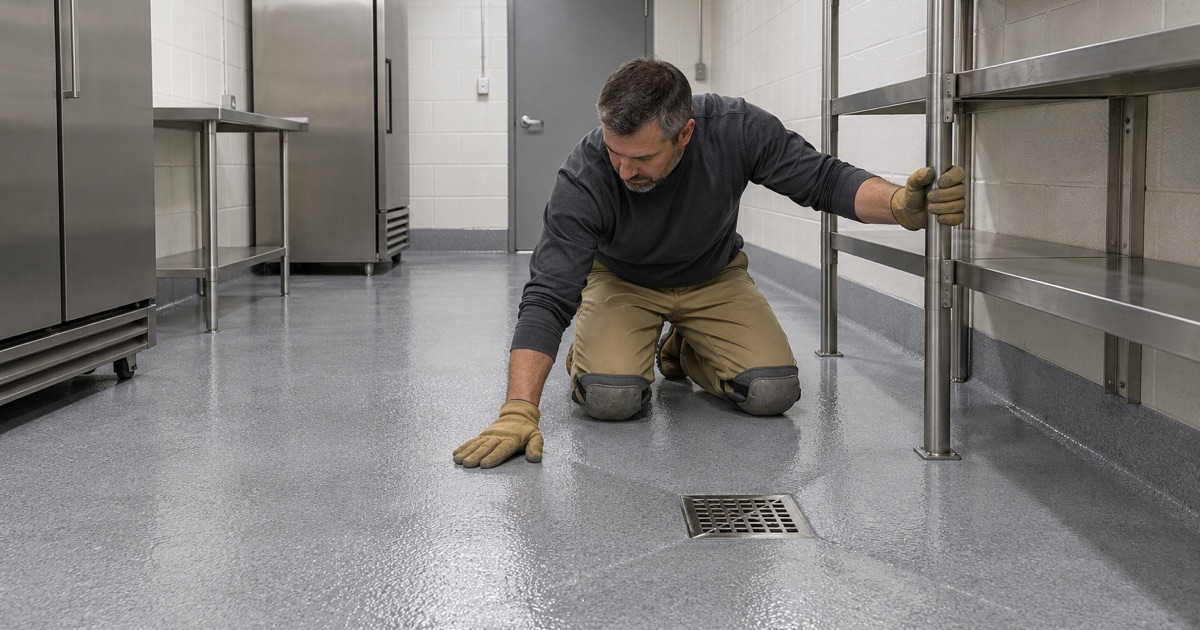
A 2010 profile described what that room holds: aisles of food, fully stocked refrigerators and stainless steel freezers, shelving for canned goods and produce coolers, with 25 to 40 volunteers typically working Thursday-night distribution. The pantry has operated since 1972. We have not worked there and have not seen its floor, but that list of fixtures describes a floor load we know well.
Why a pantry is a useful model
A pantry concentrates nearly every hard condition a floor coating faces into one modest room. It carries rolling loads in tight lanes, cold equipment that sweats, volunteers in ordinary street shoes rather than safety boots, and a full wet clean after every session. A floor that handles that combination will handle a church hall, a school storeroom or a busy home garage with room to spare.
Donations arrive all week
The parish bulletin notes that non-perishable donations are dropped off at the Ministry Center Monday through Friday. That matters for floor planning, because a room that receives boxes five days a week and distributes food on a sixth is rarely empty for long. Any coating plan for a space like it has to account for traffic on days that look quiet on the calendar.
Looking for epoxy-flooring closer to Wood Dale? See Wood Dale Epoxy-Flooring.
Aisles, Carts and Hand Trucks
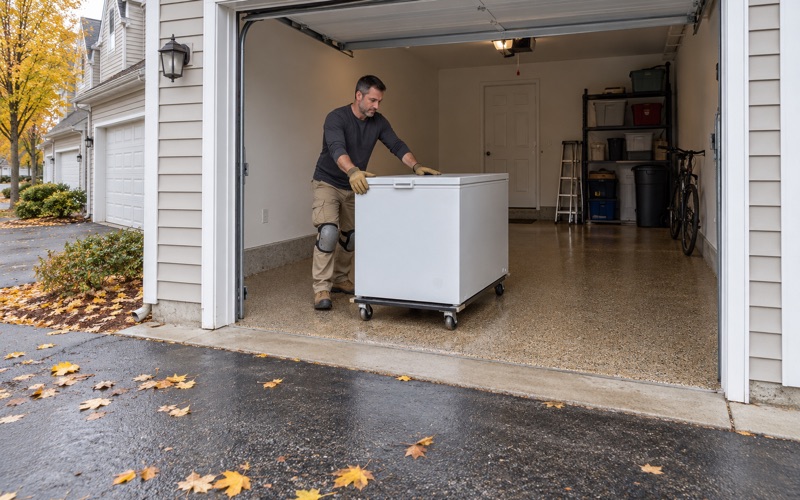
The heaviest wear on a pantry floor does not come from people. It comes from what they push. Loaded carts, hand trucks stacked with cases of canned goods and boxes of incoming donations all roll down narrow aisles, and in a narrow aisle every wheel follows the same line. A coating sees that wear concentrated into two stripes rather than spread across the whole room.
Building for wheel traffic
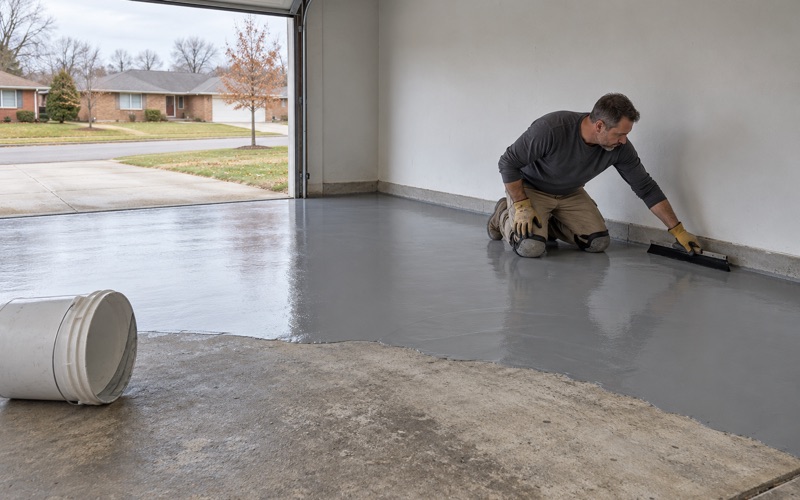
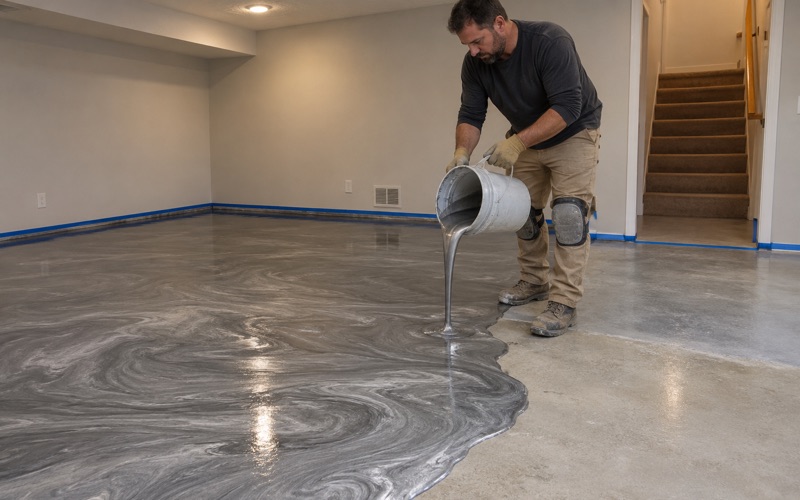
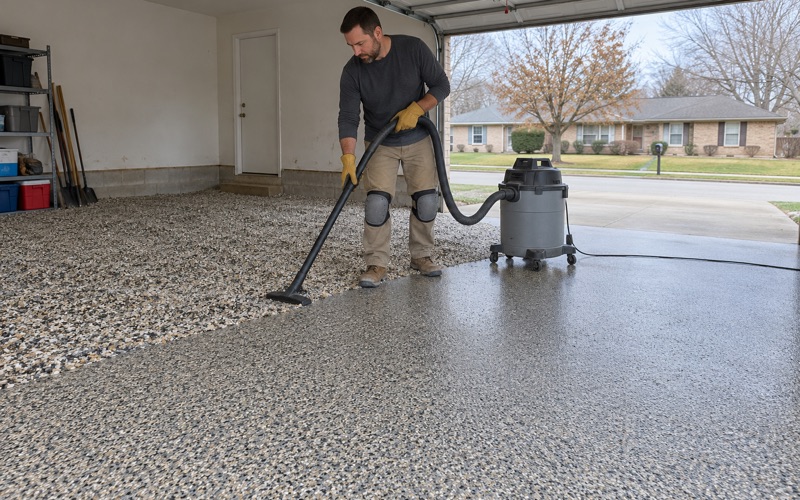
For rolling loads we favor a 100% solids epoxy base at a real build, not a single thin coat, topped with a polyaspartic or polyurea topcoat that resists scuffing and turning. A quartz aggregate broadcast between coats adds body and gives the surface a texture that survives repeated wheel passes better than a smooth gloss does. Vinyl flake broadcast is an option where appearance counts more.
Profile comes before product
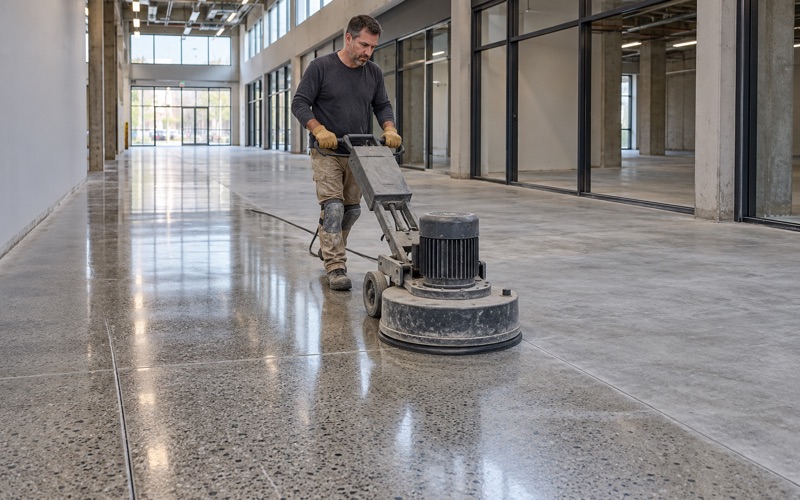
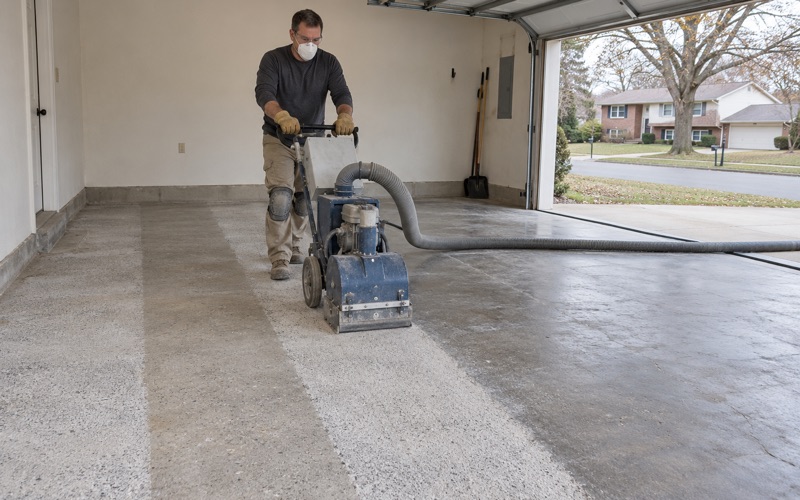
None of that bonds to a slab that has not been opened first. We grind or shot blast to a measured ICRI CSP profile so the primer has something to grip, and we do not acid etch, because an etched surface is shallow and uneven and leaves residue behind. Wheel traffic is exactly the stress that peels a coating off a poorly prepared slab.
Cracks, joints and old coatings
Before any number goes on a quote, we read the cracks and any existing coating. A cracked slab under a heavy cart route needs repair before it can be coated, and we say so plainly. A coating is a film that follows the concrete under it; it will not stop a moving crack, and we would rather explain that in advance than after a line telegraphs through the new floor.
Thresholds and transitions
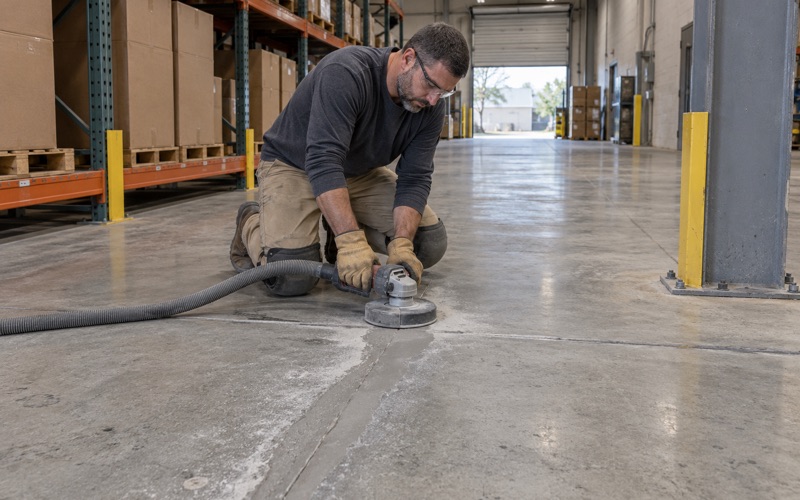
Carts also take a beating where the floor changes: at doorways, at the lip of an old tile patch, and at the edge where one coating ends and bare concrete begins. Those transitions chip first. We grind them flush, fill and feather low spots with a repair mortar before coating, and terminate the new system in a saw-cut key so a wheel has no exposed edge to catch and lift.
Refrigerators, Freezers and the Wet Spot in Front of Them
Refrigerators and freezers create a small wet zone that any pantry volunteer will recognize. Door openings let warm room air meet cold surfaces, condensation forms and drips, and the floor directly in front of each unit stays damp through a distribution night. Produce coolers add their own drips, and a dropped carton of something frozen thaws where it lands. That strip of floor works harder than the rest of the room.
Moisture from above and below
Water on top of a coating is a cleaning issue; water rising through the slab is a bond issue, and it is the one that causes blisters. That is why moisture testing is a line item in our scope rather than an add-on sold later. Depending on the slab, we use the ASTM D4263 plastic sheet test as a screen, ASTM F1869 calcium chloride emission testing, or ASTM F2170 in-situ relative humidity probes.
When the readings run high
If the numbers come back above the product’s limits, a moisture-mitigation primer goes down before the build coats, and the proposal says so. If they are far beyond what any primer can manage, we say that too. We never sell a floor coating as waterproofing, and warranty exclusions are read out before a job is signed, with moisture named first among them.
Where urethane cement fits
Where a room sees standing water, frequent washdowns or the temperature swing of a freezer door opening all night, a standard epoxy is not always the best answer. Urethane cement tolerates thermal cycling and damp conditions better, and it can be finished with a textured surface. We raise it when the readings and the use call for it, and we explain the cost difference in the proposal rather than quietly substituting.
Curing near cold equipment
Cold air around refrigeration can drag down the slab temperature and close the gap between the surface and the dew point. We schedule curing against slab temperature and dew point spread rather than a calendar date, because a coating cured too close to the dew point can develop amine blush, a greasy film that weakens the next coat and dulls the finish.
Mopped After Every Distribution, and Scheduled Around It
A pantry floor is cleaned after every session, often by whoever volunteered to stay late. The surface has to give up spilled juice, crushed produce and tracked-in slush to a single pass with a mop, and it has to stay walkable while it is still wet. Those two goals pull against each other, and the system has to be built to balance them.
Cleanability without slickness
A smooth high-gloss finish is the easiest to clean and the most likely to turn slippery under a wet mop. A fine grit or quartz texture in the topcoat gives grip, but too much texture holds dirt and shreds mop heads. We set the texture to the room, and we do not call any coating food-safe certified or slip-proof; texture lowers the risk, it does not remove it.
The cleaning routine matters as much as the texture. A neutral cleaner and a well-wrung mop keep a coated floor grippy for years, while harsh degreasers and soaking wet mops leave a film that defeats the texture underneath. We hand over plain care instructions at the end of every job, written for volunteers rather than for a maintenance crew.
Salt season at the door
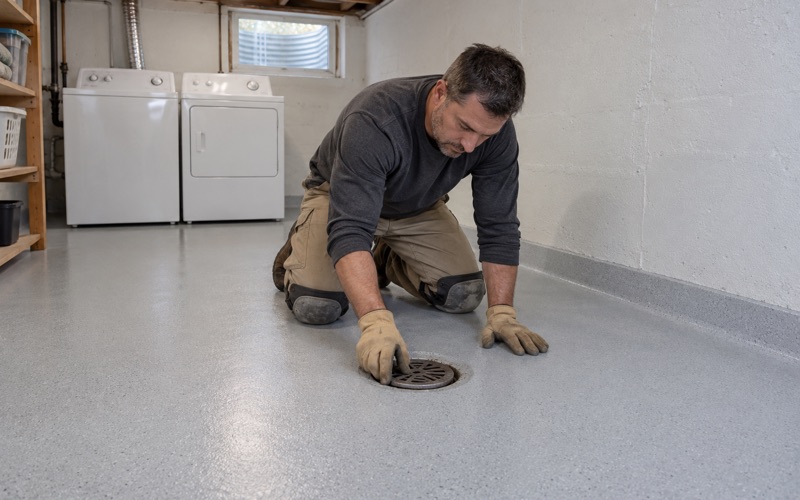
From late fall into spring, volunteers and donors walk in with calcium chloride brine and rock salt on their boots. That residue attacks weak coatings and leaves a white film near entrances. The same chemical-resistant topcoats we use on salted garage floors handle it here, and a coved edge where floor meets wall keeps brine and mop water out of the joint.
Working around a schedule that never fully stops
A ministry center with a Thursday distribution, weekday donation drop-off and other parish uses is never really closed. We plan floor work in stages around the hours a building has to stay open, including evenings and overnight windows, so one section cures while another stays in service. A polyaspartic topcoat can shorten the return-to-service time when the window is tight.
Permits and paperwork
Before a commercial job is scheduled, we ask the Village of Lake Zurich’s Building and Zoning Division, in the Community Services Department, whether the work counts as decorating or needs a permit, rather than assuming either answer. The permit desk quotes up to 15 business days for most applications, so that lead time is built into the schedule. Illinois issues no state flooring license, so we confirm the village’s own registration, bond and insurance requirements first.
Coatings that meet the state’s rules
We choose products within the Illinois limits on VOC content under 35 Ill. Adm. Code Part 223, which bind the installer as well as the manufacturer. On a home job in Lake Zurich, the same discipline applies to the paperwork: a written contract and the state’s consumer-rights pamphlet arrive before any work starts, as the Illinois Home Repair and Remodeling Act requires.
- 20+ Years Coating Concrete
- Moisture Testing in Every Scope
- Written Contract on Every Home Job