Hoffman Estates Epoxy Flooring brings more than 20 years of slab work to epoxy-flooring in Lake Forest, and on a building that mixes athletes and spectators the first question we ask is not which color of flake. It is which floors should carry resin at all. Some rooms belong to rubber, and a contractor who coats every square foot is selling the wrong product to part of the building.
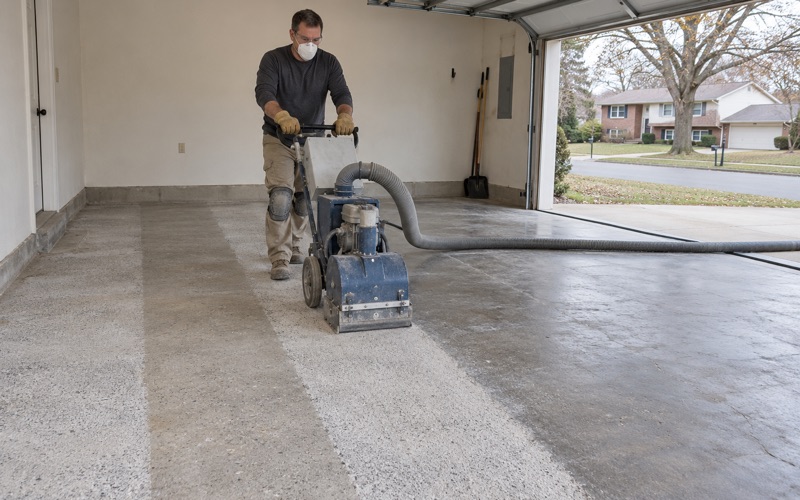
Where resin does belong, our method stays the same from a garage to a concession stand. We open the concrete with a diamond grinder or a shot blaster to a measured ICRI CSP profile, we never acid etch, and we test the slab for moisture as a quoted line item before a primer is mixed. The written proposal names the product, the system build and the finished thickness, so an owner can check what went down against what was sold.
We also read the cracks and any old coating before we price a job, and we say so plainly when a slab needs repair first. A coating is a film that follows the concrete beneath it. It will not stop a slab from moving, and we would rather say that at the walkthrough than after the first winter.
A 1950 Basketball Fieldhouse That Became a Hockey Rink
Lake Forest College’s Alumni Memorial Fieldhouse is the clearest local example of a building with two kinds of floor. It was dedicated at a basketball game in December 1950, and after the college opened its Sports Center in 1968 the fieldhouse was converted into the permanent home of Forester Hockey, a team that had played outdoors until then. Its listed address on Sheridan Road geocodes inside the city, in Shields Township.
According to the college’s athletics facilities page, the building today holds a hockey rink, seven locker rooms, a coaches office area, a concession stand, bleacher seating and rinkside standing room, with a capacity of 1,000. It also hosts Lake Forest High School hockey games. We have not worked there and have not seen its floors; we use it here because its room list maps every floor decision a rink owner faces.
Two traffic types under one roof
A rink building is split by footwear. On one side are players in skates moving between the locker rooms and the ice, and on the other are parents, students and staff in street shoes moving between the doors, the concession counter and the stands. Those two groups need different surfaces, and the boundary between them is the first thing we draw.
That line goes on the plan before any product is named. Get it wrong in one direction and a skate blade meets resin. Get it wrong in the other and a spill-heavy service floor ends up in rubber where a seamless, washable film would have served better, and neither mistake is cheap to undo once a season is underway.
The same split in smaller buildings
The pattern shows up wherever blades or spikes meet street shoes, from a private training room to a club’s equipment area. The principle does not change with the size of the building: rubber where a blade lands, resin where shoes, spills and wheels go, and a clean, deliberate edge between the two.
When an owner asks us to quote a building like this, we walk it with the floor plan in hand and mark each room by footwear before we talk products. The rubber areas go to a rubber installer, and our scope covers only the floors a coating can honestly serve.
Looking for epoxy-flooring closer to Round Lake? See Epoxy-Flooring Services in Round Lake.
Where Players Walk on Skates, and Why Resin Stops There
Epoxy, polyaspartic and polyurea are hard films. They are excellent under shoes, carts and tires, and they are the wrong surface for a skate blade. A blade concentrates a player’s weight on a thin steel edge, and that edge and a hard resin film damage each other, so we will not put a resin system anywhere a player is expected to walk on skates.
What the rubber manufacturers say
Blade-resistant rubber exists for exactly this traffic. One manufacturer describes its product as a surface designed for areas where athletes walk on skates and calls it ideal for rink perimeters, walkways and locker rooms. That is a manufacturer’s own statement rather than an independent test, but it points to the right category of material for that path.
A mat supplier makes a second point that matters to us as a coatings company: rubber around the ice also acts as a thermal barrier over the cold concrete surrounding the rink. That cold slab is a problem for resin as well, and we come back to it further down this page.
Locker rooms and the skate path
Locker rooms are where owners most often want one floor throughout. If players lace up there and walk out on blades, the skate path from bench to gate needs rubber, and resin belongs only in the spaces players cross in shoes, such as an office, a laundry or a storage room. We map those zones room by room rather than treating a locker room as one surface.
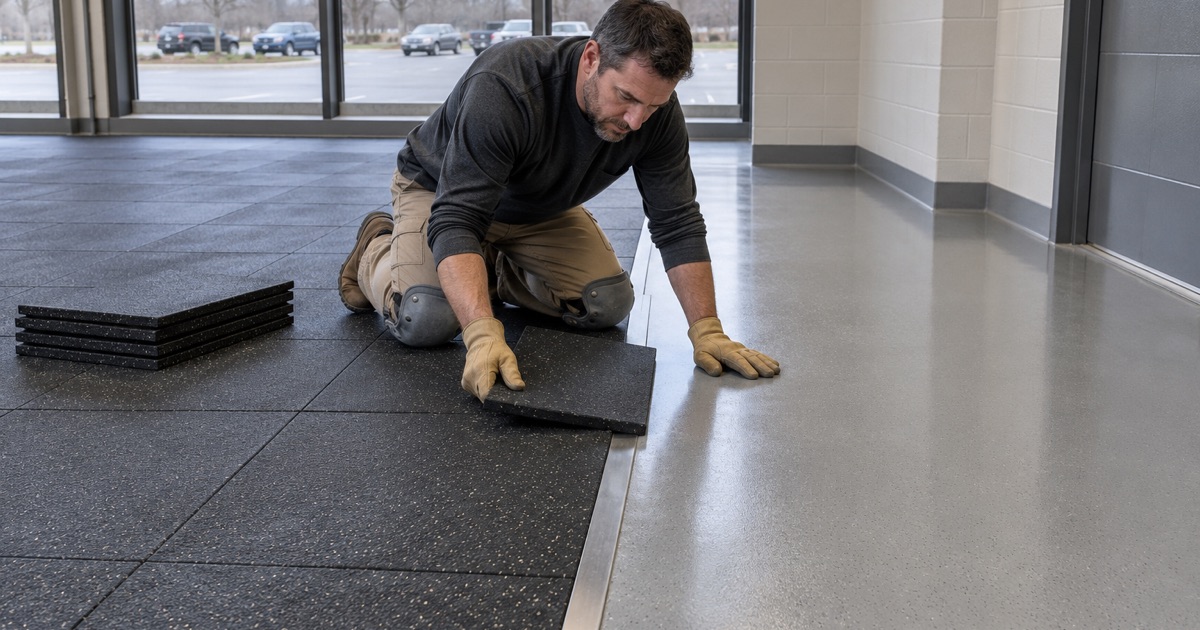
Where rubber and resin meet, the transition is a detail and not an afterthought. We stop the coating at a straight edge on ground, profiled concrete so the rubber installer has a clean line to butt against. We confirm the rubber’s thickness before we set that edge, so the seam stays flush and nobody catches a toe on it.
Lobby, Concession and Stands: The Shoe-Traffic Floors
Everything a spectator crosses in shoes is fair ground for a resin system. In a building rated for 1,000 people, that means a lobby, a concession stand, aisles and the spaces under and around the bleachers. All of it takes street grit, spilled drinks and whatever a winter boot carries in from the parking lot.
The concession floor
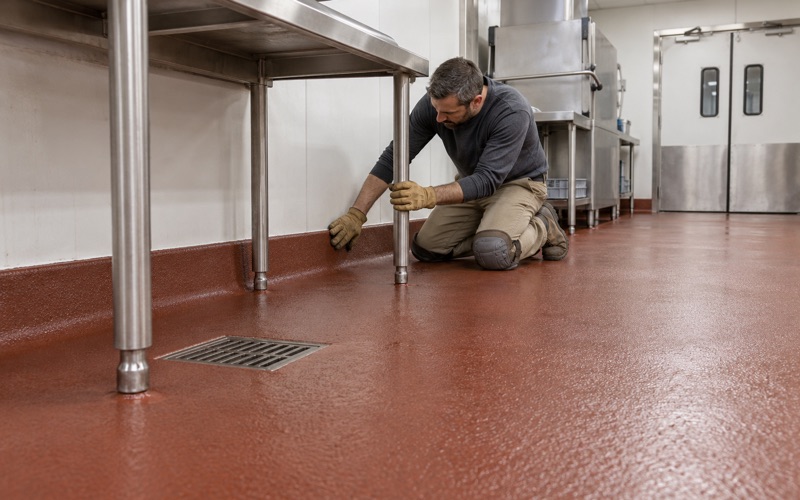
A concession stand is a food-service floor, and the Lake County Health Department handles food plan review for establishments in the county. We build these with a seamless resin or urethane cement system, coved where floor meets wall, with a broadcast aggregate sized for slip resistance on a floor that will be mopped constantly. The health department’s requirements govern the final call, so we confirm them before the job rather than after.
Stands, aisles and the lobby
Under the bleachers and along the standing rail, a quartz aggregate or vinyl flake broadcast hides scuffs and cleans with a squeegee. Boots bring calcium chloride brine and rock salt indoors all winter, and we choose topcoats that hold up to that residue instead of clouding over by February. At the entrance, slip resistance matters more than anything on the color chart.
Spectator floors in an older building often carry a previous coating or sealer. We grind it off or test its bond before deciding, because a new system laid over a failing film inherits every weakness underneath it. Whichever way that goes, the decision is written into the proposal.
Water, slush and the ice-resurfacing route
Next to the ice, water is constant. Snow scraped off the surface, slush carried on equipment and meltwater from the resurfacing machine all travel a route between the rink and wherever the machine is parked and emptied. In any rink building, that route is a wet, heavy-wheeled path, and it deserves its own specification.
For that route we lean toward a heavier build with aggregate broadcast for traction and a topcoat that tolerates standing water and cold. Drains along the path need careful detailing so water leaves the floor instead of sitting at the coating’s edge. Where the slab shows efflorescence or other signs of water moving through it, we test before we quote, because we never sell a coating as waterproofing.
Cold Concrete Beside the Ice, and What It Means for a Coating
A refrigerated rink keeps the concrete around it colder than the rest of the building, and cold concrete changes how resin behaves. Epoxy cures slowly below its rated temperature, and a film that cures too cold can develop amine blush, a greasy surface layer that weakens the bond of the next coat. A refrigerated rink also produces its own condensation on nearby surfaces, which is one more reason the slab has to be dry when we coat it.
Testing the slab, not trusting the calendar
We read slab temperature at the surface on the day, not the air temperature in the lobby, and we schedule each coat against that reading. Moisture testing uses whatever the slab calls for, from an ASTM F2170 in-situ relative humidity probe to an ASTM F1869 calcium chloride test, and the results go into the proposal. Where the numbers run high, a moisture-mitigation primer becomes part of the system build, named in writing.
Our warranty exclusions are read out before anything is signed, and moisture is the first one on the list. A cold, damp slab beside the ice is exactly where a coating fails when that conversation gets skipped.
Working around a game schedule
A rink cannot close for a week in the middle of a season. We plan arena work around the hours the building has to stay open, including overnight shifts and the windows between games, and we stage zones so a lobby or concession floor can reopen while another area cures. Every product is chosen within the Illinois limit on VOC content, a rule that binds the installer as well as the manufacturer.
Permits and paperwork in Lake Forest
Illinois issues no state license for flooring or coatings contractors, so we check local rules ourselves. In Lake Forest, building questions go to the City of Lake Forest Community Development Department, and before scheduling we ask that desk whether a coating needs a permit rather than guessing either way. On a home job, the homeowner receives a written contract and the state’s consumer-rights pamphlet before we start, as the Illinois Home Repair and Remodeling Act requires.
- 20+ Years Coating Concrete
- Moisture Testing in Every Scope
- Written Contract on Every Home Job