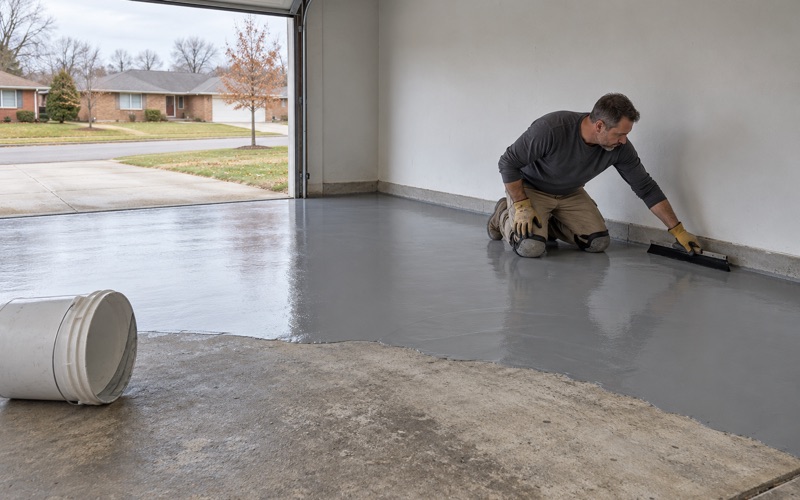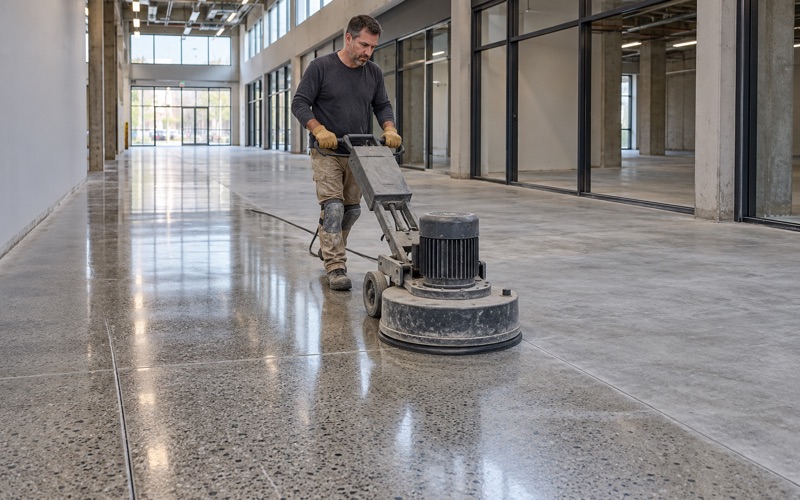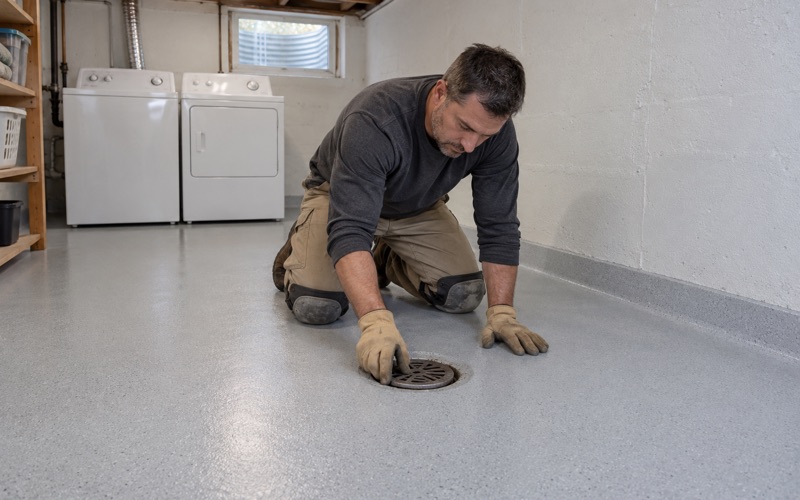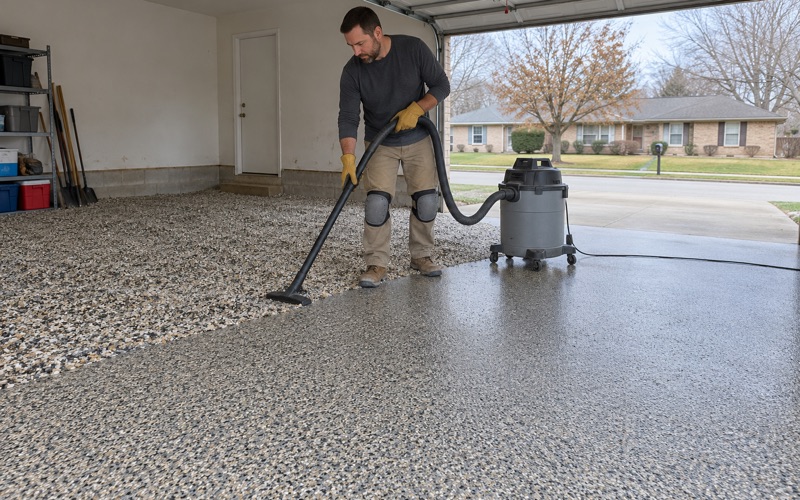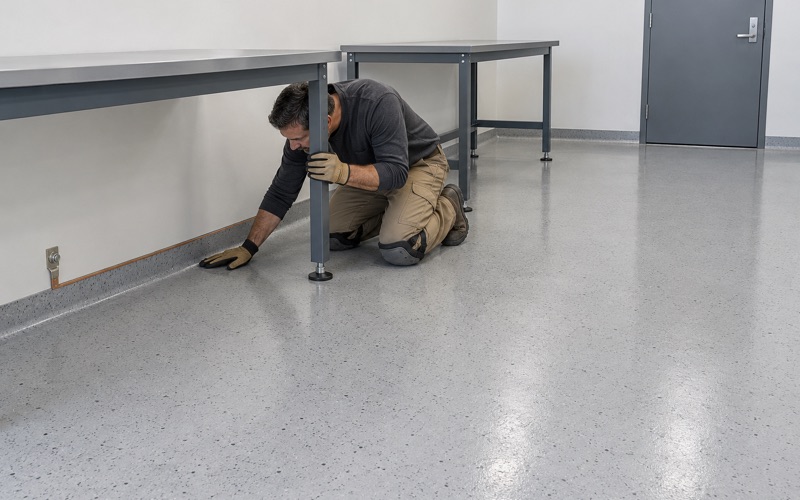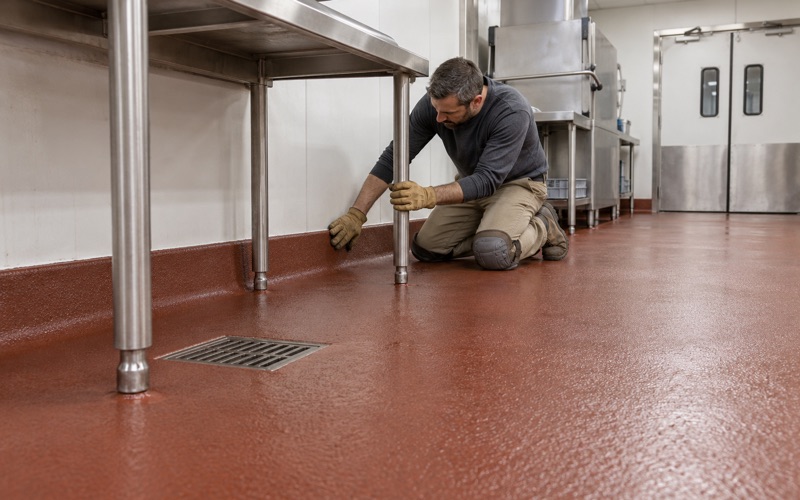
Hoffman Estates Epoxy Flooring brings more than 20 years of epoxy-flooring work to La Grange Park, and this page covers the hardest floor in an automotive service building: the below-grade pit a technician stands in. Coating a pit is not a garage coat lowered into a hole. It is confined, oil-soaked concrete sitting in the one place where fuel and solvent vapors settle, so the job is planned around air before anyone talks about color.
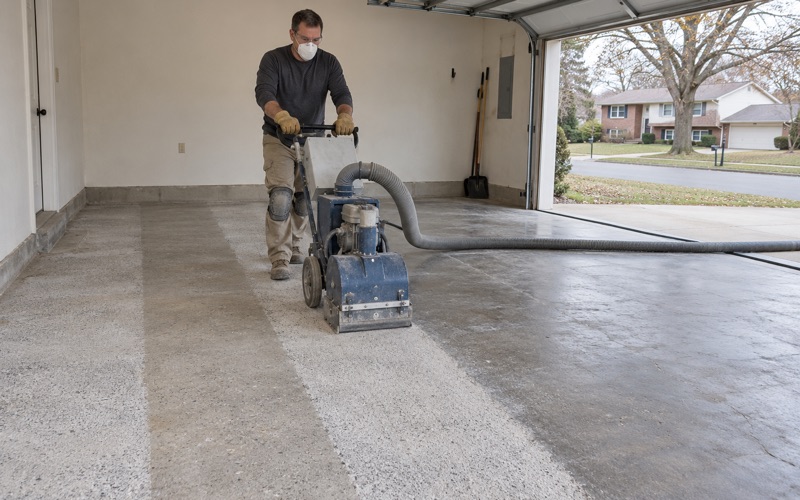
That changes the order of the work. Ventilation is set up first, the slab is degreased and bond-tested before a full batch is mixed, and the coating is chosen for low solvent content, because whatever a product releases while it cures stays down in the pit with the crew. We open every slab with a diamond grinder or shot blaster and never acid etch, and on a pit floor that mechanical profile is what lets the primer reach clean concrete instead of a film of old oil.
Our written proposal names the product, the system build and the finished thickness, so an owner or manager can check what went down against what was quoted. Before we price anything, we read the walls, the cracks and any old coating, and we say plainly when the concrete needs repair before it can be coated at all.
An oil change you stay in the car for, on La Grange Road
What the service format tells us
Jiffy Lube store 223 sits at 1119 N. La Grange Road, which the US Census Geocoder places inside La Grange Park village, in Proviso Township, Cook County. Its location page lists conventional, synthetic blend and full synthetic oil changes, filters, batteries and fleet services, and tells customers they may choose to stay in their car or relax in the lounge. We have never worked there, and we have not seen its bays.
A stay-in-car oil change is normally done from below, with a technician working under the vehicle from a below-grade pit while the driver sits in the bay above. The store’s page does not describe a pit, so we treat it as what the format implies rather than something we have read. What matters for anyone running or building a lube shop in this village is the type of floor that format calls for, not this particular address.
Why the pit, not the bay, is the hard floor
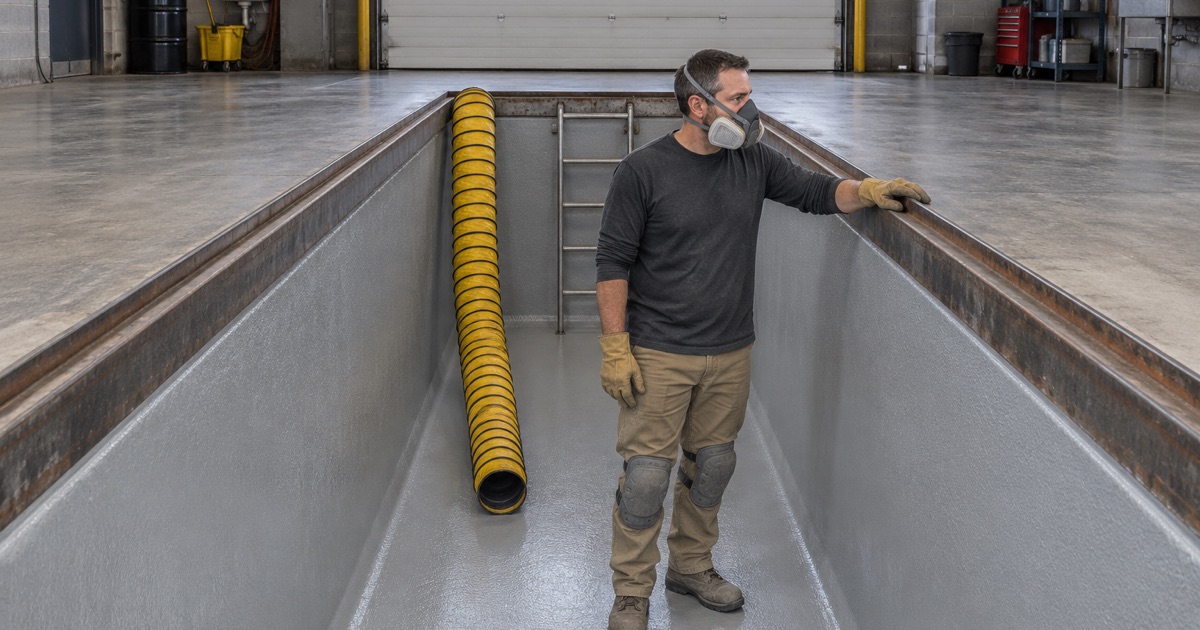
The bay floor upstairs takes tires, drips and a squeegee. The pit floor takes all of that plus a technician standing in one narrow strip for a full shift, oil and filter drips falling straight down, and cleanup done in a trench with very little room to work. One trade source describes oil changes as requiring employees “to immerse themselves into the depths of a dark, confined pit beneath the undercarriage of a car.”
The walls matter as much as the floor. Oil splashes onto them and gets wiped down them, and a coating that stops at the floor line leaves the corner where floor meets wall as the place fluid collects and works under the edge. We scope pit walls together with the floor rather than treating them as an afterthought, and we tell the owner which surfaces the quote covers.
The residential version of a low spot
Homeowners have a smaller version of the same problem. A home mechanic’s garage pit, or the pit around a basement sump or floor drain, is a confined low spot where vapor from fuel, solvents or a curing coating can gather. We plan air movement for those the same way, only at a smaller scale, and every home job gets a written contract and the Home Repair: Know Your Consumer Rights pamphlet before work starts, as the Illinois Home Repair and Remodeling Act requires.
Looking for epoxy-flooring closer to Lincolnwood? See Lincolnwood Epoxy-Flooring.
Vapors that sink: ventilation before the first coat
One trade source puts it bluntly: “Gasoline and most flammable-liquid vapors are heavier than air. They do not disperse upward and away. They sink and collect in the lowest available space, which in a service bay is the pit, exactly where the technician stands and breathes.” A coating crew working in that pit is standing in the same spot.
Classification is a general rule, not a verdict on any shop
Electrical-code summaries state that an unventilated lubrication or service pit is classified Class I, Division 1 up to floor level, and that a pit can be unclassified with at least four air changes per hour. We do not assign a classification to any shop; that call belongs to the owner, the electrician and the authority having jurisdiction. What the rule tells us as coaters is that air movement in a pit is a safety question, not a comfort one.
How we set up the air
Before the first coat, we confirm with the owner how the pit is ventilated and add supplemental air that draws from the bottom of the pit, where heavy vapors sit, rather than blowing across the top. Ignition sources stay out of the pit and the bay during mixing and application, and air readings are taken at the bottom of the pit throughout the coat, not only when the crew first climbs down. We treat the pit as confined-space work, with a crew member stationed at grade whenever someone is down below.
Timing is part of the same plan. The work is scheduled while the building is closed, so no engine runs overhead and no customer car pulls in during a coat. For a shop open Monday through Saturday, that usually means evenings and Sundays, and the cure time is built into the schedule before the job is booked rather than discovered on reopening day.
Oil in the concrete: cleaning and testing a pit floor
Degrease first, then open the slab
Concrete under years of oil changes is not just dirty on top. Oil wicks into the pores, and a grinder run over oil-soaked concrete can smear it around rather than remove it. We degrease first, rinse and let the slab dry, then grind or shot blast to an open profile measured against the ICRI CSP scale, and we degrease again if the fresh surface still darkens.
Drains, trench edges and any steel curb or rail at the top of the pit get the same attention. Old sealant around them is cut out, and the coating ends in a groove ground into sound concrete, so it has an edge to lock into rather than a feathered rim that oil can creep under and lift.
Bond testing before the full floor
An oil-soaked pit is where a test patch earns its cost. We coat a small area, let it cure and pull at it before committing the whole floor, because a primer that will not hold on a test patch will not hold across the pit either. Where oil keeps returning to the surface, we say so in writing and talk through repairing or replacing that section rather than coating over it and hoping.
Moisture is still a line item
A below-grade pit is a concrete box set into the soil, so it gets the same moisture testing as a basement slab. That starts with an ASTM D4263 plastic sheet test as a first read, followed by ASTM F1869 calcium chloride or ASTM F2170 in-situ relative humidity probes where the result decides the system. If the numbers call for it, the build starts with a moisture-mitigation primer.
Moisture is also the first exclusion we read out on the warranty, before the job is sold. A pit floor that tests wet today is not one we will promise stays bonded without that primer, and a coating is a film that follows the concrete under it. It will not stop a crack from moving, and we say so before the work rather than after.
Choosing a low-solvent system for a confined, below-grade space
Why solids content matters down in a pit
Every solvent a coating releases while it cures has to go somewhere, and in a pit the answer is down. That is why we lean on 100% solids epoxy for the build coats in enclosed spaces: there is very little solvent to evaporate, so far less vapor settles in the bottom. Every coating we use is also chosen within the Illinois limit on VOC content for architectural coatings, which binds the installer as well as the manufacturer.
Topcoats, texture and curing in still air
We check the solids content of a polyaspartic or polyurea topcoat as closely as the base, because some fast-cure topcoats carry more solvent than the coats beneath them. A quartz aggregate broadcast gives a technician’s boots grip on a floor that will always see some oil. On the pit walls, the same system goes on in thinner passes so it does not sag down the vertical face before it sets.
Pits are cool, still spaces, and the dew point spread at the slab surface can close quickly once work lights and bodies are down there. When it does, epoxy can develop amine blush, a greasy film that weakens the next coat’s bond. We schedule each coat against slab temperature and dew point rather than the clock, and we hold the next coat when the readings say to wait.
Who to ask before the work starts
La Grange Park is a non-home-rule village, and its building code services are contracted to an outside consultant rather than handled by an in-house plans examiner. We call Building & Inspectional Services at (708) 354-0225 to learn what a coating scope requires before we promise a schedule, and we confirm the village’s contractor registration, bond and insurance rules at the same time.
The same question applies at home. The village’s Residential Detached Garage packet says a permit is required to repair an existing garage, so we ask before treating a garage floor coating as decorating. For a shop owner, a mechanic with a home pit or a homeowner with a low basement drain, the answer shapes the timeline, and we would rather have it in hand before the first bag of aggregate is opened.
- 20+ Years Coating Concrete
- Moisture Testing in Every Scope
- Written Contract on Every Home Job