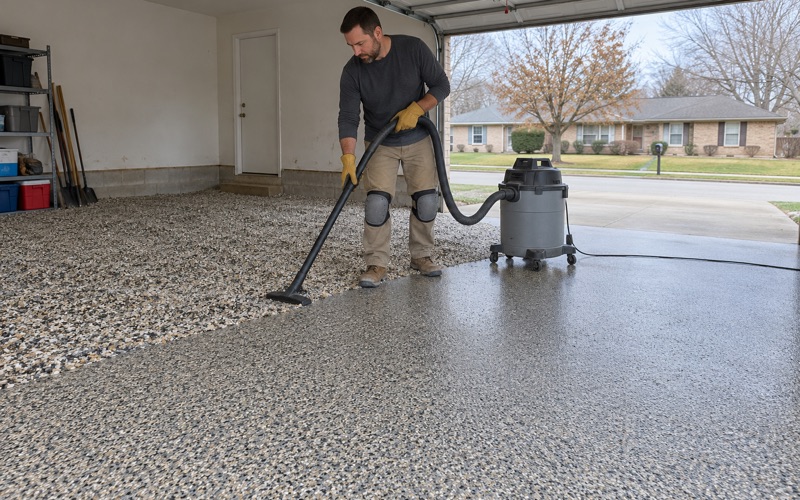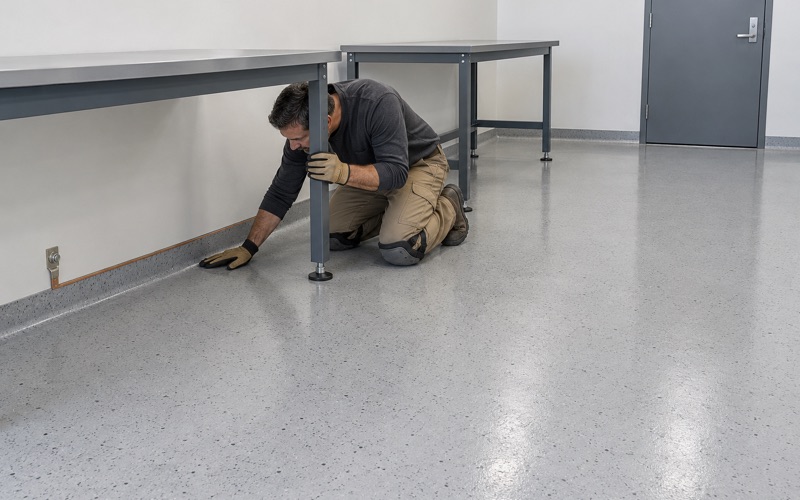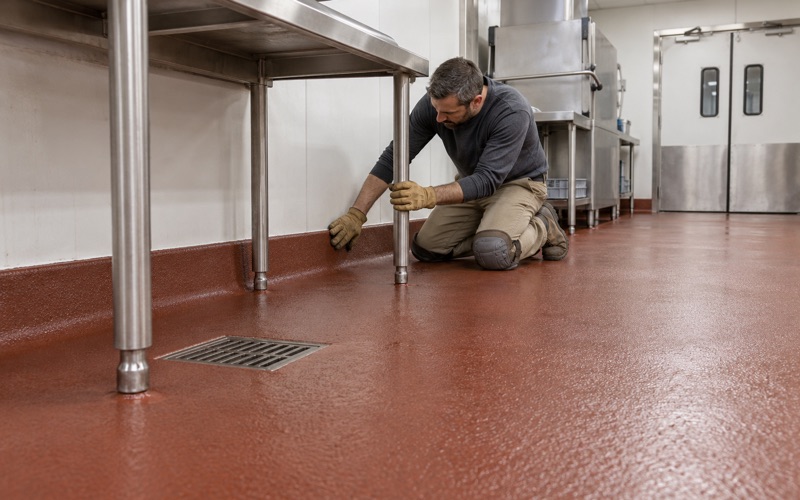
Hoffman Estates Epoxy Flooring brings more than 20 years of epoxy flooring in Hinsdale and the neighboring suburbs to rooms where the floor gets disinfected every day. Animal care rooms, grooming areas, home dog rooms and mudrooms all ask two things of a resin floor. It has to take strong cleaners without breaking down, and it has to stay smooth enough that the cleaner can actually reach everything it is meant to reach.
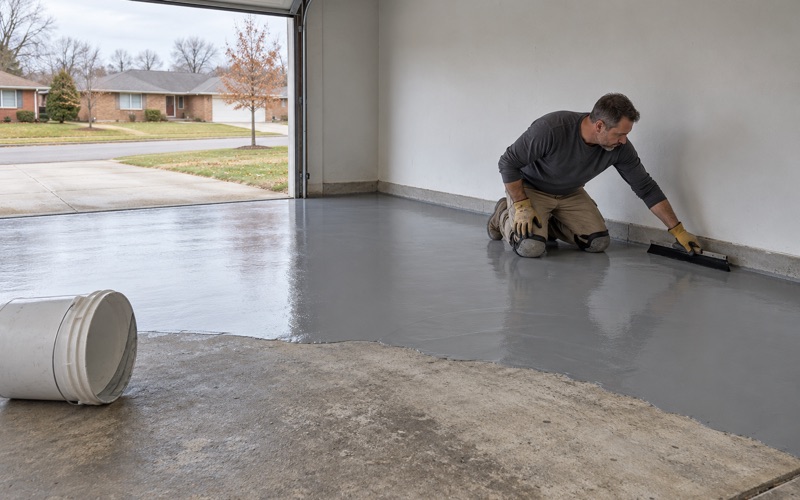
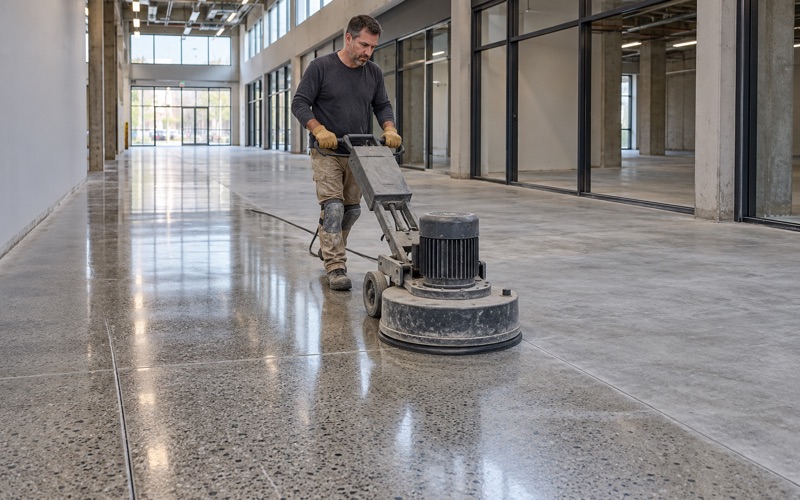
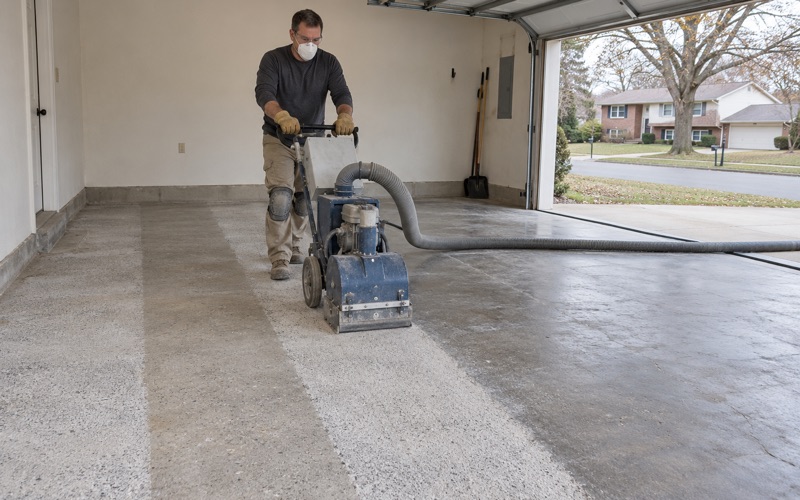
A floor coating does not disinfect anything, and we never sell one as if it did. What a well-built resin floor can do is give a disinfectant an unbroken, non-porous surface to work on, and keep giving it one after years of scrubbing. That starts with how the slab is opened: every job is prepared with a diamond grinder or a shot blaster, never an acid etch, so the resin bonds to sound concrete rather than a weak skin.
Our proposal names the product, the system build and the finished thickness in writing. On a floor whose whole job is to stay intact under daily chemistry, being able to check what was quoted against what went down is not a formality.
A shelter on Salt Creek Lane and the cleaners that stop parvovirus
Dogs, cats and critters at 21 Salt Creek Lane
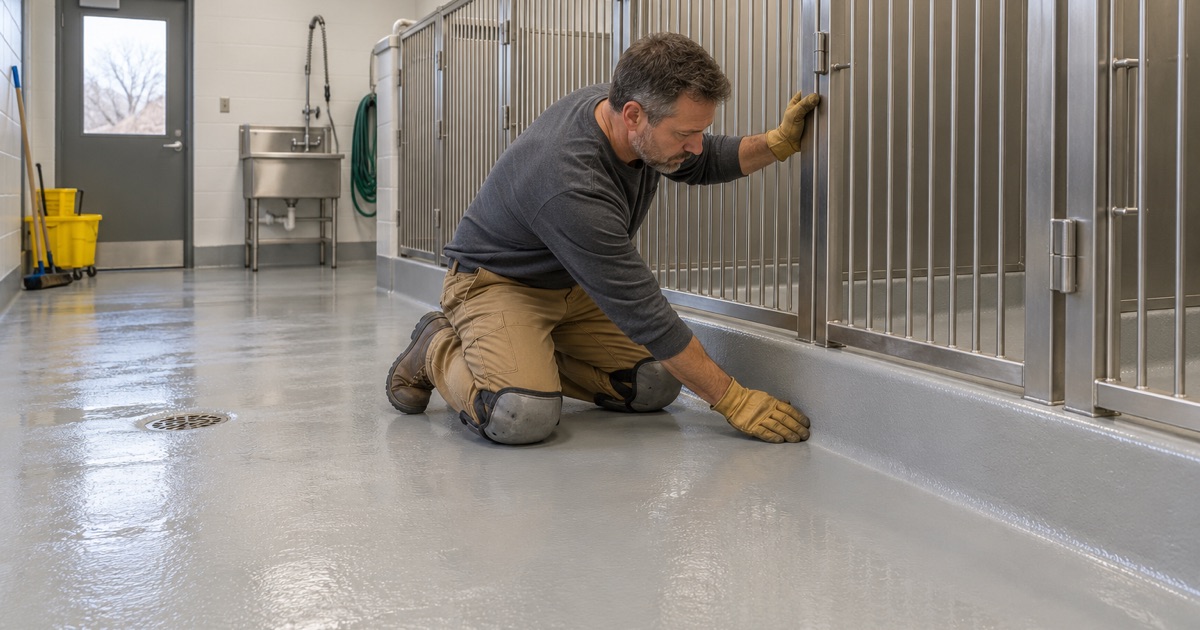
The Hinsdale Humane Society shelters dogs, cats and the small animals it lists for adoption as Critters at 21 Salt Creek Lane, an address that geocodes inside the village in York Township, DuPage County. Directory summaries describe the move there in fall 2018 from 22 North Elm Street, into a larger building named the Tuthill Family Pet Rescue and Resource Center. In the two years before January 2023 the shelter took in 400 strays from the 12 cities and villages it serves.
By its own count the society has rescued and placed more than 1,600 pets, and the current facility is described as a multi-million dollar building. That is a long way from 1958, when it built a new dog pound for $25,000. A shelter of that size moves a steady stream of animals through its rooms, and every turnover is another round of cleaning and disinfection.
The society’s website carries the line Saving Lives Since 1947, while The Hinsdalean dates the founding to 1953, when six Hinsdale women set out to replace a dog pound they found unacceptable. The two dates have not been reconciled. To be plain about it, we have never worked in that building and know nothing about its floors or its cleaning program; we raise it because shelter medicine has published unusually clear guidance on what a disinfected floor needs.
Non-enveloped viruses and why quats fall short
The Association of Shelter Veterinarians’ Guidelines for Standards of Care in Animal Shelters, second edition, published in 2022, say disinfectants used in animal areas must be effective against non-enveloped viruses such as parvovirus, panleukopenia and calicivirus. These viruses lack the fatty outer envelope that ordinary cleaners break apart easily, which is what makes them so persistent.
The same guidance notes that several studies found quaternary ammonium products do not eliminate non-enveloped viruses despite their label claims. Accelerated hydrogen peroxide, potassium peroxymonosulfate and bleach products are effective at the appropriate concentration and contact time. In other words, the products that do the job are oxidizers, and oxidizers are hard on finishes.
What oxidizers ask of a floor
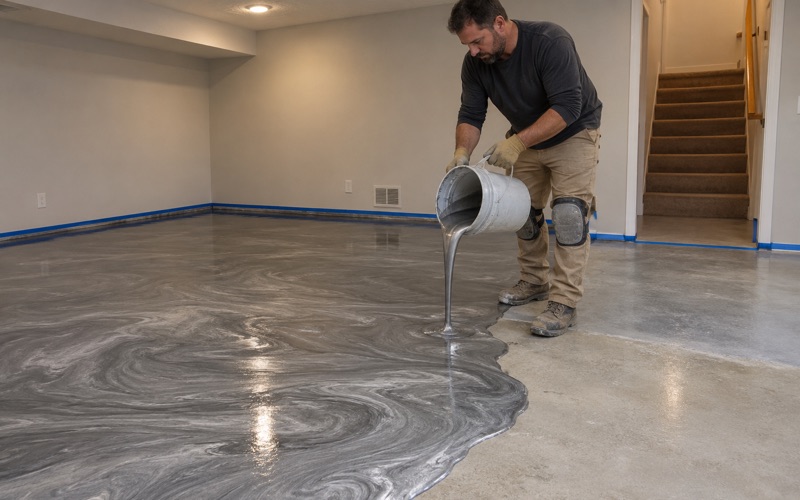
Contact time means the solution sits wet on the surface for minutes at a stretch, and in animal areas that happens every day. A floor in this service has to tolerate repeated wet exposure to bleach or peroxide chemistry without softening, chalking or wearing through in the lanes where cleaning is heaviest. Thin, low-solids coatings are the most likely to give out first, which is why we steer these rooms toward 100% solids epoxy built to a stated thickness, with a chemical-resistant topcoat or a urethane cement system where the exposure is heaviest.
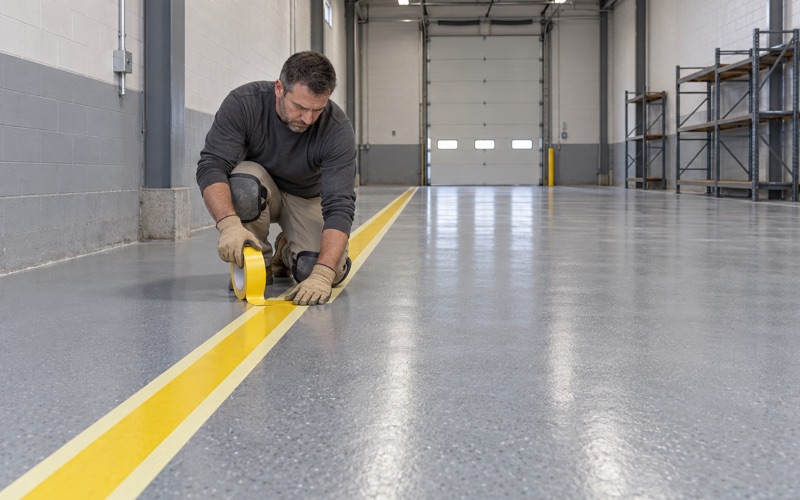
The edges matter as much as the field. Where a coating stops at a wall, a door threshold or a column base, the film is thinnest and the most likely to be undercut by cleaning solution that pools against it. We carry the system up the wall as a cove where the room calls for it, and we detail each termination so a mop and a squeegee meet resin rather than a raw concrete edge.
Looking for epoxy-flooring closer to La Grange Park? See Epoxy-Flooring Services in La Grange Park.
A scratch is a place a virus survives
Porosity defeats the disinfectant
The ASV guidance is blunt on this point: items with scratched, damaged and porous surfaces are difficult or impossible to completely disinfect. Summaries of the full guidelines go further and recommend a sealed, impermeable surface such as resinous epoxy or resinous urethane for shelter flooring. Bare concrete fails that test by nature, because a slab is full of capillary pores that hold liquid and whatever it carries.
That is the real case for coating a room that gets disinfected. The resin closes the pores so the cleaner sits on a continuous film instead of soaking into the slab. It only works for as long as the film stays continuous, so the floor has to be chosen for how it will be scratched, not just for how it looks on day one.
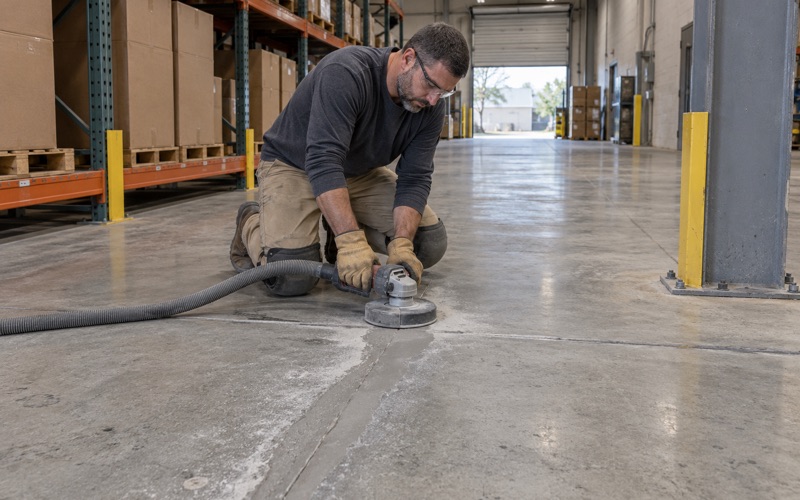
Bond is the other half of continuity. A coating that lets go at a chip or a crack edge leaves a ragged hole with bare concrete at the bottom, which is exactly the porous spot the guidance warns about. Grinding or shot blasting to a measured ICRI surface profile gives the primer something to grip, and it is why we refuse to shortcut preparation on a floor that will be scrubbed for years.
Where the scratches come from
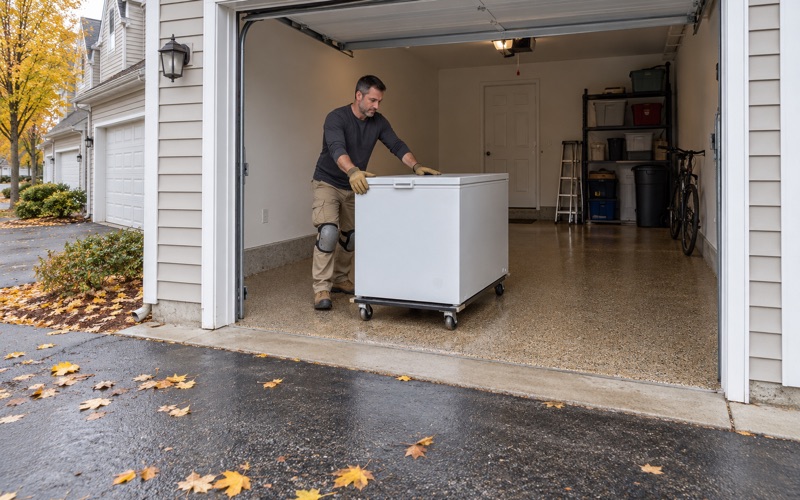
Grit tracked in on paws and shoes, crates and carts dragged across the room, metal feet on kennels and furniture, and the brushes and pads used for daily scrubbing all abrade a floor. A soft or thin topcoat collects fine scratches quickly, and every one becomes a groove a disinfectant has trouble reaching. Harder topcoats, including polyaspartic and polyurea formulations over an epoxy base, hold up better to that kind of wear.
Texture against cleanability
A quartz aggregate broadcast gives a wet floor real traction, which matters where people and animals move across freshly cleaned surfaces. The trade-off is more surface area for the cleaner to cover, so we lock the broadcast under enough topcoat to round off sharp peaks while keeping grip. We also read the cracks and any old coating before quoting, and we say so plainly when a slab needs repair first, since a coating laid over a damaged slab simply carries the damage up through the film.
Dry before the animals come back
Cure is scheduled, not guessed
Resin chemistry runs on temperature and humidity, so we schedule curing against slab temperature and the dew point spread at the slab surface rather than the calendar. Coating a slab that sits too close to its dew point invites amine blush, a waxy film that weakens the bond of the next coat and leaves a surface that cleans poorly. In an occupied building, room-by-room sequencing has to allow full cure before anything heavy or wet returns to the floor.
Daily turnaround after cleaning
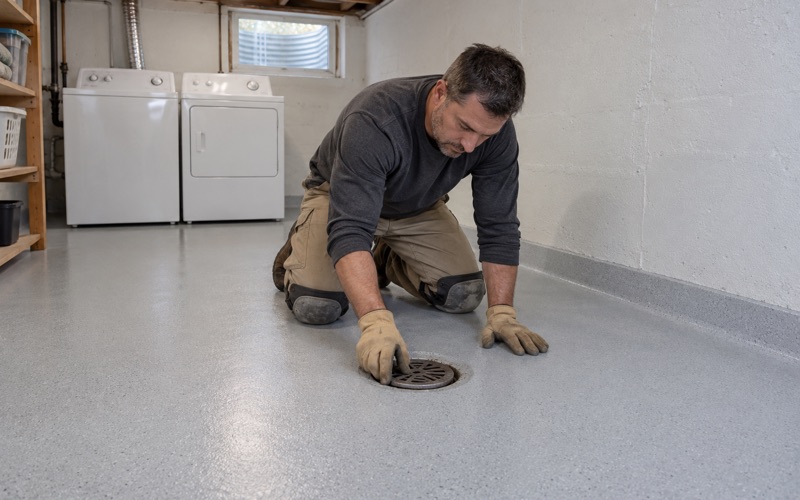
The ASV guidelines state that dry surfaces are required before animal use, and that standing water must be prevented with drainage or with squeegee and towel drying. A smooth, sound resin floor sheds water to a squeegee in a pass or two, while a worn or pitted one holds puddles in every low spot. Turnaround after cleaning is a feature of the floor as much as of the cleaning crew.
That is also why we set expectations about flatness before quoting. A coating is a film that follows the slab under it, so it will not level out a sag or stop a slab from moving, and a crack that opens under the floor will eventually telegraph through the resin. Where a low spot needs correcting, it is repaired and patched before the coating goes on, not hidden under a thicker coat.
Boots, not footbaths
The same guidance says footbaths must not be relied on, and that dedicated boots or shoe covers are used in isolation and surgery areas. For the floor, that makes a boot-change point a wet, high-traffic spot in its own right. We give those zones a slip-resistant texture and enough topcoat to survive constant foot traffic over a damp surface.
Choosing a resin floor that stays non-porous under daily oxidizers
Moisture comes before chemistry
The fastest way to lose a non-porous floor is moisture pushing up from beneath it, lifting the coating into blisters that crack and open. Moisture testing is a written line item in our scope, using ASTM F1869 calcium chloride emission testing, ASTM F2170 in-situ relative humidity probes or an ASTM D4263 plastic sheet test as the slab calls for. Where readings run high, a moisture-mitigation primer goes down before the build coats, and moisture is the first exclusion we read out when we go over the warranty.
The same floor at home
A dog room, a mudroom or a basement grooming area cleaned with diluted bleach faces the same chemistry on a smaller scale. The answer is the same: a mechanically profiled slab, a 100% solids base, a hard topcoat and a texture that drains to a squeegee. If the dog room is a converted garage bay, we test before coating rather than trusting the slab’s age, because the model residential code exempts garage slabs from the under-slab vapor retarder requirement and a newer pour can be just as damp as an older one.
Every home job gets a written contract and the Home Repair: Know Your Consumer Rights pamphlet before work starts, as the Illinois Home Repair and Remodeling Act requires. The proposal attached to it names the product, the system build and the finished thickness, so what was quoted can be checked against what went down.
Hinsdale paperwork and product limits
Before scheduling, we ask Village of Hinsdale Community Development whether a given coating job counts as decorating or needs a permit, rather than assuming either answer. Illinois issues no state license for flooring work, so we confirm the village’s own contractor registration, bond and insurance rules. The products we specify also fall within the Illinois limit on VOC content, which binds the installer as well as the manufacturer.
- 20+ Years Coating Concrete
- Moisture Testing in Every Scope
- Written Contract on Every Home Job