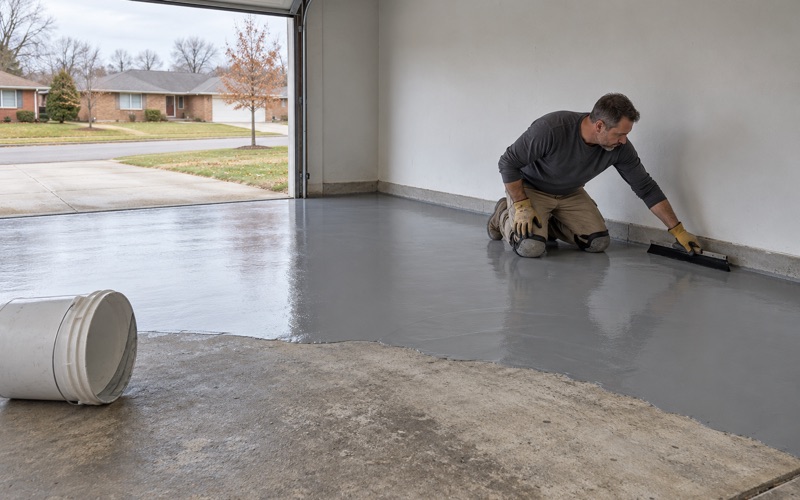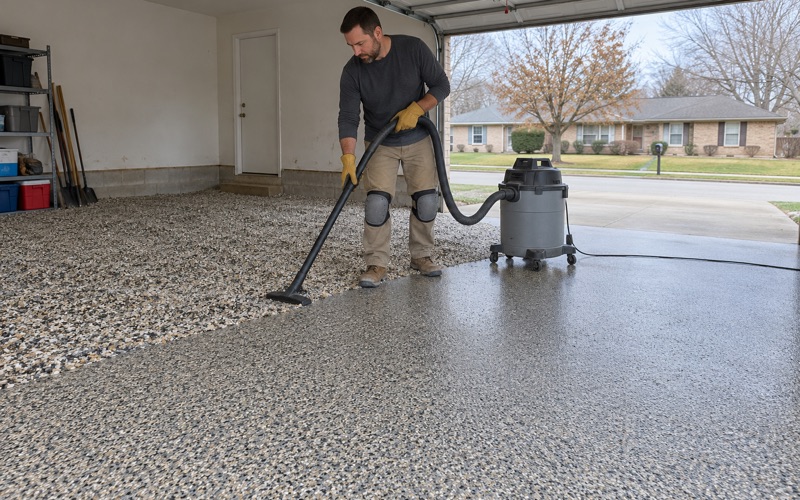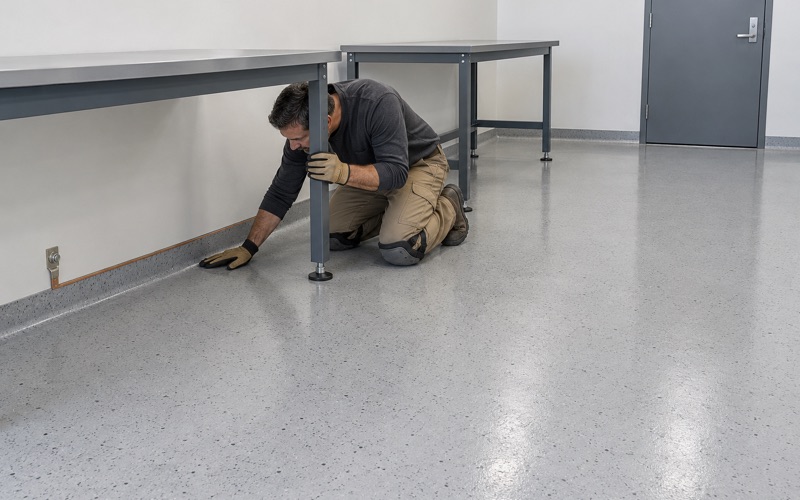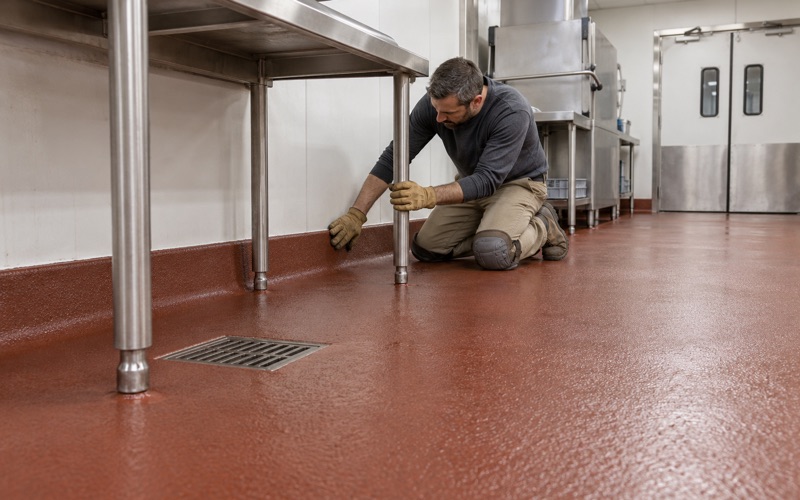
Hoffman Estates Epoxy Flooring has spent more than 20 years on epoxy-flooring in Forest Park, and the floors that teach us the most are the ones that never dry out. A wash bay is the clearest case: water, detergent and chemistry land on the same concrete from opening to closing, and the coating has to keep its grip while people walk across it.
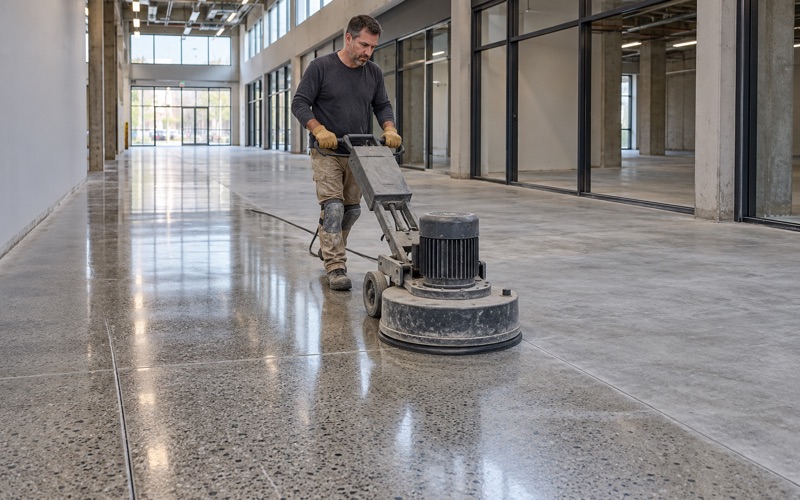
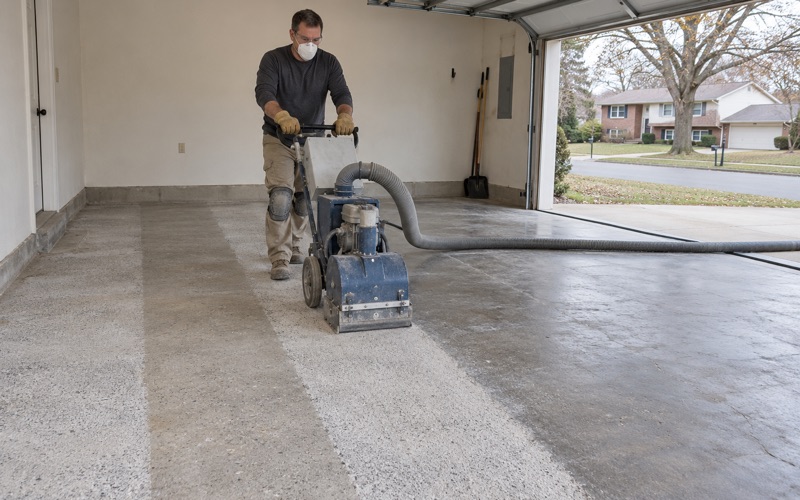
This page is about that kind of floor: commercial wash bays, self-serve and touchless, where the question is not color or flake pattern but chemical exposure under constant water, traction for the person holding the wand, and drain edges that are never allowed a day off. Before we quote one, we read its cracks and any old coating; on the job, the slab is opened with a diamond grinder or shot blaster, never acid etched.
The proposal you get names the product, the system build and the finished thickness, so an owner or manager can check what went down against what was quoted. Commercial work is scheduled around the hours a business has to stay open, which matters for a wash that serves customers every day of the week.
Ten wash bays on Roosevelt Road and Madison Street
Forest Park is a village in Cook County, in Proviso Township, and its car washes are a useful picture of the floor we are describing. Spotless Carwash lists two locations in the village, 7343 Roosevelt Road and 7802 Madison Street, and says it has operated since 1995. Each site publishes 2 touchless automatic bays and 3 self-serve bays, ten bays in all, and describes them as heated indoor bays.
Forest Park is also where the CTA Blue Line ends: the Forest Park terminal, on the Eisenhower Expressway at Des Plaines Avenue, is the line’s western terminus. Both wash sites sit on main streets of a village of 14,339 people at the 2020 census.
We have not worked at either site, and we have not seen their floors, drains or chemical labels. What the operator’s own published menu does tell us is what bays like these put on the concrete, and that is the useful part for anyone running a wash, a detail shop or a fleet wash bay of their own.
Presoak, wheel cleaner and wax
The self-serve settings listed include presoak, detergent, foaming brush, rinse, wheel cleaner, clear coat sealant, a gloss product, spot-free rinse and an air dryer. Automatic packages add undercarriage wash, double presoak and wax. Nearly every one of those settings sends chemistry or water to the floor, and it lands there over and over through a working day.
Wheel cleaner is the one we pay closest attention to in any wash bay, because wheel products are formulated to cut brake dust and road film, and a cleaner strong enough for that is strong enough to test a floor finish. We do not know the brands or pH used at those two sites, so we do not guess; on a real job we ask the owner for the product data sheets and match the topcoat to them.
Sealant, wax and a slippery film
Wax and clear coat sealant are meant to bead water and leave a slick film on paint. Overspray carries the same film to the floor, which is part of why a wash-bay surface needs real texture rather than a smooth gloss finish that looks good on the first day.
Looking for epoxy-flooring closer to Western Springs? See Epoxy-Flooring Services in Western Springs.
A floor that is wet from 7:00 a.m. to 10:00 p.m.
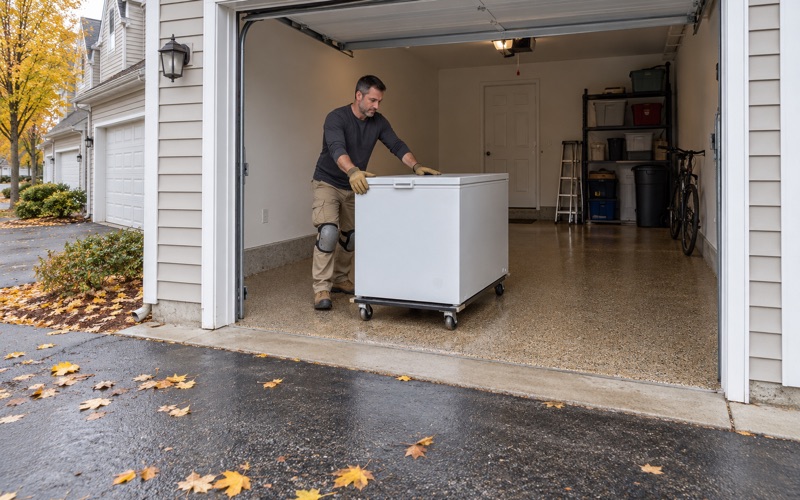
Both Spotless locations publish the same hours, 7:00 a.m. to 10:00 p.m. every day. A residential garage floor gets wet when a car drips in from the street and then dries for hours; a bay floor on that schedule sees water from opening to closing and has only the overnight gap to recover.
Heated indoor bays change the curing math
Heated indoor bays are good news for a coating in one respect: the slab is not sitting at winter temperature when the resin goes down. We still schedule curing against slab temperature and the dew point spread at the slab surface rather than the calendar, because a warm room full of wet air can put moisture right where a fresh coat is trying to bond.
The other half of the schedule is the business itself. A wash open every day cannot close for a week, so a bay recoat is best planned bay by bay in the overnight window, with fast-return polyaspartic and polyurea topcoats considered where the system allows them.
Water from below as well as above
Constant water on top is only half of the moisture story. A slab can also carry vapor up from underneath, and a coating sealed over a wet slab can blister from below no matter how good the topcoat is. Moisture testing is a line item in our scope, using ASTM F1869 calcium chloride testing or ASTM F2170 in-situ relative humidity probes, and moisture is the first warranty exclusion we read out.
We also say plainly that a coating is not waterproofing. On a wash floor, its job is to resist chemistry and hold texture; water management belongs to slope and drains, which is where the next sections go. A floor that sheds water quickly to a working drain is a floor that spends less of its day under standing chemistry.
Walking a wet bay: traction for the person with the wand
In a self-serve bay the floor is also a walkway. The customer is on foot, holding a pressure wand, stepping around a car on wet concrete filmed with soap and wax overspray. That is a different traction problem from a showroom or a garage where people mostly walk on a dry floor.
Aggregate, not gloss
For a wet bay we build texture into the system with a quartz aggregate broadcast, locked down and topcoated so the grit stays on the floor rather than in the drain. The profile is a balance: coarse enough to grip under a soapy film, not so coarse that it traps dirt the rinse cannot carry away or tears up the brushes and mops used to clean it.
Decorative vinyl flake broadcast has its place in a home garage, but on its own it is not the texture answer for a floor that is wet every working hour. Where an owner wants color for branding, we keep it in the base coat and let the aggregate do the gripping.
The topcoat carries the chemistry
Texture only lasts if the film around it does. Wash chemistry and constant abrasion from grit on tires wear a soft topcoat fast, so we look at 100% solids epoxy as a base with harder polyaspartic or polyurea topcoats, or urethane cement where the slab sees heavier chemical exposure. Amine blush, a waxy film some epoxies form while curing in humid air, is another reason a damp bay needs a cure plan, not just a product.
Touchless bays are a different case
The touchless automatic bays put a different load on the floor from the self-serve ones. Nobody walks them during a cycle, but the undercarriage wash in those packages is aimed up from floor level, so the coating along the vehicle’s path takes the heaviest chemistry and the most water. For those bays, chemical resistance outranks texture when we choose a topcoat.
Keeping the grip after opening day
A textured floor in a wash bay keeps its traction only if it is kept clean. Wax and sealant residue build up in the low points of the texture, so an owner should plan on periodic scrubbing with a cleaner the coating supplier approves. It also pays to check the walking path around the car, where wear shows first, and to recoat the topcoat before the aggregate underneath starts to polish smooth.
Trench drains, slope and the edges where coatings let go
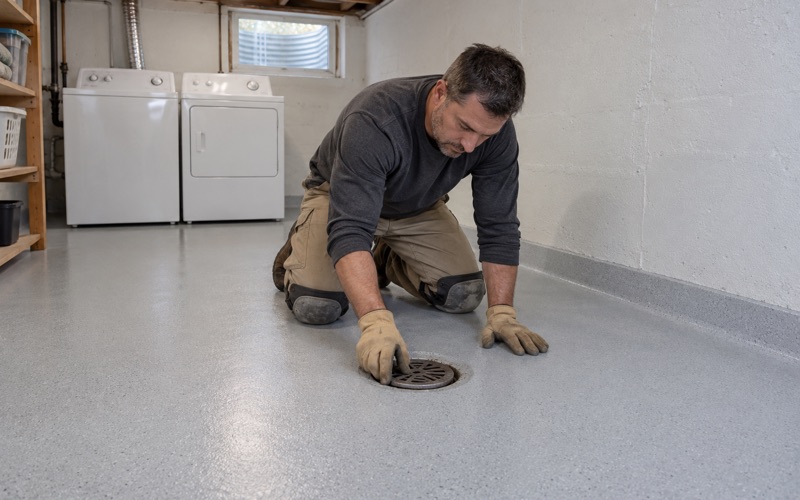
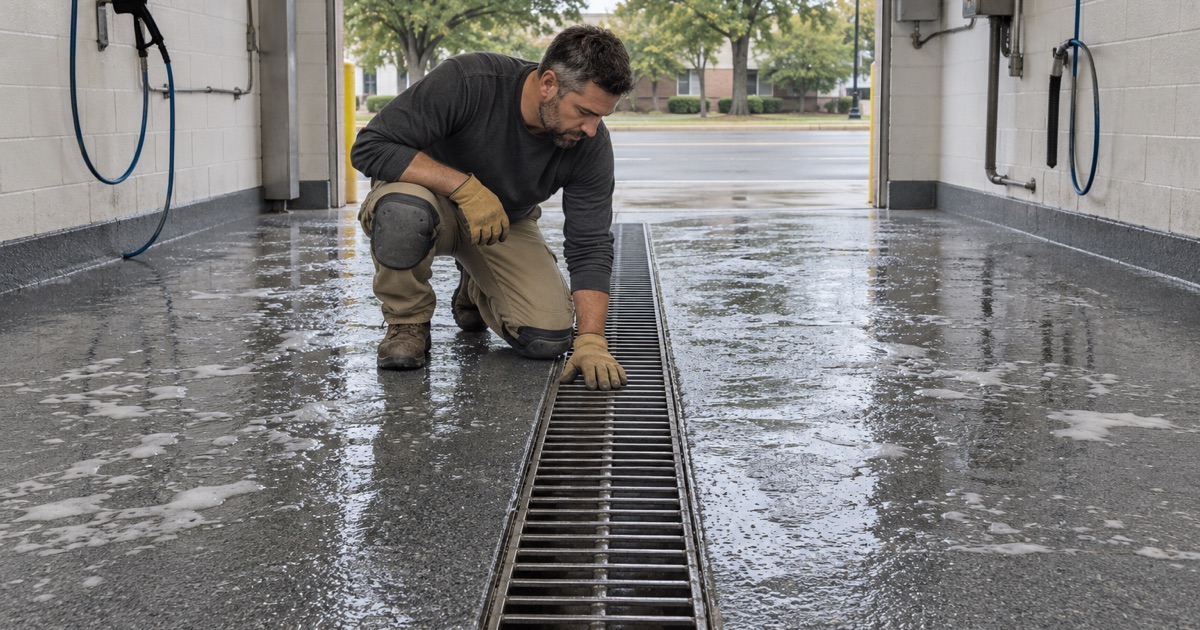
On a wash floor, coating failure tends to start at an edge, not in the middle of the bay. The edge of a trench drain, the lip of a floor drain and the line where the slab meets the wall are where water sits longest, where the concrete was finished by hand, and where a thin coat feathers out to nothing.
Opening the slab to the drain lip
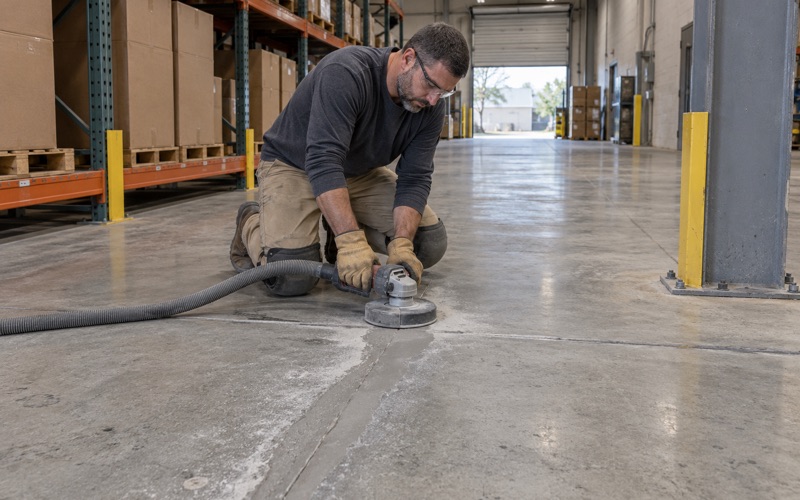
Because we prepare slabs mechanically, the grinder goes right to the drain lip, so the coating has a profile in the ICRI CSP range the system calls for. We then terminate the coating in a saw-cut key rather than letting it thin out where water will get under it first. Old coating that has already lifted at a drain is cut back to sound material, not coated over.
Trench drain grates and frames are usually metal set in concrete, and the joint between metal and slab moves as temperatures change. We detail that joint with a flexible sealant rather than running rigid coating across it, because a crack there opens a path for water under the whole edge.
Slope is set in the concrete
A coating follows the slab under it. If a bay holds a puddle because the slope to the trench is too flat or a section has settled, a new floor will hold the same puddle, and we say so before the job rather than promising the coating will fix it. Where slope or cracked concrete is the problem, we tell the owner the slab needs repair before it can be coated.
Who signs off in Forest Park
The building authority here is the Village of Forest Park Building Department and Engineering, and we ask that desk before the job whether a coating counts as decorating or needs a permit. Illinois issues no state license for flooring or coatings work, so we confirm the village’s own contractor registration, bond and insurance rules before we schedule.
Coatings are also chosen within the Illinois limit on VOC content under 35 Ill. Adm. Code Part 223, which binds the installer as well as the manufacturer and matters in an enclosed, heated bay where the air does not clear quickly. Get those decisions right and a wash floor can be judged where it matters most: at the drain edges, after months of water, chemistry and foot traffic.
- 20+ Years Coating Concrete
- Moisture Testing in Every Scope
- Written Contract on Every Home Job