
Hoffman Estates Epoxy Flooring handles concrete floor repair in Hoffman Estates, IL, serving surrounding cities including Barrington, Lake Zurich, Wood Dale, Prospect Heights and Cary. Repair is the part of a coating job most likely to be skipped on a low bid, and after 20+ years we have learned it is also the part most likely to decide whether a new floor still looks right after a few winters.
Before we quote any floor, we read the cracks, spalls, joints and old coatings and tell you plainly which ones need repair before a coating can go down. Those repairs are named in the proposal, line by line, so you can see what is being fixed and why rather than finding an extra charge on the day of the job.
Much of the housing here dates from the 1960s and 1970s, which means many garage and basement slabs have decades of salt damage, settlement cracks and patch work behind them. A coating over damaged concrete inherits every one of those problems, so repair always comes first.
Crack Repair and Telegraphing
Concrete cracks for many reasons: shrinkage as it cures, settlement of the soil beneath, and expansion and contraction with temperature. Hairline shrinkage cracks are common and usually harmless. Wider cracks, cracks with one side higher than the other and cracks that keep growing tell us the slab is still moving.
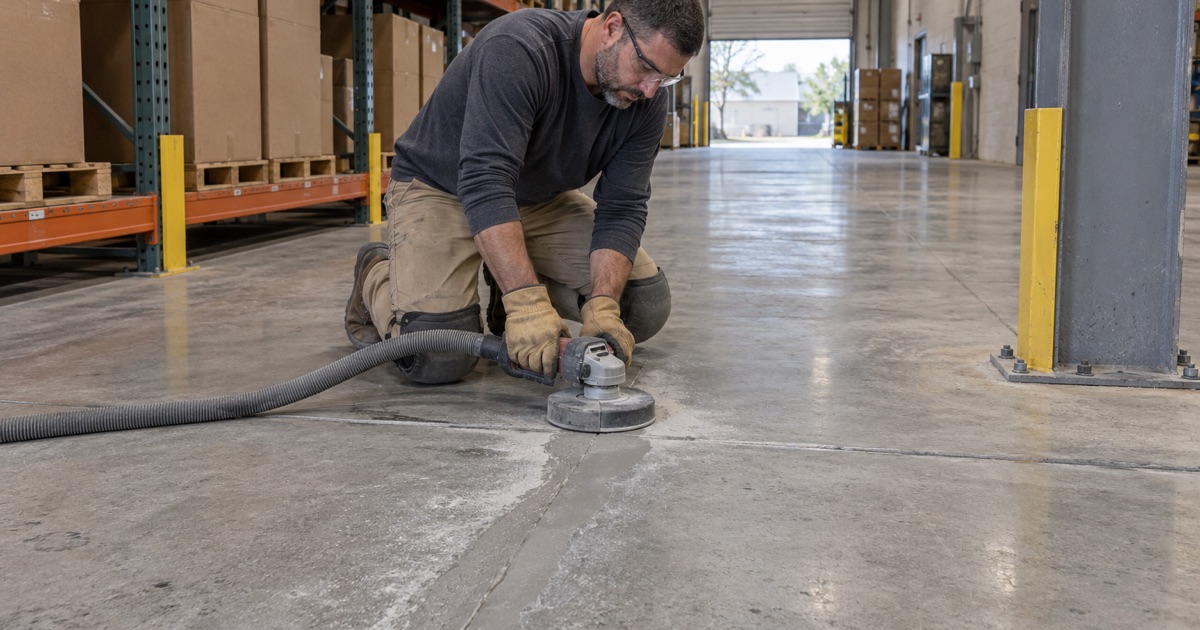
We rout static cracks open, clean them and fill them with a rigid epoxy or polyurea filler, then grind the repair flush with the floor. Active cracks are handled differently, because a rigid repair will simply crack again beside it. A coating is a film that follows the slab under it, and we say so before the job rather than promising that any coating will stop a moving crack from showing through.
Spalling, Scaling and Salt Damage
The village’s own building criteria rate weathering here as severe, with a 42-inch frost line, and garage floors near the door take the worst of it. Calcium chloride brine and rock salt drip off the car, soak into the concrete and freeze in its pores, breaking the surface away in flakes and pits. That scaling grows every winter if the slab is left bare.
We cut spalled areas back to sound concrete with square edges, so the patch has something to lock against, and rebuild them with a polymer-modified repair mortar or an epoxy mortar depending on depth. After grinding, the repaired area sits flush and is sealed beneath the new coating, which keeps salt brine on the surface from then on.
Joint Repair and Surface Defects
Control Joints and the Garage Apron
Control joints are the saw cuts or tooled lines that encourage a slab to crack in a straight line instead of randomly. Their edges chip under car tires and forklifts, and old fillers dry out and pull away. We clean out failed joints and refill them, using a rigid filler where the joint has stopped moving and a flexible one where it has not.
The joint between the garage slab and the driveway apron moves more than any other on a residential floor, because the apron sits outside and heaves with the frost. We treat it as a moving joint, keep it flexible and terminate the coating cleanly at the slab edge so the apron’s movement does not tear the new floor.
Pitting, Pop-Outs and Surface Defects
Pits, pop-outs where aggregate near the surface has burst, and rough troweling marks all show through a thin coating. After grinding opens the slab, we fill those defects with a fast-setting epoxy patch or a skim coat, then grind again so the surface is smooth. This step matters most under metallic epoxy and solid color systems, which have no flake broadcast to hide what lies beneath.
Old anchor holes, sawed-off bolts and leftover equipment pads in commercial spaces are cut down, filled and leveled the same way, so the finished floor is continuous and free of trip hazards.
Basement Slab Repairs Before Coating
Basement floors have their own repair list. Cracks that let water seep up after heavy rain, a cove joint where the wall meets the floor that weeps in spring, and old patches around a replaced sump pit or a plumbing trench are all common. Before we repair any of them, we moisture test the slab, because a repair that seals a crack on the surface does nothing about water moving through the concrete beneath it.
Where a crack is dry and static, we fill it as we would in a garage. Where water is actively entering, we recommend a drainage or waterproofing contractor first, since a floor coating is not waterproofing and a crack repair is not either. Plumbing trench patches are checked for hollow spots and settlement, cut out where they have failed and rebuilt so the coating has a continuous base.
When a Slab Needs More Than Repair
Some floors are past the point where patching makes sense. A garage slab with widespread scaling across most of its surface, large sections that have sunk several inches, or concrete that crumbles under a screwdriver is a candidate for an overlay or for replacement. We say so plainly during the walk-through rather than selling a coating over concrete that will keep failing beneath it.
A cementitious resurfacer can rebuild a badly scaled but structurally sound slab, restoring a smooth, uniform surface that can then be coated. Full replacement is concrete contractor work, and in the village concrete replacement carries its own permit, unlike the floor coating itself. We can coat the new slab once it has cured long enough and passes a moisture test.
- 20+ Years Coating Concrete
- Moisture Testing in Every Scope
- Written Contract on Every Home Job