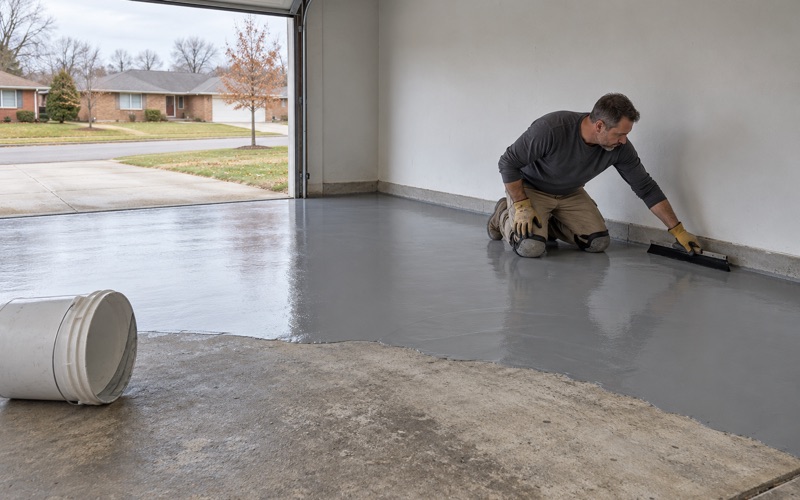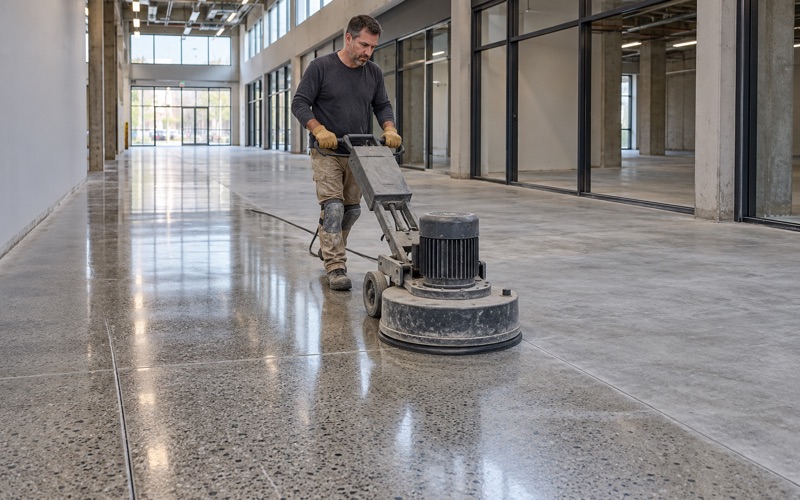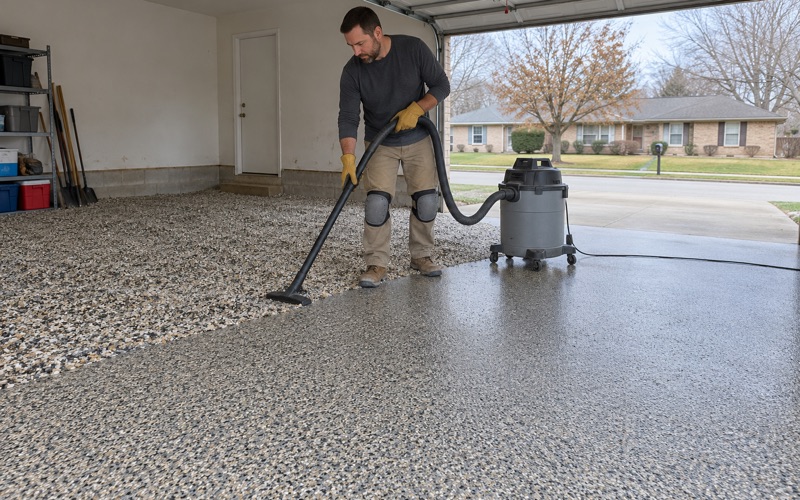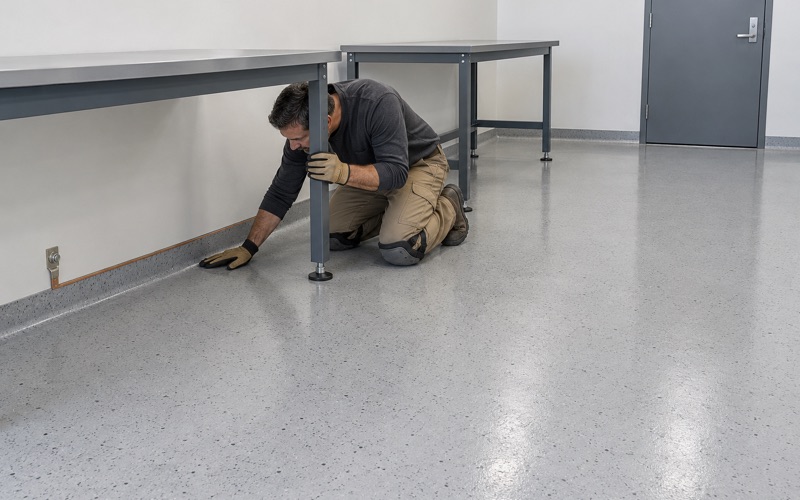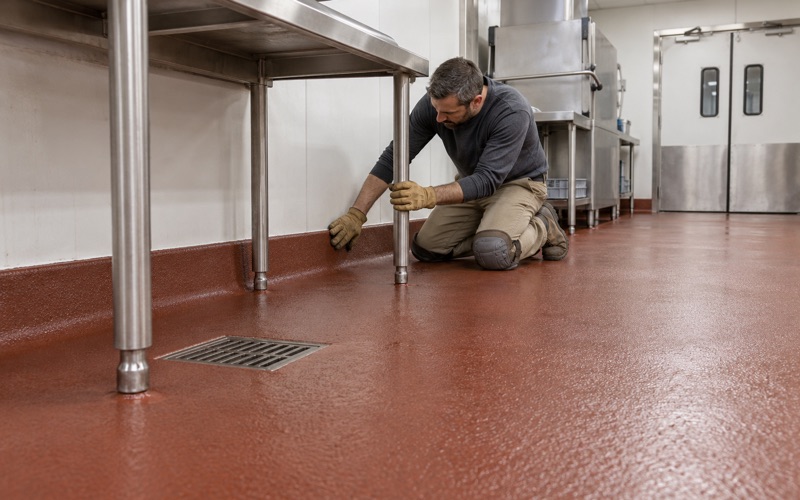
Hoffman Estates Epoxy Flooring brings more than 20 years to epoxy-flooring in Cary, and the floors we think hardest about here are the ones where something small, hard and round ends up underfoot. A plant floor that handles plastic resin has to give a worker sure footing, carry forklift traffic and still give up every stray pellet to a vacuum at the end of a shift. Texture is the decision that settles all three.
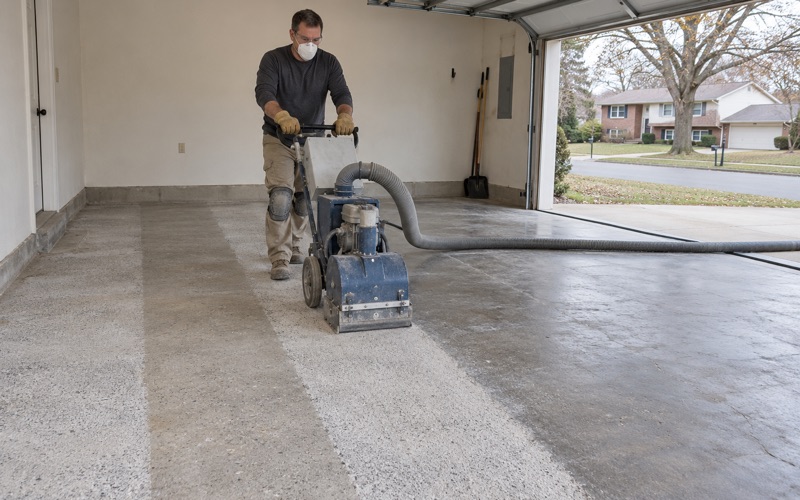
That decision only holds if the coating stays bonded, so every slab we take on is opened with a diamond grinder or a shot blaster, and we never acid etch. Moisture testing is written into the scope as its own line. The proposal names the product, the system build and the finished thickness, so a plant engineer can check what went down against what was quoted, line by line.
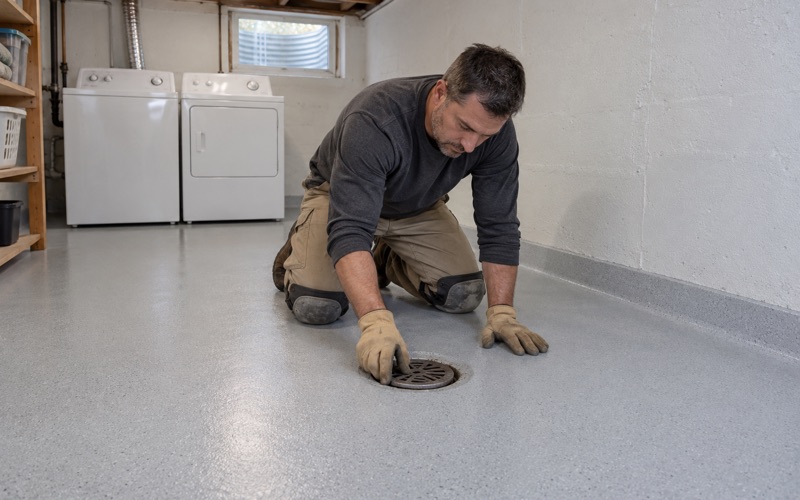
We coat garages and basements across the village too, and those jobs get the same testing and the same written paperwork. This page, though, is about the industrial side of the work and the kind of manufacturing that gives it a particular problem to solve.
A Film Plant on Chicago Street in Cary, Illinois
165 Chicago Street and its film blends
ProAmpac, a privately held flexible and paper packaging manufacturer, lists a Cary plant at 165 Chicago Street, and that address geocodes inside the village, in Algonquin Township, McHenry County. A directory listing describes the Cary operation as manufacturing over 200 customer and proprietary film blends, and the Cary Grove Chamber lists ProAmpac among the village’s manufacturers. Manufacturing is the largest employment sector in Cary, and plastic film is one visible piece of it.
We should be plain about what we know. We have not been inside that building, and nothing on this page describes its floor, its layout or its equipment. We name the plant because it shows the kind of work Cary does, not because we have any connection to it. What follows is what any floor under resin handling tends to face, drawn from trade practice.
What blending resin means for the slab below
A film blend starts as plastic resin, and resin arrives and moves as pellets. Wherever pellets are poured, conveyed, weighed or mixed, some of them escape: a bag tears, a hopper is changed, a transfer line is opened for cleaning. In resin-handling plants generally, that loose material reaches the floor every working day, and the floor has to be designed with that in mind from the start.
Cary, Illinois, not Cary, North Carolina
Search for Cary and the results lean heavily toward the Town of Cary, North Carolina, including its planned sports and recreation community center. This page is about the village on the Fox River in McHenry County. Here the building permit question goes to the Village of Cary, while fire protection comes from the Cary Fire Protection District at 400 Cary-Algonquin Road, a separate district rather than a village department.
Looking for epoxy-flooring closer to Bensenville? See Bensenville Epoxy-Flooring.
Pellets on the Floor: Ball Bearings Underfoot
Why a round pellet is a slip hazard
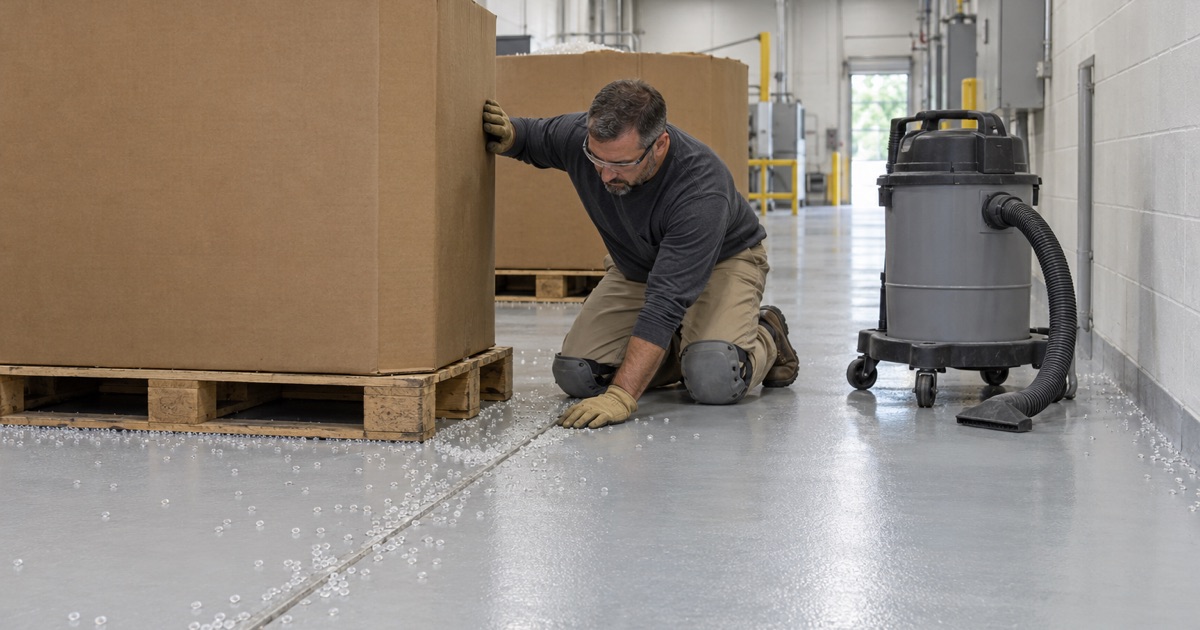
A resin pellet is small, hard and close to round, which is exactly the shape that rolls. Step on a scatter of them and the foot rides across the floor on a layer of tiny ball bearings rather than gripping the coating underneath. The same thing happens under a pallet jack wheel or a hand truck, and a load that skids is a load that can tip over.
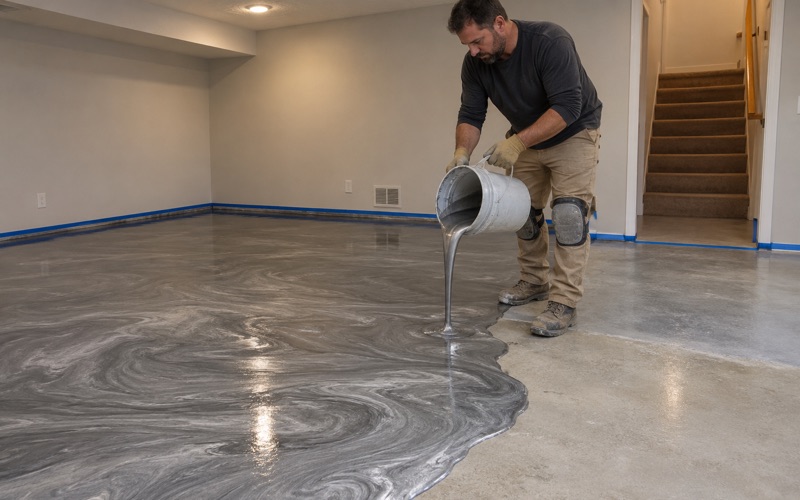
The hazard is worst on the floor most people picture when they hear epoxy: a smooth, high-gloss 100% solids epoxy with nothing broadcast into it. That surface is easy to mop and looks clean in a photo, but it gives a rolling pellet nothing to catch on. On a resin floor, the glossy finish that sells a showroom is the wrong choice for the aisle.
Where loose resin gathers
Pellets do not spread evenly. They collect where material changes hands, around the places where bags are opened, where hoppers are filled and where transfer lines connect, and they drift along the paths that wheels and boots travel most. A floor plan that treats every square foot the same misses that pattern, and the busiest walking lanes often turn out to be the slipperiest ones.
We look at how material actually moves through a space before we specify anything. The answer can be one system for the whole floor or a heavier texture in the transfer zones with a finer one elsewhere. Either way, the proposal states which build goes where, so the quote and the finished floor can be compared area by area.
Why sweeping alone does not solve it
A push broom moves pellets, but on a slick floor it also scatters them, sending some under racks and into corners where they stay. A vacuum does better, as long as the surface lets it. That is the tension at the center of a resin-plant floor: the floor needs enough grip to stop a pellet rolling, and not so much that a vacuum leaves the pellet behind.
Texture That Grips but Still Vacuums Clean
Choosing the aggregate
Texture comes from what is broadcast into the coating while it is still wet. Quartz aggregate broadcast is the usual choice on an industrial floor, because the grain size can be picked to suit the job and the quartz itself is hard wearing. A fine grade gives a light, even tooth that a vacuum head glides over. A coarse grade gives more grip and more places for small things to lodge.
Vinyl flake broadcast suits many garages, but on a resin floor the flake edges and the valleys between them can hold pellet fragments and fines. For a film-blending floor we would usually steer toward a fine to medium quartz, then judge it on a sample board. Roll a handful of pellets across the board, vacuum it, and see what stays behind before committing a whole plant to one grade.
Locking the texture with a topcoat
The topcoat decides how sharp the texture feels. A heavier topcoat rounds off the peaks of the aggregate, which makes the floor easier to vacuum and gentler on knees, at some cost to grip. A thinner one leaves the texture crisper. Polyaspartic and polyurea topcoats cure quickly and hold up to traffic, and on hard-working process floors urethane cement is another system worth pricing.
Whichever topcoat goes down, the curing is planned around slab temperature and the dew point spread at the slab surface, not around a calendar date. A topcoat applied too close to the dew point can develop amine blush, a waxy film that weakens the bond of the next coat. Floor coatings are also chosen within the Illinois VOC limits in 35 Ill. Adm. Code Part 223, which bind the installer as well as the manufacturer.
Texture means nothing without a bond
The best texture in the world fails if the coating lifts, so preparation comes first. Diamond grinding or shot blasting opens the slab to an ICRI CSP profile the system calls for, and we test moisture before anything is mixed, using ASTM F1869 calcium chloride testing or ASTM F2170 in-situ relative humidity probes. Warranty exclusions are read out before the job is sold, with moisture named first.
Joints, Edges and Corners Where Pellets Collect
Joints and cracks as pellet traps
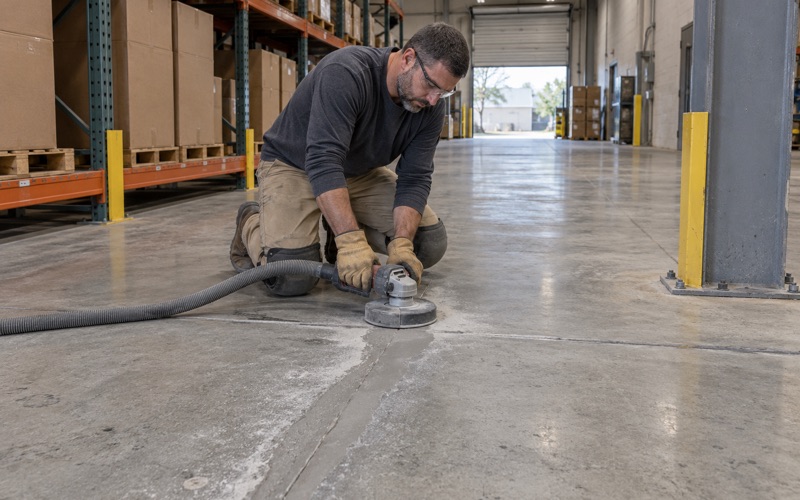
A saw-cut control joint is a narrow trench, and a narrow trench is a perfect resting place for a pellet. Once one lodges there, a vacuum passes over it and a broom pushes it deeper. Joints on a resin floor are best filled flush with a semi-rigid joint filler, so the surface reads as one plane that a vacuum head can clear in a single pass.
Cracks deserve the same care, and they get it before the quote is written. We read the cracks and any old coating first, and we say plainly when a slab needs repair before it can be coated. A coating is a film that follows the concrete under it. It will not stop a moving crack from moving, and we tell a client that up front rather than after the line reappears.
Coving the wall line
The joint between floor and wall is the other place pellets pile up. A square corner holds whatever a vacuum cannot reach, and over time it fills with resin, dust and debris. A coved base, where the coating curves up the wall in one continuous piece, removes that corner. Column bases, rack legs and equipment pads benefit from the same treatment where the layout allows.
Zero resin loss housekeeping
Operation Clean Sweep is the Plastics Industry Association’s zero resin loss program, built around standard operating procedures and facility checklists for keeping pellets contained. A floor does not run that program, people do, but the floor can make it easier or harder. Flush joints, coved edges and a texture a vacuum can clear all mean pellets are recovered rather than left behind.
That is the brief we bring to a resin-handling floor in Cary: enough grip to keep people upright, a surface that gives up every pellet, and edges that leave nowhere for them to hide. It all starts with a mechanically prepared slab, a measured moisture reading and a written proposal that spells out the system, so the plant can hold us to it.
- 20+ Years Coating Concrete
- Moisture Testing in Every Scope
- Written Contract on Every Home Job