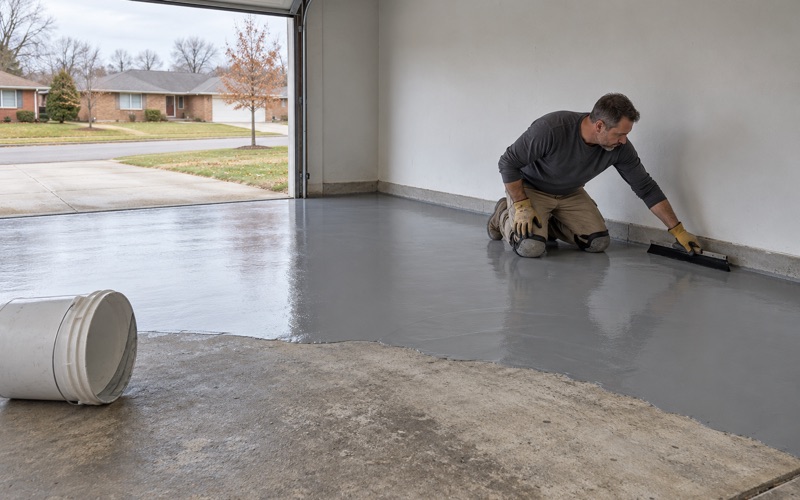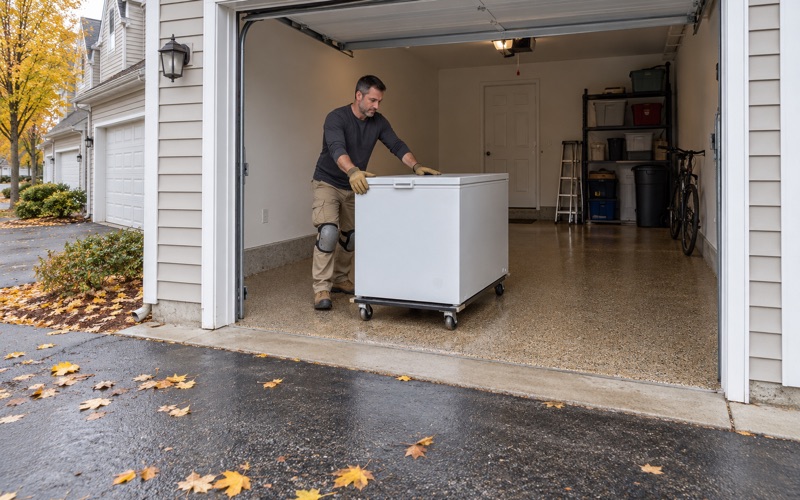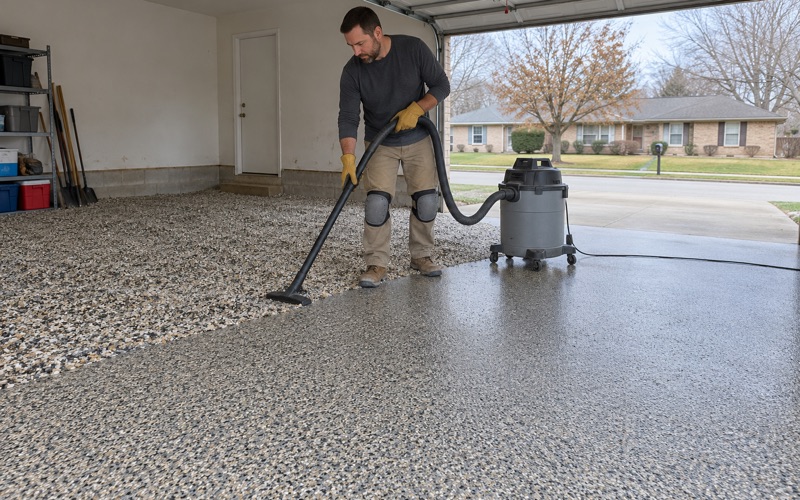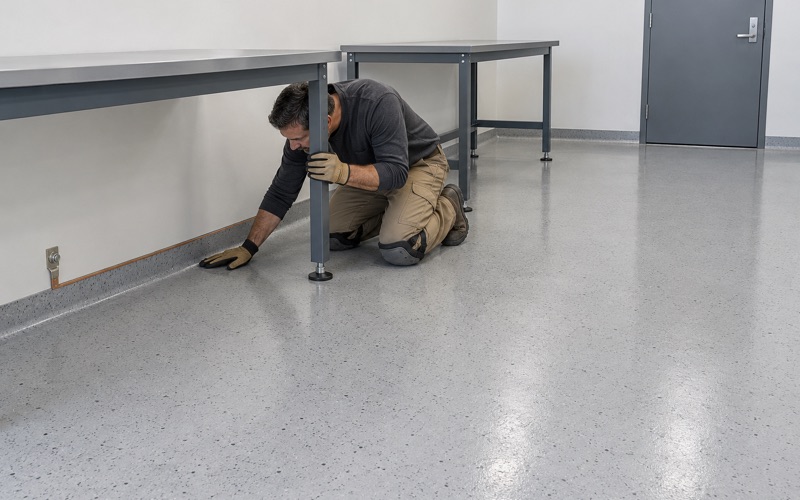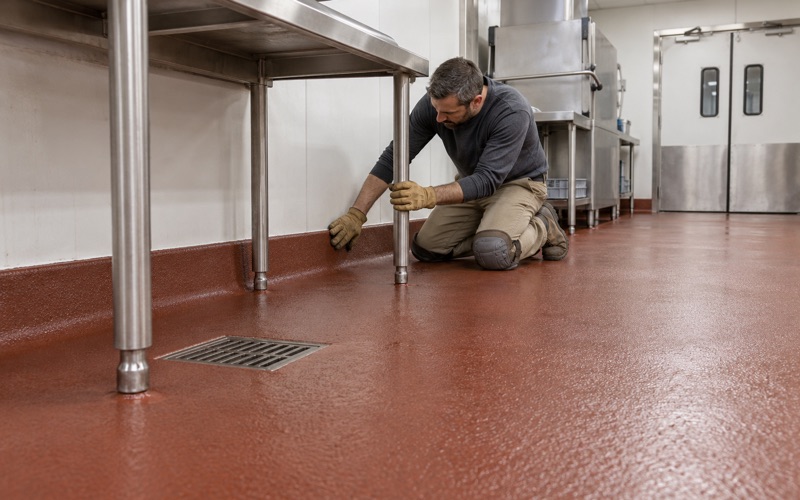
Hoffman Estates Epoxy Flooring has spent more than 20 years on epoxy flooring in Brookfield and the surrounding suburbs, and the floors we think hardest about are the ones that get wet on purpose. A garage where a vehicle rolls in dripping, a utility room beside a laundry, a slab that gets hosed down at the end of a shift: each one is judged on how it sheds water and cleans down. Looks come second on floors like these.
That changes how we start. Before we quote, we read the cracks, the old coating and the fall of the slab, and we say plainly when the concrete needs repair before anything can go on it. Moisture testing sits in the scope as its own line item, because a wet-service floor that blisters a year later is usually a floor nobody tested first.
Our proposals name the product, the system build and the finished thickness, so an owner can check what went down against what was quoted. We read the warranty exclusions out loud before anything is signed, and moisture is the first one we name. What follows is how we approach a floor whose daily job is dirty water.
A Sewer Truck That Parks Indoors on Eberly Avenue
The old ESDA building and its new job
The clearest local picture of a wet-duty floor in Brookfield is not one of ours. In October 2022 village trustees voted 4-0 to award YAD Construction a $197,666 contract, the lowest of seven bids, to remodel the former ESDA building at 4523 Eberly Avenue. The Emergency Services and Disaster Agency had been disbanded in 2006 after 50 years, and its building shares the site with Brookfield Public Works at 4545 Eberly Avenue.
The remodel turned the building into what the village described as a storage garage for water equipment and the Vactor truck. The scope added a foreman’s office, a locker room for water division staff, a conference room, a laundry area and an accessible restroom, along with new heating and air conditioning. The reporting on it names no floor work at all, and we have never seen that garage’s floor.
What a jet-and-vacuum truck brings home
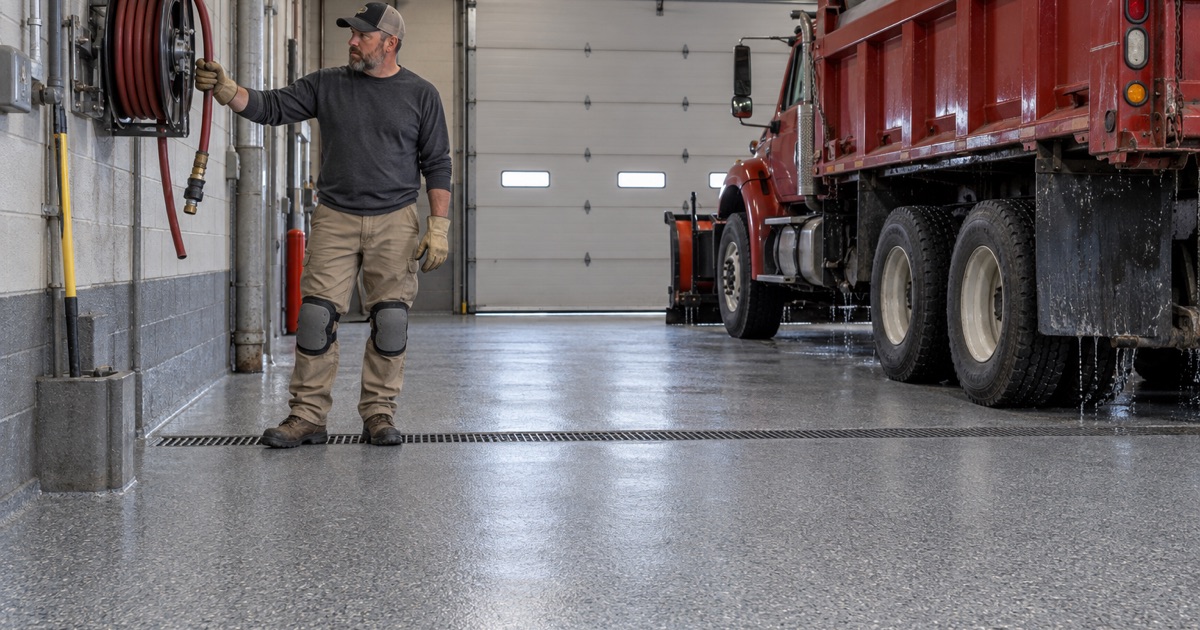
Vactor describes its combination sewer cleaners as machines that integrate jetting and vacuum with debris collection bodies and water tank systems. In plain terms, a truck like that spends its working day pushing water into sewer lines and pulling the mess back out. Whatever stays on the tires, the hoses and the chassis comes back to the garage with it.
For the slab under it, that means a parked load that arrives wet and gritty instead of dry. Water runs off the truck, sediment settles wherever it stops, and the floor gets washed down far more often than a house garage ever would. A storage garage is not a repair shop, so the daily stress is water, silt and cleaning rather than dropped parts and solvent spills.
Exhaust extraction in a closed truck bay
The village also paid for a ventilation system to extract the truck’s exhaust, which means the truck runs inside the building at least long enough to come and go. For a floor coating, a closed truck bay matters in two ways. The room has to be ventilated properly while a coating cures, and heavy tires parking on the finish in a heated room are where hot tire pickup shows up on thin film coatings.
Looking for epoxy-flooring closer to La Grange? See Epoxy-Flooring in La Grange.
Drainage, Slope and Washdown on a Storage-Garage Slab
Water should leave, not sit
On a floor that is washed down routinely, the coating’s job is to let water and silt travel to the drain without catching. That starts with the concrete. If the slab has low spots or an area pitched back toward the wall, a coating will follow them faithfully, because a coating is a film that follows the slab beneath it, and we say so before the job.
Where a floor needs its slope corrected, we tell the owner that is concrete repair, scoped and priced on its own. Urethane cement or a patching mortar can rebuild a broken edge or fill a shallow depression, but rebuilding the fall of a whole bay is a bigger conversation. Pretending otherwise is how a wet floor ends up holding puddles on a brand new finish.
Drains, edges and seams
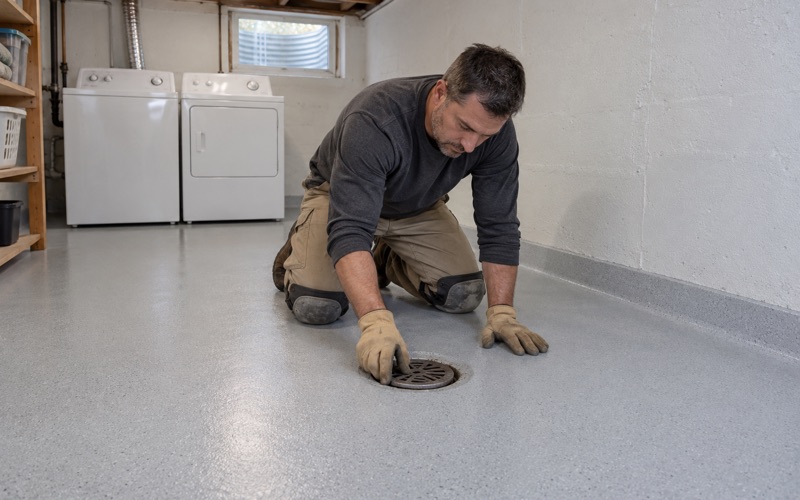
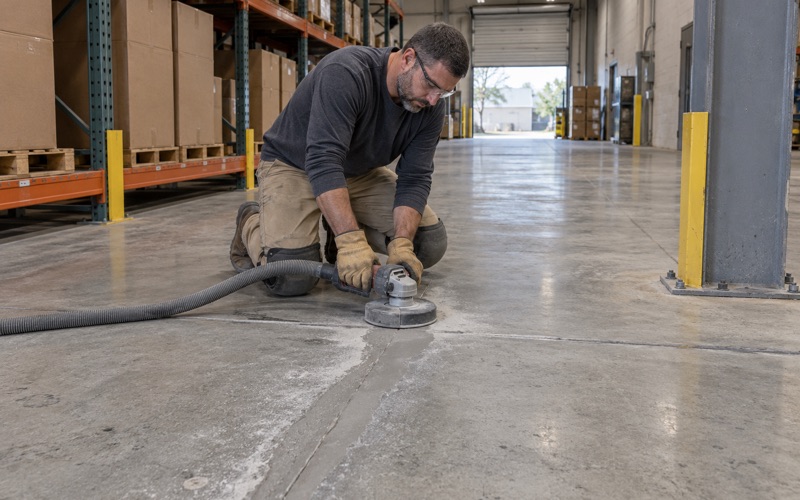
Water attacks a coating at its edges. A floor drain lip left uncoated, a saw cut never filled, or a coating feathered thin against a wall gives water a path under the film. Sump pit and floor drain detailing is where we spend extra time on any wet-service slab, and on commercial floors we often turn the coating up the wall in a cove so the corner can be cleaned.
Texture is the other trade-off. A floor that gets hosed and squeegeed needs enough grip that boots do not slide on it wet, but not so much texture that sediment packs into it and stays. We usually tune that with a quartz aggregate broadcast or a fine vinyl flake broadcast under a polyaspartic or polyurea topcoat, chosen for the way that floor actually gets cleaned.
Grinding before anything goes down
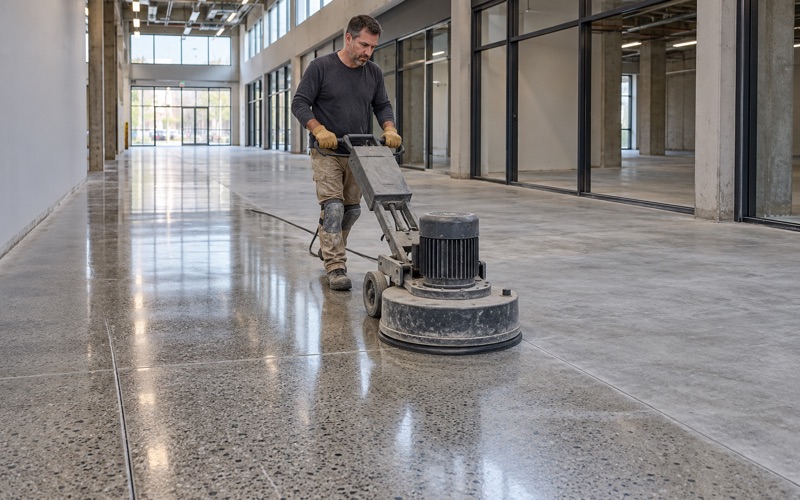
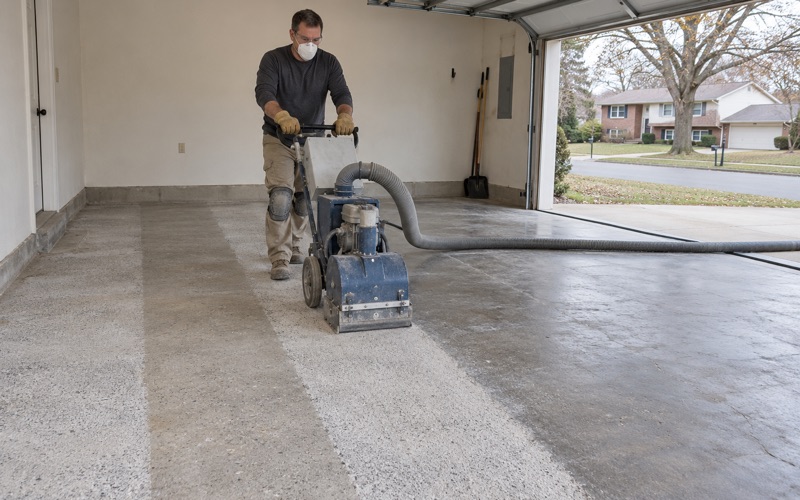
None of that matters if the coating does not bond. We open every slab mechanically with diamond grinding or shot blasting to an ICRI CSP surface profile matched to the system, and we do not acid etch. A garage floor that has had vehicles parked on it may also carry oil, and trade guidance is blunt that coating over grease, oil, paint or wax guarantees a failure. Stained areas get degreased and profiled before any primer goes on.
Locker Room and Laundry: The Clean Side of a Wet Building
Two kinds of floor under one roof
The Eberly Avenue remodel is a useful picture of something many owners face on a smaller scale: a dirty room and a clean room sharing a wall. Water division staff step off a wet truck and walk into a locker room, a laundry area and an office. The garage floor has to tolerate grit and runoff, while the rooms beside it have to stay dry, sanitary and quick to mop.
Those floors rarely want the same system. A truck or equipment bay usually calls for a thicker build of 100% solids epoxy with a broadcast and a tough topcoat. A locker room or laundry floor can often take a thinner, smoother system that cleans in minutes, finished with a coved edge where the floor meets the wall so water has no corner to sit in.
Where the moisture comes from
Laundry rooms and locker rooms bring their own water: machine leaks, wet towels, wet boots and daily mopping. That is water from above, and a well-built coating handles it. Water vapor rising through the slab is a different problem, so before we coat we run ASTM F1869 calcium chloride tests or ASTM F2170 in-situ relative humidity probes, often starting with an ASTM D4263 plastic sheet test as a first read.
If the readings come back high, a moisture-mitigation primer may be the right answer, or the honest answer may be that the slab needs drainage work before any coating. We never sell a floor coating as waterproofing. When results point to water coming up through the concrete, we name it plainly and leave the drainage diagnosis to the trade it belongs to.
Timing the cure in a working building
A building that has to keep running needs its floors done in sections. We schedule commercial and institutional floors around the hours the space must stay in use, including overnight windows. Curing is planned against slab temperature and the dew point spread at the surface rather than the calendar, because coating a cold, damp slab invites amine blush and a weaker bond than the system was designed for.
From a Village Garage to Your Own
What carries over to a house
Most floors we are asked about in Brookfield are not municipal. The village sits 13 miles west of downtown Chicago, its 2020 census population was 19,476, and most of its 7,927 housing units are single-family detached homes. Plenty of those owners have the Eberly Avenue question in miniature: a garage that takes in a wet car, with a laundry or utility room a few steps inside the house.
The lessons from a sewer-truck garage scale down cleanly. Get the slope and the drain right before the coating, detail every edge and saw cut, and pick a texture for the way the floor will be cleaned. Much of the housing here is old, with 2,543 units built in 1939 or earlier and 2,086 in the 1950s, so we test every slab rather than guess what is beneath it.
What does not carry over
A homeowner does not need a municipal truck-bay system. A house garage sees a family car, not a sewer cleaner coming back from the street, so the build can be lighter and the finish can be chosen partly for color and looks. Even a newer garage slab poured to code may have no vapor retarder under it, because IRC R506.2.3 exempts garages, so testing stays in the scope regardless.
What also carries over is honesty about movement. A coating will bridge hairline cracks cosmetically, but it will not stop a slab that is still moving, and we explain that before the job instead of after the first crack telegraphs through. Where a crack is structural or active, we say the slab needs repair first, and we price that repair as its own item.
Paperwork before the first grinder pass
Illinois issues no state license for flooring or coatings work, so we confirm the Village of Brookfield’s own contractor registration, bond and insurance rules before a job is scheduled. We also ask the village permit desk whether a given coating scope needs a permit instead of assuming the answer either way, since a relocated floor drain or new drain tile changes it.
Every home job gets a written contract and the state’s Home Repair: Know Your Consumer Rights pamphlet before work starts, as the Illinois Home Repair and Remodeling Act requires. Coatings are selected within the Illinois VOC content limits for architectural coatings, which bind the installer as well as the manufacturer. Then the grinding starts, and the floor gets built for the water it will actually see.
- 20+ Years Coating Concrete
- Moisture Testing in Every Scope
- Written Contract on Every Home Job