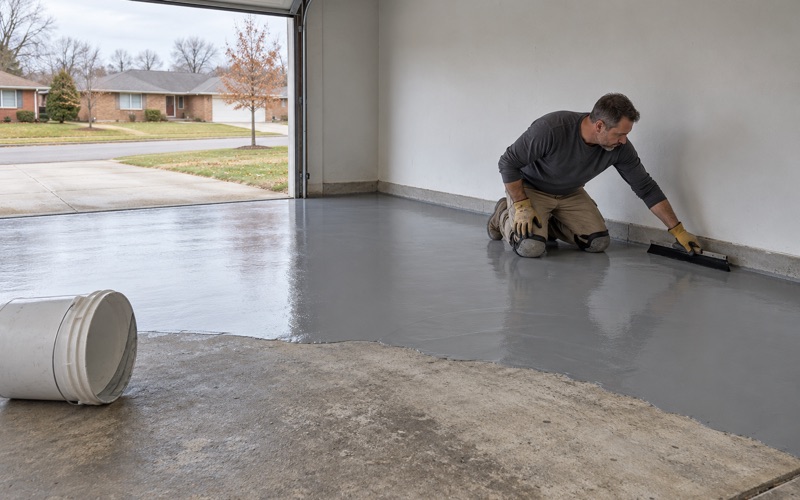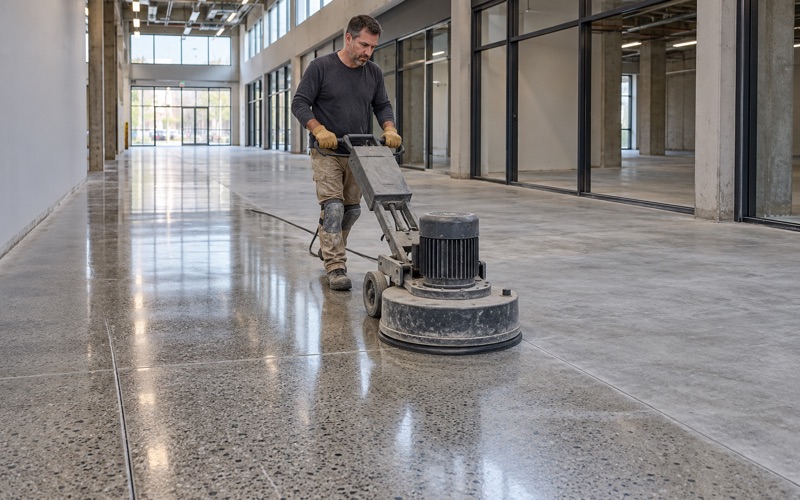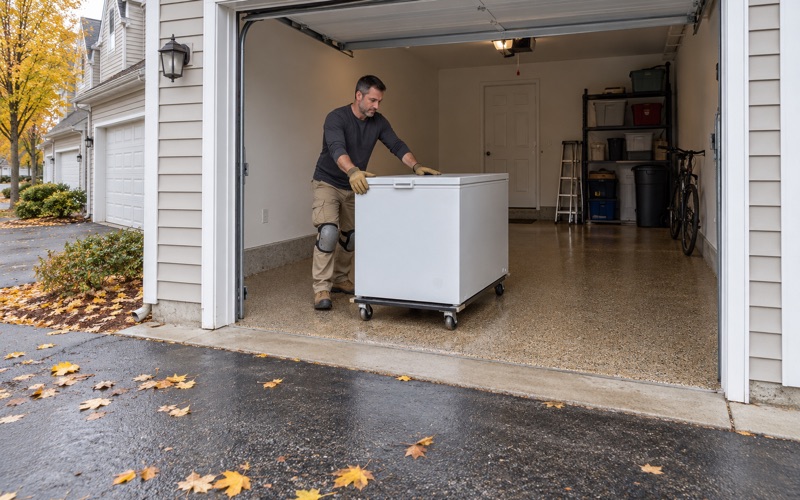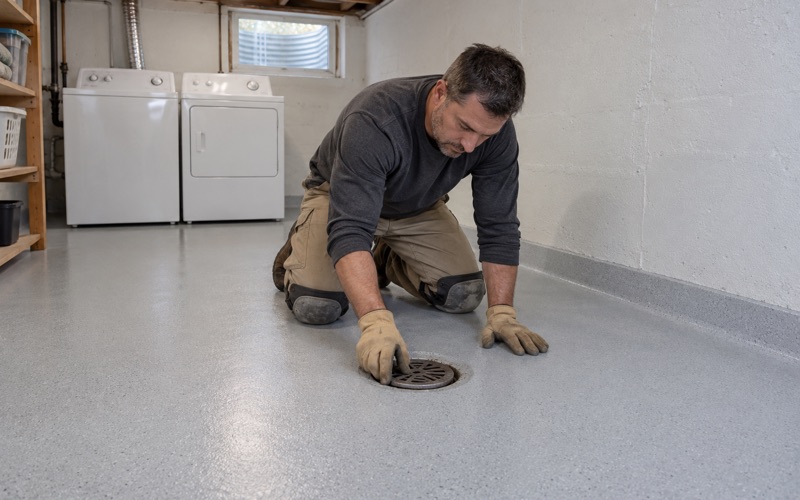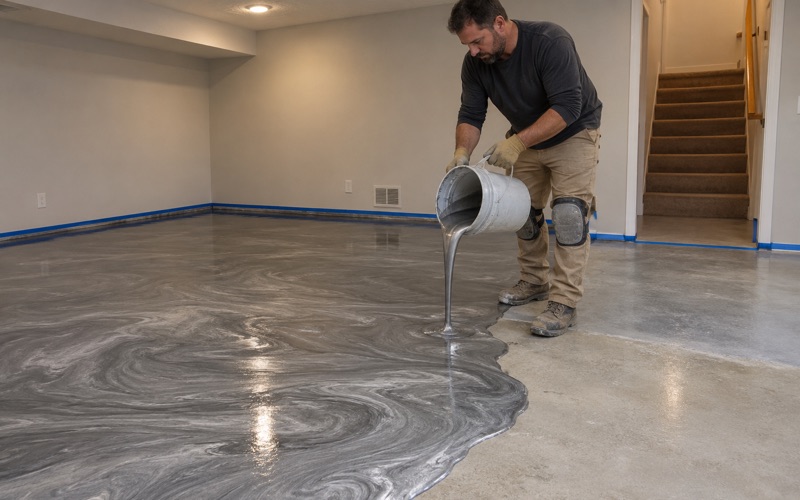
Hoffman Estates Epoxy Flooring takes on epoxy flooring in Bellwood with more than 20 years behind us, and the floors we think hardest about are the ones where something has already moved into the concrete. A slab that has absorbed oil, compound or metal fines is not ready for resin just because it has been swept. The first decision on that kind of floor is whether it can be made clean enough to bond, and only after that which system goes on top.
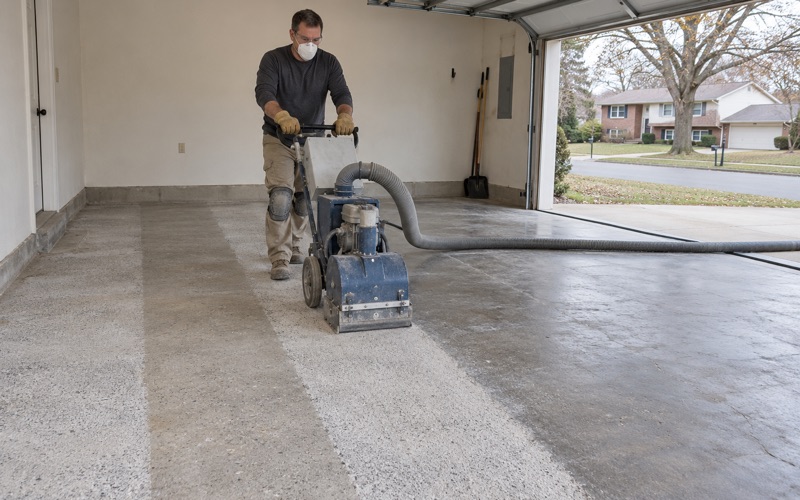
We answer that question with machines rather than chemistry sold by the gallon. Every slab we coat is opened by a diamond grinder or a shot blaster, and we never acid etch, because acid does nothing for residue sitting below the surface. Moisture testing is priced into the scope as its own line, on a basement slab or a shop floor, instead of being offered after a coating has already lifted.
Before a quote goes out we read the cracks, the stains and any old coating, and we say plainly when the slab needs repair or deeper cleaning first. Our proposal names the product, the system build and the finished thickness, so whoever signs it can hold the paper up against the finished floor.
A Stainless Strip Service Center on Grant Avenue and What Settles Around It
Bellwood is a village in Proviso Township, Cook County, about 13 miles west of the Loop, and its industry sits close to its homes. One plant on Grant Avenue shows why a floor here is so often judged by what it has absorbed rather than what it has carried. The same lesson applies whether the floor is a production bay or a two-car garage.
Combined Service Centers at 2401 W Grant Avenue
Combined Service Centers, part of Combined Metals, lists its Bellwood facility at 2401 W Grant Avenue, an address the Census geocoder places inside the village. The company describes precision slit coil, coil to coil buffing and polishing, stamping, punching and cut-to-length sheet in stainless steel strip and sheet. Its rolled strip comes from sources that include the company’s own rolling mill in Hampshire, Illinois.
We have not worked in that plant, and we have not seen its floor. We name it because the processes it lists are the clearest local example of a floor problem we meet in shops of every size, from production lines down to a single bench in a basement.
What buffing and polishing leave behind
Buffing and polishing stainless is abrasive work by design. A wheel or belt carries compound against the metal, and in general that process sheds spent compound, fine metal particles and lubricating oil, much of which lands on and around the line. Slitting, stamping and punching add their own oils to the mix.
None of this is a claim about the Grant Avenue floor, which we have not inspected. It is what polishing lines produce wherever they run, and it settles as a dark gray film that foot traffic presses down into bare concrete shift after shift, year after year.
Why the film matters more than the load
Most people picture an industrial floor failing under weight. A floor around a finishing line is more likely to fail at the bond, because a coating laid over compound and oil is attached to the residue rather than to the concrete. The resin can look perfect for months before it lets go in sheets exactly where the film was heaviest.
Looking for epoxy-flooring closer to Lake Forest? See Epoxy-Flooring in Lake Forest.
Oil and Compound in the Slab: Preparation Before Any Coating
Concrete behaves like a hard sponge. Oil and the binders in polishing compound wick into the pores and keep traveling, so a slab that looks merely stained on top can be saturated well below the depth a grinder reaches. The question before any coating is how deep the contamination runs and whether it can be brought back out.
Cleaning before grinding, not after
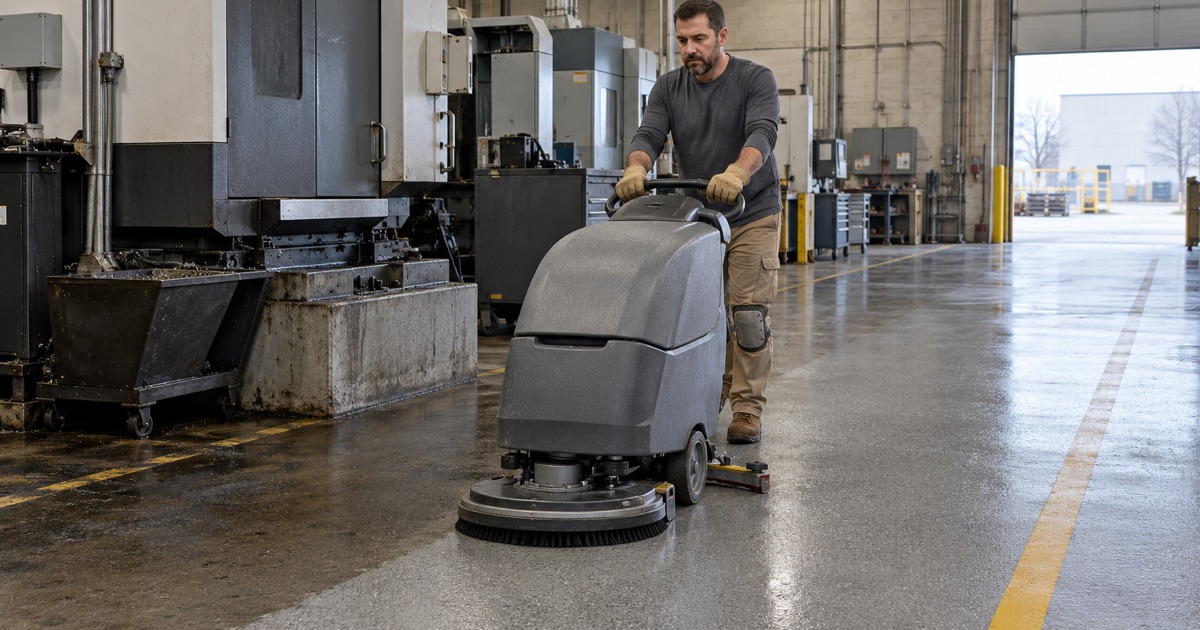
We degrease first, with a cleaner matched to oil-based residue and a scrubber that lifts the dirty slurry off the floor instead of pushing it around. Grinding a contaminated slab can smear residue into freshly opened pores, so mechanical preparation follows cleaning. The target profile is then set on the ICRI CSP 1-10 scale for the system going down.
Drawing oil out of the concrete
Where oil keeps returning after a clean grind, the slab is giving it back from below. Repeated degreasing, poultice extraction and controlled heat can pull some of it up for removal, and we check again after each round. A drop of water that beads instead of darkening the concrete tells us the work is not finished yet.
Knowing when a slab cannot be saved
Some floors have soaked up too much for too long. When oil is still rising after extraction, the honest answer is to saw out and patch the worst areas, or to leave that section uncoated, and we say so before quoting rather than after a failure. A bond test on a prepared patch settles the question better than any promise, so we run one before committing the whole floor.
Moisture is a separate test
Oil is not the only thing a slab carries. We run ASTM F2170 in-situ relative humidity probes or ASTM F1869 calcium chloride tests as the floor calls for, and a high reading means a moisture-mitigation primer under the system. Before the contract is signed we read the warranty exclusions aloud, and the first item on that list is moisture.
Cleaning Routines a Coated Floor Has to Survive
A metal finishing floor gets cleaned hard and often, so we design it for the scrubber as much as for the traffic. The useful questions are which cleaners will touch it, how often, and whether residue can be lifted off the surface before it works into the coating. A floor that cannot be cleaned back to its original color is a floor that will be ground off early.
A surface that lets residue go
A dense, nonporous topcoat keeps compound and oil on top, where a scrubber can reach them. Over a 100% solids epoxy body, a polyaspartic or polyurea topcoat stands up to the degreasers a metal shop uses, and urethane cement is often the tougher body where hot water washdown or harsh chemistry is part of the routine. Heavy broadcast texture can trap fines in its valleys, so we keep the profile modest wherever cleaning is the main job.
Seams, joints and the wall base
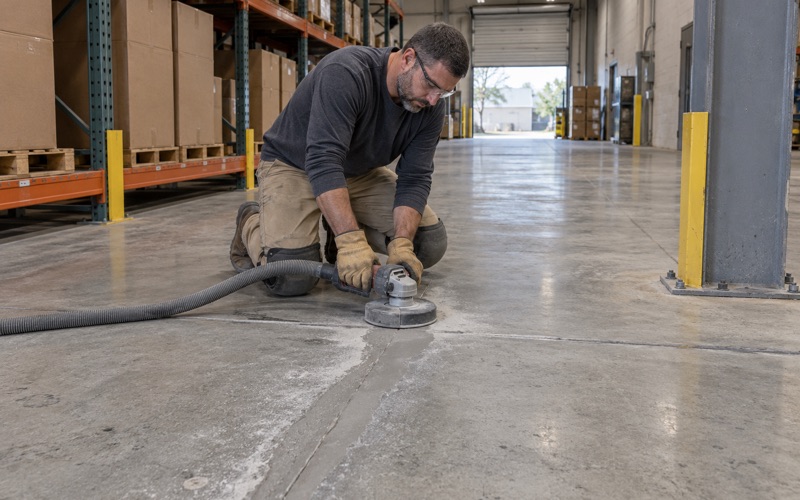
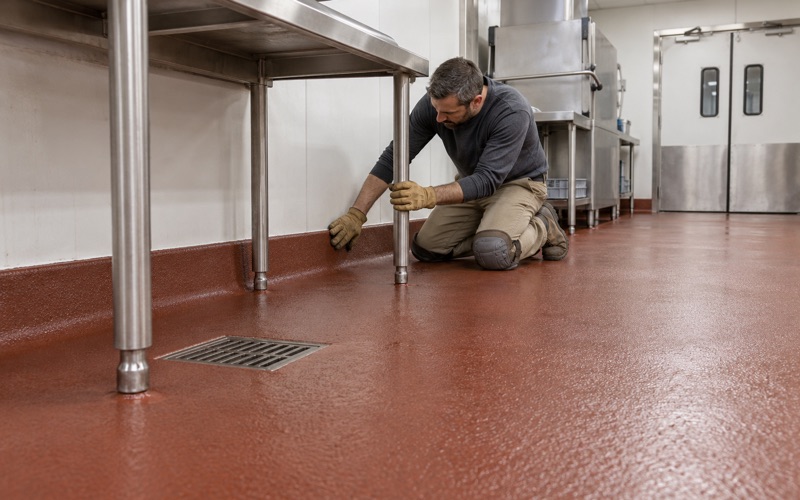
Residue collects wherever the floor changes plane. Control joints, cracks and the line where slab meets wall or machine base are where film builds up first, and where an aggressive cleaner can creep under a coating edge. We fill and detail those areas before the field goes down, because a flawless field with open joints still holds the worst of the dirt.
A coating is a film that follows the slab under it, so a moving crack will eventually show through any system. We tell owners that before the job, along with which cracks we will repair and which ones we expect to telegraph, rather than promising that resin will hold concrete still.
Planning for the next topcoat
Every scrub wears a topcoat a little. We plan finishing floors as surfaces that will be cleaned, lightly abraded and topcoated again in place, which works only while the base film stays bonded and nothing has soaked through it. In an operating plant we phase the work around the hours the building has to keep running, and the coatings we choose fall within the Illinois limit on VOC content, a rule that binds the installer as well as the manufacturer.
From a Polishing Line to a Home Shop: The Same Contamination Question
The Grant Avenue lesson shows up at a much smaller scale in Bellwood’s garages and basements. The village counts 4,168 owner-occupied single-family detached homes, and plenty of them have a corner where someone sharpens, grinds, welds or works on an engine. A home shop floor collects the same things a plant floor does, only less of them: motor oil, cutting oil, grinding dust and metal filings tracked in on shoes.
Oil-stained garage pads
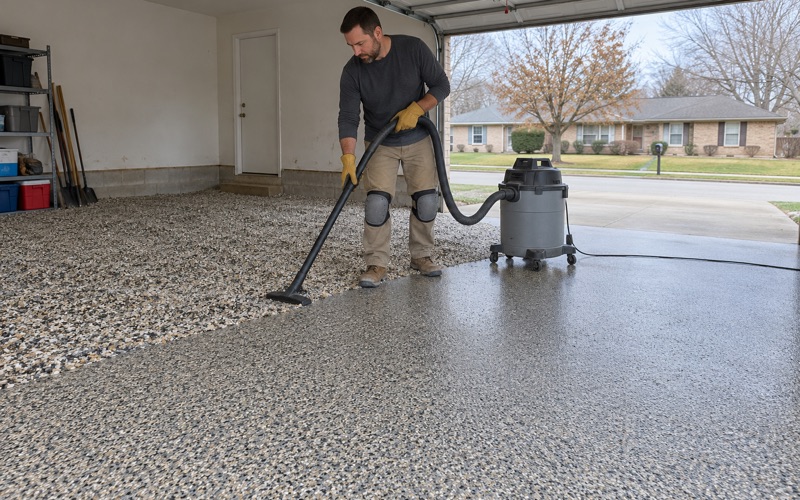
A garage slab with years of drips under the car is a smaller version of the oil-soaked plant floor. We degrease, grind, watch for oil returning and treat or patch stained areas before any primer goes down. A garage slab poured to code may also have no vapor retarder beneath it, because the IRC R506.2.3 exception lets garages skip one, so we test for moisture rather than assume a newer slab is a dry one.
Metal dust and winter brine
Fines from a bench grinder are abrasive and can embed in a soft finish, so a home shop is a good place for a hard topcoat over a vinyl flake or quartz broadcast. The same floor takes calcium chloride brine and rock salt off the tires all winter, and we build garage systems to stand up to both. In an unheated garage, curing waits on slab temperature and dew point rather than the calendar, which sometimes means waiting for spring.
Paperwork and permits for a home job
Every home job gets a written contract and the Home Repair: Know Your Consumer Rights pamphlet before work starts, as the Illinois Home Repair and Remodeling Act requires. Illinois issues no state license for flooring or coating work, so we confirm the village’s own contractor registration, bond and insurance rules before scheduling.
The Village of Bellwood Building Department handles permits here, and it reports its building code as the 2006 IBC, adopted in 2008. We ask that desk before the job whether a floor coating counts as decorating or needs a permit, rather than guessing at either answer, and we never sell a coating as waterproofing for a basement that takes on water from below.
- 20+ Years Coating Concrete
- Moisture Testing in Every Scope
- Written Contract on Every Home Job