
Hoffman Estates Epoxy Flooring installs basement floor epoxy in Hoffman Estates, IL, serving surrounding cities including Barrington, Lake Zurich, Wood Dale, Prospect Heights and Cary. After 20+ years of coating concrete, we approach every basement with the same first question: how much water is moving through this slab, and can a coating live with it?
A basement floor has soil on every side and below, so it behaves differently from a garage or an interior room. Moisture rises through the concrete, salts migrate with it, and the spring water table can sit closer to the slab than the floor’s dry August appearance suggests. That is why the moisture test is a line item in every basement proposal we write.
In the village, just over half of houses have a full or partial basement, with the rest on slabs or crawl spaces. When a basement is part of the house, it often becomes a playroom, home gym or laundry area, and a coated floor makes it washable, brighter and easier to live with.
Moisture Comes First
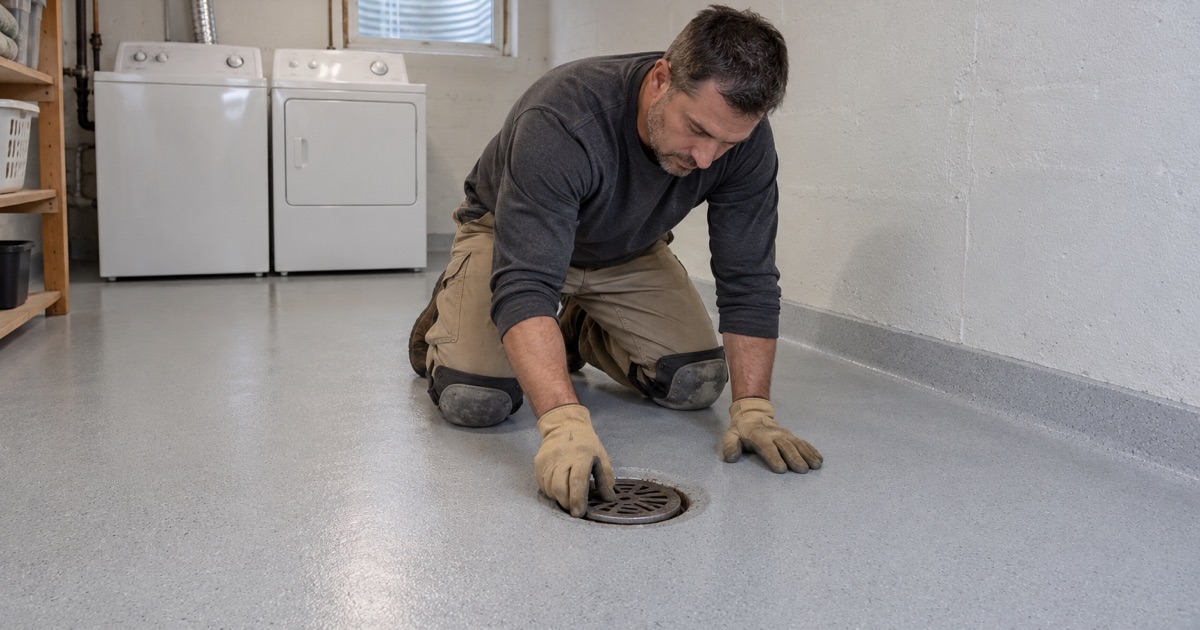
Plastic Sheet, Calcium Chloride and RH Testing
We begin with a plastic sheet test under ASTM D4263, taping a square of clear plastic to the slab and checking for condensation or darkening after a set period. That screen tells us whether we need a closer look. When it does, calcium chloride tests under ASTM F1869 measure the moisture vapor emission rate, and in-situ relative humidity probes under ASTM F2170 read moisture deeper in the slab.
Those numbers are compared against the limits published by the coating and primer manufacturers. They decide which system goes down, or whether one should go down at all.
Hydrostatic Pressure Under a Basement Slab
When the soil around and beneath a basement is saturated, water pushes upward on the slab. That hydrostatic pressure drives moisture and dissolved salts into the concrete, where they collect beneath any coating and push it off as blisters.
A basement that only gets damp after heavy spring rains is still under that pressure part of the year. We ask about seasonal water, sump pump cycling and past leaks before quoting, because a single summer reading can miss the problem.
Glacial Till Soils and the Spring Water Table
The soils mapped across much of the area are glacial till with silty clay loams in the lower spots, which drain slowly and hold water. The water table rises each spring as snow melts and rain soaks in. A basement floor can test dry in late summer and sit over saturated soil in April.
We factor the season into our testing and our recommendations. If a slab tests marginal in a dry month, we treat it as wetter than the number suggests.
Basement Floor Problems We Address
Efflorescence and Salt Deposits
White, powdery deposits on a basement floor are efflorescence, minerals carried to the surface by moisture and left behind as it evaporates. Efflorescence prevents any coating from bonding and signals that moisture is reaching the surface.
We grind the deposits away, test the slab and, where the readings allow, use a moisture-mitigation primer before the decorative coat. If efflorescence keeps returning, the water source needs attention before a floor goes down.
Floor Drains, Sump Pits and Cove Joints
The cove joint where the basement wall meets the floor, the edges of the sump pit and the rims of floor drains are where water enters and where most basement coatings fail first. We terminate the coating cleanly at each one, keep the sump liner uncoated and slope transitions so water reaches the drain rather than pooling at a coating edge. If water is visibly entering at the cove joint, we recommend addressing it with a drainage contractor before coating.
Coating After a Sewer Backup
Many older homes in the area have floor drains connected to the sanitary sewer, and a heavy storm can send water back up through them. A floor that has taken a backup needs to be cleaned, disinfected and fully dried before coating. Addressing the cause, such as an overhead sewer conversion or a backflow valve, protects the new floor.
We test the slab after cleanup and schedule the coating only once it reads dry enough. Coating too soon traps contamination and moisture beneath the film.
Basement Coating Systems
Moisture-Mitigation Primers
A moisture-mitigation primer is a dense epoxy layer designed to hold back moisture vapor up to a limit stated by its manufacturer. It goes down first, and the decorative system goes on top. We recommend one when test readings fall within its rated range. If readings exceed that range, no primer will reliably hold the floor, and we say so rather than install a coating that is likely to fail.
Flake and Quartz Basement Floors
A flake or quartz broadcast system over an epoxy base gives a textured, durable floor that hides dust and small imperfections. Quartz adds more grip, which helps near a laundry sink or a basement bathroom. We seal both under a clear topcoat that wipes clean. Blends can be matched to cabinetry, trim or the room’s intended use, from a neutral gray for a utility area to warmer tones for a family room.
Metallic and Solid Color Basement Floors
Metallic epoxy creates a seamless, marbled finish that suits a finished basement, a home bar or a media room. Solid color coatings work well in storage areas, mechanical rooms and workshops where function matters more than decoration.
Both require the same moisture testing and grinding as a flake floor. A decorative finish does not change what the slab underneath can tolerate.
What a Basement Coating Is Not
Not Waterproofing
We never sell a floor coating as waterproofing. Water coming up through a basement slab or in at the cove joint is a drainage question, and a film over the problem will be pushed off from below. Drain tile, sump pumps, grading and gutters solve water problems; a floor coating protects a dry slab. We will tell you plainly when a basement needs water management first, and the moisture test is how we know.
Not Radon Mitigation
Radon mitigation in Illinois is licensed through the state’s emergency management agency, and it works by depressurizing the soil beneath the slab, usually with a fan and vent pipe. A floor coating may seal surface pores, but it does not reduce radon in a way that counts as mitigation.
If your radon test results are high, a licensed mitigator should install the system first. We can coat the floor afterward, detailing around the suction point.
Not a Flood-Proof Floor
FEMA’s guidance on flood damage-resistant materials treats concrete and certain coatings as able to survive flooding, but no coating keeps water out of a basement during a flood. Flooding is a minor hazard on the village’s own record, yet any basement can take water from a failed sump or a backup. A coated floor cleans up more easily afterward, which is its real benefit.
After a water event, a sound coating can usually be cleaned, dried and kept, provided the water did not get beneath it. Where it did, the lifted sections are cut out, the slab is dried and retested, and the area is patched and recoated, which costs far less than replacing a finished floor covering.
Planning a Basement Floor Coating
Clearing the Room and Working Around Mechanicals
The floor has to be clear for grinding, but furnaces, water heaters, softeners and laundry machines can often stay where they are. We grind and coat up to them carefully, or move lighter appliances aside and return them once the floor has cured. The written scope names which items stay and which need to move before we arrive.
Dust, Odor and the Living Space Above
Our grinders run with HEPA dust extraction, and we seal the stairway opening with plastic to keep dust out of the house above. We choose low-odor products within the Illinois VOC limits for floor coatings and ventilate the basement while the coating cures, so the household can usually stay home through the job.
- 20+ Years Coating Concrete
- Moisture Testing in Every Scope
- Written Contract on Every Home Job