Hoffman Estates Epoxy Flooring has spent more than 20 years on epoxy-flooring in Barrington, and on an older basement our first visit is spent on the concrete rather than on color charts. A resin floor is a film measured in mils or, at most, a fraction of an inch, and it takes on the shape and the strength of whatever slab sits under it. If that slab is thin, hollow or crumbling at the edges, no product rescues it.
So our quote starts with a question many coating sales calls skip: is this floor worth keeping at all? We sound it, check its edges and patches, read its cracks and test it for moisture before we name a system. When the answer is no, we say so plainly and explain what repairing or replacing the slab involves, before anyone spends money on a finish that would fail along with it.
When the answer is yes, the written proposal names the product, the system build and the finished thickness. That way what we promised on paper can be checked, coat by coat, against what actually went down on your floor.
Barrington’s White House and the Floor Under It
A restoration that lowered a basement floor
The clearest local example of this question sits at 145 W. Main Street. Barrington’s White House, the three-story house built in 1898 for John and Julia Robertson, was restored by the Village of Barrington as a cultural and community center and is now listed on the National Register of Historic Places. Before the work began, the 14,000-square-foot house was in poor condition, with fire damage, lead paint, asbestos and rotting wood.
The project’s published description includes a detail every basement owner should notice: the restoration included removing and lowering the basement floor to provide proper slab thickness. Pepper Construction’s foreman later recalled the basement being dug deeper by hand and watching the concrete go in. The same project lowered the third floor 13 inches to create the upstairs ballroom, and the building earned LEED Gold certification in December 2015.
Thickness before finish
Nobody restoring that house treated the old basement floor as something a finish could fix. The floor came out, the basement went deeper and new concrete was poured, because a thin original floor under an old house is not a base. We have no record of how thick either slab is, and we do not need one to draw the lesson: thickness and soundness get settled first, and only then does anyone choose a color or a flake blend.
A homeowner a few blocks away faces a smaller version of the same decision. An old basement floor may be a thin original pour, a later replacement, or a patchwork of both, and nothing about the house above it tells you which. The village counts 575 housing units built in 1939 or earlier, so this question comes up in Barrington more often than it does in a suburb built after the war.
What a coating can and cannot add
A coating is a film that follows the slab under it. It adds abrasion resistance, chemical resistance and a surface that mops clean; it adds no structural thickness, and it does not stop water pushing up from below. We say that before the job, not after a crack has telegraphed through the topcoat. A floor that needs depth or drainage needs those things first, and the resin comes afterward if it comes at all.
Looking for epoxy-flooring closer to Lake Zurich? See Epoxy-Flooring Services in Lake Zurich.
Reading an Old Basement Slab Before We Quote
Sounding for hollow spots
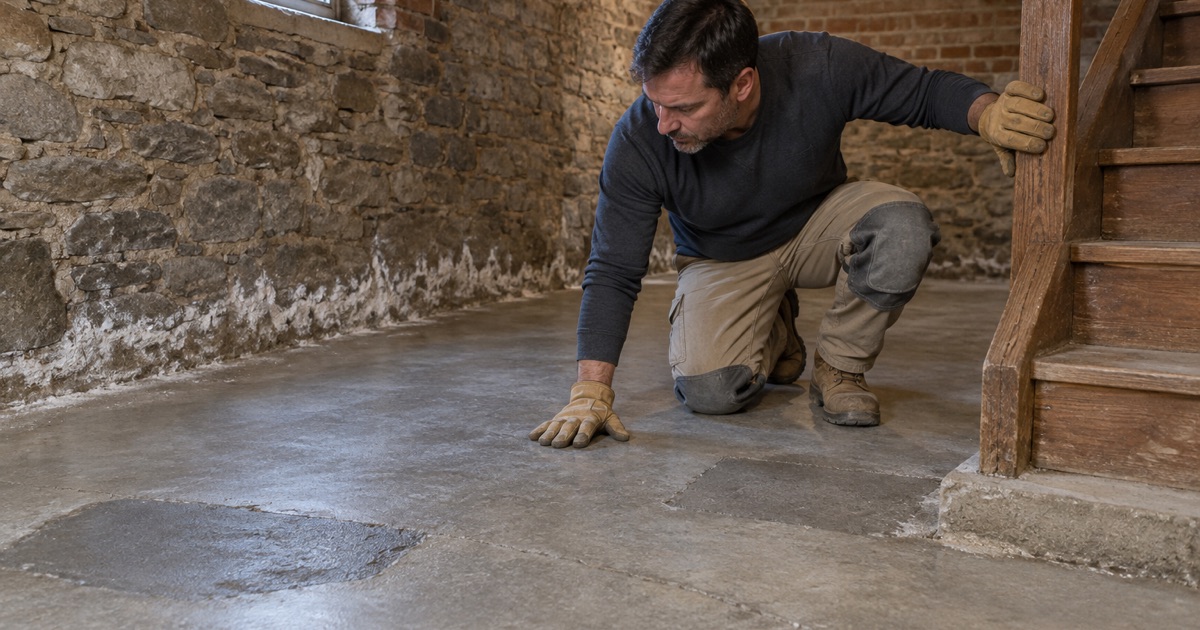
We start by sounding the whole floor, dragging a chain or tapping with a hammer in a grid and listening to what comes back. Sound concrete rings sharply. A delaminated topping, a void under a thin section or a patch that never bonded answers with a dull, hollow note. We mark those areas on a sketch of the room, because a hollow spot under a resin coat tends to become a cracked, lifting spot within a season or two.
Edges, cracks and old patches
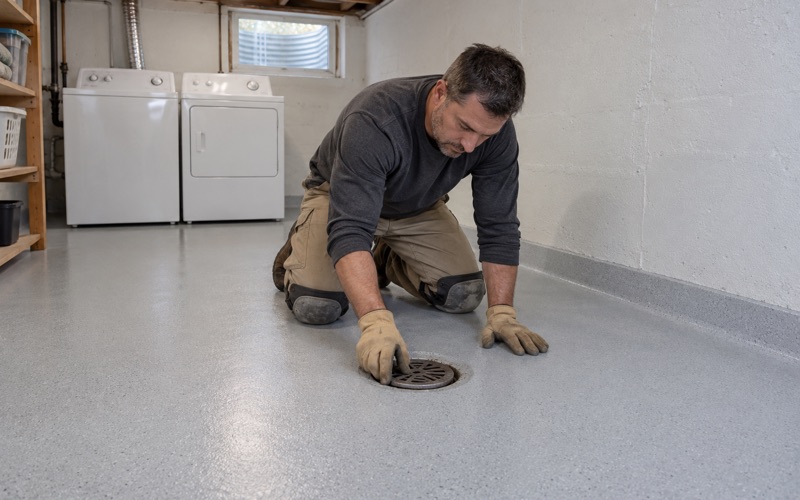
The edges tell us a great deal. Where the floor meets the foundation wall, we look at how the slab was finished, whether it has crumbled back, and whether its depth shows at a floor drain, a sump pit or an old utility cut. Those openings are often the only places the real thickness of an old basement floor can be read without coring through it, so we look at every one before we form an opinion.
Then we read the cracks and the patches. A hairline shrinkage crack that has not moved in years is routine work; a crack with one side higher than the other, or one that keeps reopening after it is filled, says the slab or the soil below it is still moving. Old patches in a different mix, paint, adhesive and earlier coatings all get identified, because each one changes how the floor has to be prepared.
Moisture, measured rather than guessed
Moisture testing is a line item in our scope, not an upsell offered after a floor has blistered. On a basement we may start with an ASTM D4263 plastic sheet test as a quick screen, then measure properly with ASTM F2170 in-situ relative humidity probes or ASTM F1869 calcium chloride testing. Efflorescence, the white mineral salt that blooms on damp concrete, is a sign we take seriously before any meter comes out of the case.
Northern Illinois basements can sit in poorly drained glacial till soils with a spring water table, and hydrostatic pressure under a basement slab drives moisture up through it. When water is the problem, we treat it as a drainage question first. We never sell a floor coating as waterproofing, and we do not sell one as radon reduction either; in Illinois that work requires an IEMA radon mitigation license.
Coat, Overlay or Replace: Three Answers for an Old Floor
Once a floor has been sounded, read and tested, it falls into one of three groups. Most of the real work in a quote is deciding honestly which one, and that answer comes from the slab itself, not from whichever system we would most like to sell on a given week.
Coat: a sound slab with acceptable moisture
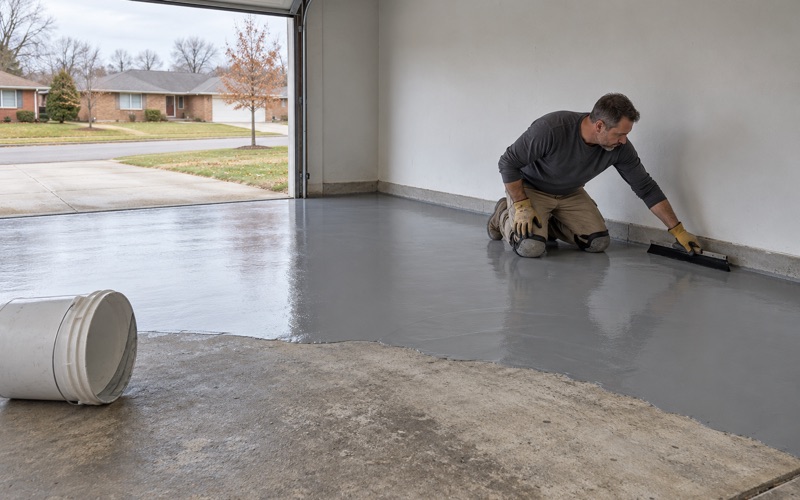
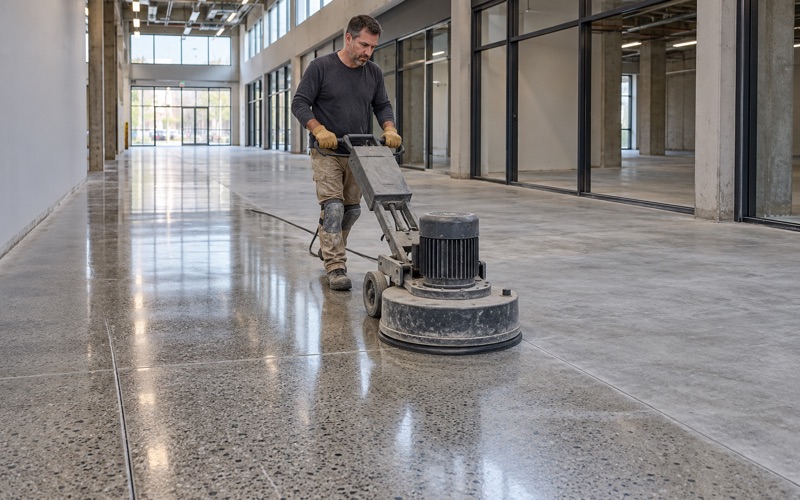
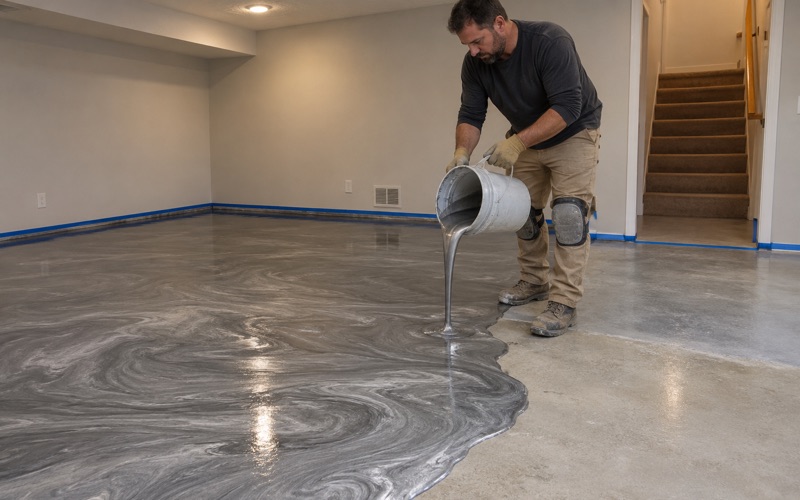
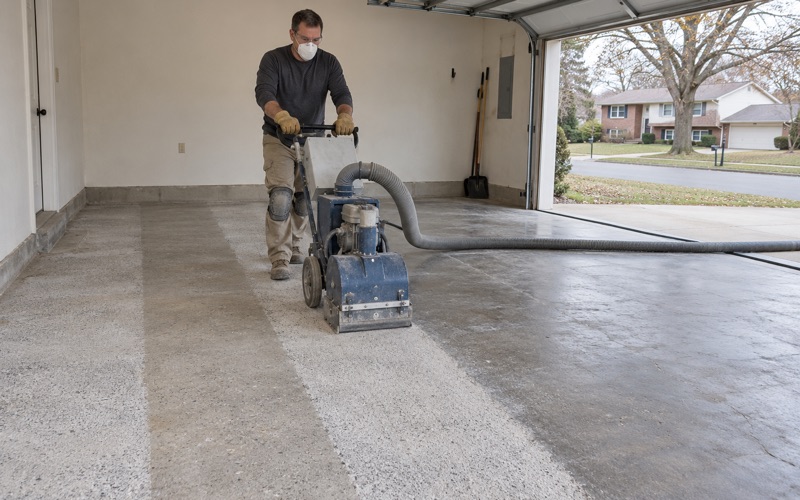
If the slab is solid, its cracks are stable and its moisture readings fall within the product’s limits and the ASTM F710 thresholds, it can be coated. We open every slab mechanically with diamond grinding or shot blasting to the ICRI CSP profile the system calls for, and we never acid etch. A typical basement build is a 100% solids epoxy base coat, a vinyl flake broadcast and a polyaspartic topcoat that resists scuffs and stains.
Where readings run high but the slab is otherwise sound, a moisture-mitigation primer can become part of the build, and the warranty terms state exactly what it does and does not cover. Every product we choose falls within the Illinois VOC limits in 35 Ill. Adm. Code Part 223, which bind the installer as well as the manufacturer. In a closed basement with small windows, that limit is worth having.
Overlay or repair: mostly sound, failing in places
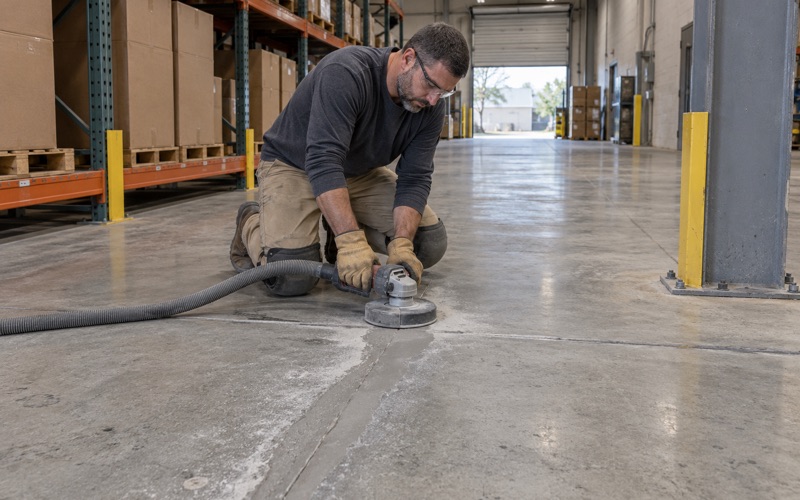
Some floors are sound across the middle and failing in spots. Hollow areas can be cut out and patched, spalled edges rebuilt, and active cracks routed and filled with a material suited to the movement. A urethane cement system, troweled thicker than a film coating, is one option where a floor needs more body and more tolerance for moisture than a thin epoxy offers. It still is not a structural slab, and we do not describe it as one.
Replace: when the floor is not a base
When the floor is thin across large areas, broken into loose pieces or hollow over much of its surface, the honest recommendation is replacement, the same answer the White House restoration reached. Taking out an old basement floor is also the moment some owners lower it for headroom, and that is excavation and concrete work, a separate trade with its own engineering questions about footings and foundation walls.
We will tell you when a floor falls into this group, and we will not quote a coating over it just to keep the job. If a new slab is poured, a coating can follow once it has cured and tested dry, but that is a separate decision made on the new concrete, never a reason to coat the old one in the meantime.
A Public Building on Main Street, and the Older House Near It
The same question at a smaller scale
The White House is a village-owned public building, used for community cultural events and rented for weddings, corporate meetings and fundraisers. A private basement is a far smaller job, but it carries the same first question. The restoration answered it by digging out and pouring again; a homeowner can usually answer it with a hammer, a moisture test and a careful look at the edges before any money goes into a finish.
Asking the village before the work
Barrington is a home-rule village that spans Cook and Lake counties, and 145 W. Main Street sits on its Cook County side, in Barrington Township. Illinois issues no state license for flooring or coatings work, so we confirm the village’s own contractor registration, bond and insurance rules before a job is scheduled. We also ask Village of Barrington Development Services whether a coating counts as decorating or needs a permit, rather than assuming either answer.
An interior floor coating should not fall under the Historic Preservation Overlay District’s exterior review. Slab replacement, an excavation to lower a basement, or any change that reaches the outside of the house is a different matter, and it is a question for Development Services before the work goes on the calendar.
Contracts, warranty terms and the cure
Every home job gets a written contract and the Home Repair: Know Your Consumer Rights pamphlet before work starts, as the Illinois Home Repair and Remodeling Act (815 ILCS 513) requires. Warranty exclusions are read out before the job is sold, and moisture is the first one we name, because it is the most common reason a basement coating lets go of its slab.
Curing is scheduled against slab temperature and the dew point spread at the slab surface rather than the calendar. A basement is usually steadier than a garage, but a cold floor in a damp room can still raise amine blush on fresh epoxy, so we measure on the day of the install and adjust the plan. If the slab needs repair first, the schedule starts with the repair.
- 20+ Years Coating Concrete
- Moisture Testing in Every Scope
- Written Contract on Every Home Job